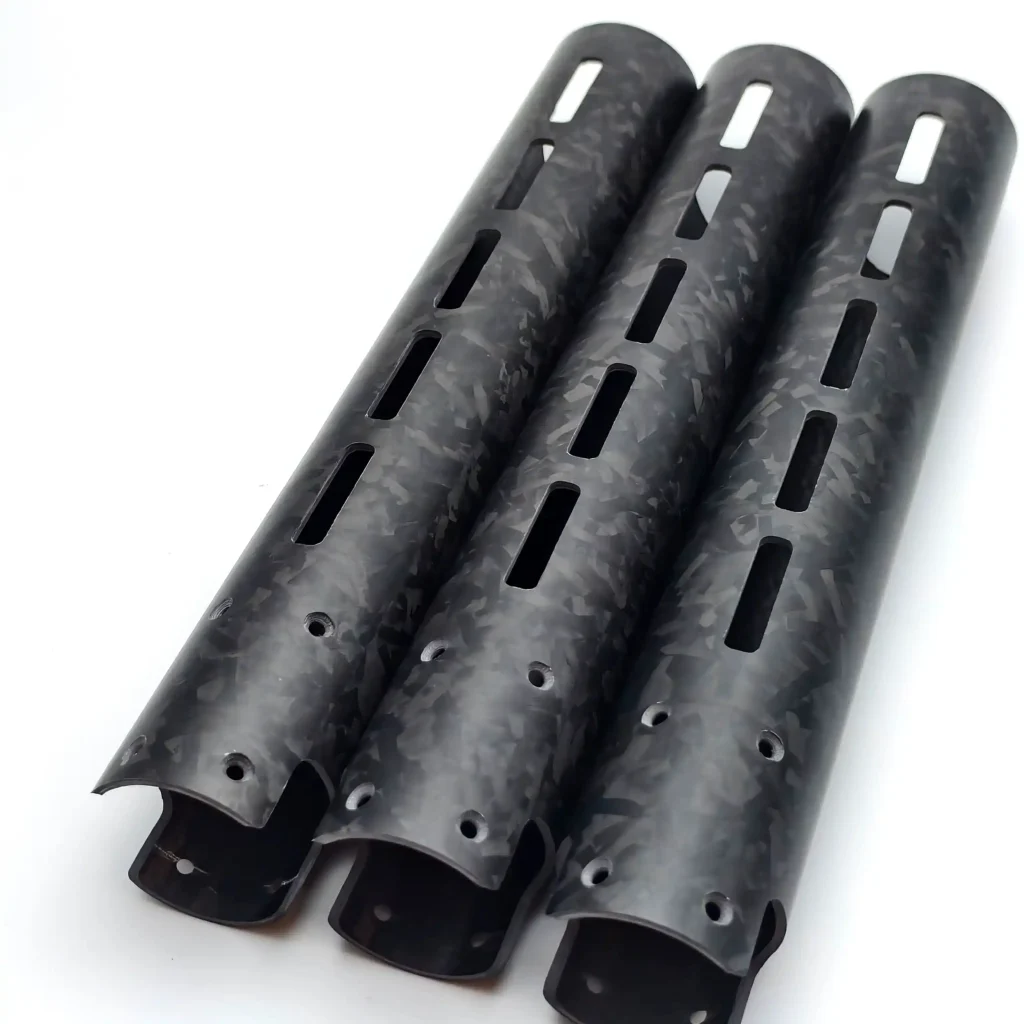
Carbon fiber can be cut, drilled, routed, sanded, and CNC machined.
But it should not be machined exactly like aluminum, steel, wood, or plastic.
Koolstofvezel reinforced polymer is made from hard, abrasive fibers held together by resin. The fibers wear cutting tools quickly, while the layered composite structure can develop frayed edges, splintering, delamination, or damaged holes if the wrong tool or machining method is used.
For a one-off prototype, a simple cut may be possible with basic composite-compatible tools.
For production parts, CNC plates, precision holes, telescopic tubes, bonded inserts, or parts made from customer drawings, machining quality becomes much more important.
The practical rule is:
- Use sharp, abrasion-resistant tools.
- Support the material during cutting and drilling.
- Minimize unnecessary cutting force.
- Control carbon fiber dust at the source.
- Avoid damaged edges around holes and joints.
- Use CNC machining when dimensions and repeatability matter.
This guide explains how to cut, drill, and machine carbon fiber sheets, tubes, rods, and custom parts without creating unnecessary damage.
Can You Cut and Drill Carbon Fiber?
Ja.
Cured carbon fiber composite can be:
- Saw cut
- Abrasive cut
- CNC routed
- Milled
- Drilled
- Countersunk
- Sanded
- Edge finished
The challenge is not whether carbon fiber can be machined.
The challenge is maintaining clean edges, accurate dimensions, good hole quality, and the structural integrity of the laminate.
A carbon fiber plate with a rough outside edge may still be usable.
A poorly drilled hole in a structural bracket, telescopic tube, drone frame, or bonded insert area can become a much more serious problem.
What can go wrong during machining?
Typical problems include:
- Delamination
- Fiber breakout
- Frayed edges
- Splintering
- Chipped surfaces
- Oversized holes
- Poor hole roundness
- Heat damage to resin
- Cracking around tube ends
- Damaged cosmetic surfaces
- Rapid tool wear
- Excessive carbon fiber dust
The machining method should therefore match the final use of the part.
Why Is Carbon Fiber Difficult to Machine?
Carbon fiber combines two very different materials.
The carbon fibers are hard and abrasive.
The polymer resin surrounding them is softer and more sensitive to heat and local damage.
This creates several machining challenges.
Carbon fiber is highly abrasive
Carbon fibers can wear conventional cutting edges quickly.
A tool may still look usable but gradually lose sharpness. As the cutting edge becomes dull, cutting forces rise and edge quality can become worse.
For repeated production, tool condition is therefore an important part of process control.
Carbon fiber is layered
A laminate contains several plies.
If drilling or cutting forces push these layers apart, delamination can develop around the edge or hole.
The risk depends on:
- Laminate structure
- Fiber direction
- Tool geometry
- Tool sharpness
- Feed
- Support
- Part thickness
- Hole location
This is why tools designed specifically for composites are valuable in precision production.
Carbon fiber does not form metal-like chips
Machined carbon fiber generally produces fine particles and short fiber fragments rather than normal metal chips.
Dust control is therefore part of the machining process, not just a housekeeping issue.
Heat can damage the resin
Excessive friction can raise the temperature at the cutting zone.
If heat becomes too high, the resin matrix can soften, discolor, smear, or lose local performance.
A sharp tool and an appropriate machining process help limit unnecessary heat generation.
How to Cut Carbon Fiber Sheets
Carbon fiber sheets and plates are commonly cut for:
- Droneframes
- Machine panels
- Mounting plates
- Robotics parts
- Beugels
- Equipment covers
- Fixtures
- Sports components
The best cutting method depends on whether the part needs a simple straight cut or a precise finished profile.
Cutting simple carbon fiber sheets
A simple straight cut can often be made with an abrasive or composite-compatible cutting tool.
The sheet should be fully supported and secured so that it does not vibrate during the cut.
The main goals are:
- Keep the cut stable
- Reduce vibration
- Avoid pulling fibers from the laminate
- Control dust
- Leave enough material for final edge finishing if necessary
For a prototype, a simple cutting method may be adequate.
For finished production parts, CNC machining normally provides better repeatability.
How to prevent frayed edges
Fraying is more likely when the cutting edge is dull or the laminate is poorly supported.
Good practice includes:
- Use a sharp cutting tool
- Support the plate close to the cut
- Avoid excessive vibration
- Do not force the tool through the laminate
- Inspect both the entry and exit edges
- Finish damaged edges before assembly
Masking the cosmetic surface can help protect it from scratching, but tape does not replace the correct cutting tool or machining parameters.
CNC cutting carbon fiber sheets
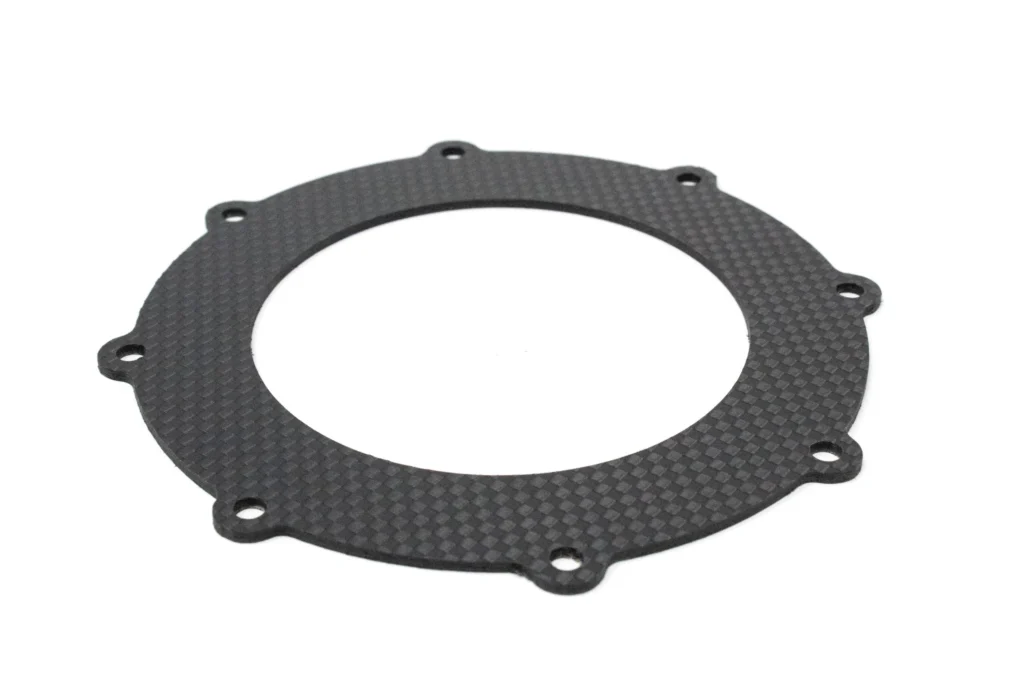
CNC machining is generally the better option when a plate requires:
- Complex outside profiles
- Repeated parts
- Accurate mounting holes
- Slots
- Cutouts
- Verzinkboren
- Controlled tolerance
- Consistent edge quality
For B2B production, a DXF or CAD file allows the manufacturer to program the entire part rather than cutting and drilling each feature manually.
This also makes nesting possible when many parts are cut from a larger sheet.
Better nesting can reduce material waste and improve batch consistency.
How to Cut Carbon Fiber Tubes
Carbon fiber tubes require different handling from flat sheets.
The tube can vibrate, rotate, crush under excessive clamping pressure, or splinter around the cut end.
Support the tube correctly
The tube should be supported securely without crushing the laminate.
A thin-wall tube needs more care than a heavy-wall tube.
The fixture should prevent:
- Rotation
- Chatter
- Tube deformation
- Excessive clamping pressure
For production work, a dedicated fixture helps maintain consistent cutting length and squareness.
Use a clean, controlled cut
Do not force the cutting tool through the tube.
High cutting force can increase:
- Edge breakout
- Splitting
- Delamination
- Surface damage
Sharp tooling and stable support generally produce a cleaner tube end.
Inspect the tube end after cutting
After the cut, check for:
- Loose fibers
- Delamination
- Cracks
- Uneven wall
- Chipped surface
- Sharp fiber edges
The cut end may then be lightly finished and cleaned according to the final assembly requirement.
Tube-end quality matters around connectors
Cut quality becomes especially important when the tube will receive:
- Aluminium inzetstukken
- Schroefdraadkoppelingen
- Ferrules
- Eindkappen
- Bonded fittings
- Telescopic components
A damaged tube end can reduce the effective bonding area or create a weak point near the connection.
How to Cut Carbon Fiber Rods
Solid carbon fiber rods are generally simpler to cut than hollow tubes because there is no thin tube wall to crush.
However, the same basic machining issues remain:
- Abrasive fibers
- Slijtage van gereedschap
- Fiber breakout
- Dust
- Heat generation
For small quantities, cut-to-length processing may be straightforward.
For production batches, controlled cutting fixtures help keep length consistent.
If the rods will be bonded into another component, the end condition and bonding surface should also be considered.
How to Drill Carbon Fiber
Yes, carbon fiber can be drilled.
But drilling is one of the machining operations most likely to create delamination or fiber breakout.
A good drilled hole should have:
- Correct diameter
- Good roundness
- Minimal entry damage
- Minimal exit damage
- Clean surrounding laminate
- Correct location
These requirements become more important when the hole carries a bolt, rivet, pin, or bonded insert.
What Drill Bit Is Best for Carbon Fiber?
For occasional simple work, sharp carbide tooling is commonly preferred over general-purpose soft-material tooling.
For repeated or demanding production, composite-specific solid carbide, diamond-coated carbide, or PCD tooling may be used.
The reason is wear resistance.
Carbon fiber rapidly wears cutting edges, and a dull drill can increase thrust and damage the laminate.
Professional CFRP drilling tools often use geometries designed specifically to reduce cutting force and delamination.
Why ordinary dull drills cause problems
A dull drill tends to push harder against the laminate instead of cutting the fibers cleanly.
This increased axial force can contribute to:
- Fiber breakout
- Delamination
- Poor exit quality
- Heat
- Oversized or rough holes
For repeat production, changing or monitoring tools before hole quality becomes unacceptable is important.
How to Prevent Delamination When Drilling Carbon Fiber
Delamination is one of the main concerns in CFRP drilling.
Several factors help reduce the risk.
Use a sharp drill
Tool sharpness is critical.
An old tool that works acceptably on metal may produce poor results on carbon fiber.
Support the exit side
When possible, support the laminate beneath the hole.
The highest risk of breakout often occurs when the drill exits the back surface.
Good support helps reduce bending and separation of the final plies.
Keep the part stable
Movement during drilling can damage the hole edge.
Secure the part without applying excessive localized clamping pressure.
Use composite-appropriate tool geometry
Special CFRP drill geometries are designed to cut fibers with lower axial force.
For repeated production or critical holes, the drill design can have a meaningful effect on hole quality.
Avoid treating every carbon fiber laminate the same
A thin woven sheet, thick quasi-isotropic plate, roll-wrapped tube, and pultruded rod may require different machining conditions.
There is no single feed or speed that is correct for every carbon fiber product.
How Close Can You Drill to the Edge of Carbon Fiber?
There is no universal edge-distance rule that is correct for every carbon fiber laminate.
The safe distance depends on:
- Diameter van het gat
- Laminate thickness
- Fiber direction
- Lay-up
- Load direction
- Fastener type
- Bearing load
- Tube wall thickness
- Required safety factor
This is especially important for structural holes.
Putting a hole too close to the end of a carbon fiber tube or the edge of a plate can reduce the amount of material available to transfer the load.
For critical parts, the hole position should be reviewed as part of the structure rather than chosen only from a general rule.
Drilling Carbon Fiber Tubes vs Carbon Fiber Plates
A tube requires additional attention because the drill passes through a curved and relatively thin wall.
Potential problems include:
- Tube rotation
- Local wall deformation
- Breakout on the inner surface
- Splitting around the hole
- Poor alignment through both walls
A drilling fixture can be useful for repeated tube production.
For plates, the main concerns are usually entry and exit delamination, hole accuracy, hole-to-edge distance, and flat support.
How to CNC Machine Carbon Fiber
CNC machining is the preferred method for many precision carbon fiber parts.
Typical operations include:
- Profiling
- Routing
- Pocket cutting
- Drilling
- Slotting
- Verzinken
- Edge trimming
CNC machining is especially useful for:
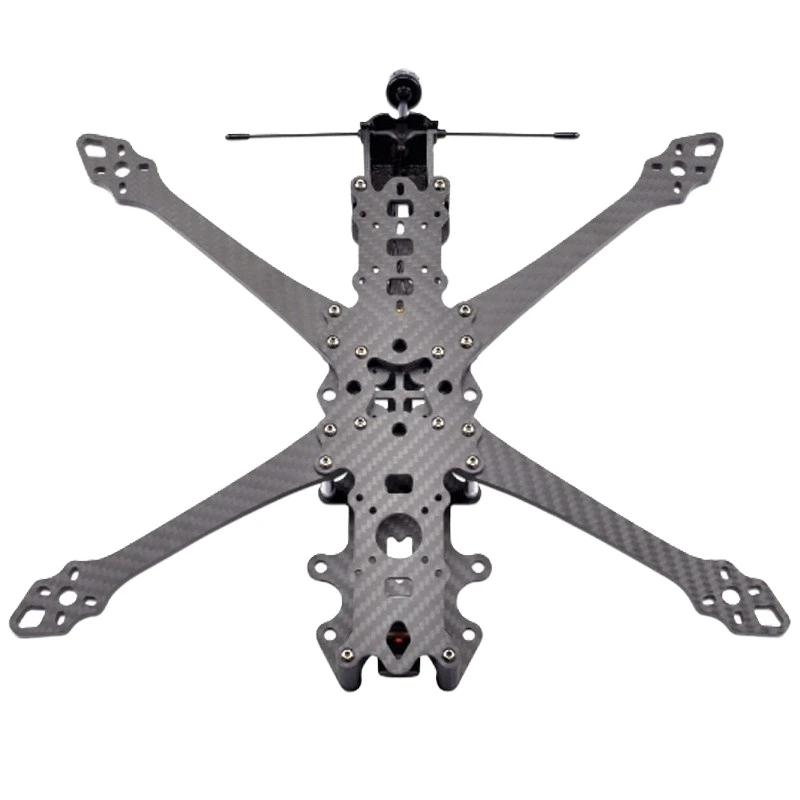
- Droneframes
- UAV plates
- Robotics brackets
- Machine components
- Mounting panels
- Industriële armaturen
- Custom OEM parts
Tool selection
Carbon fiber is abrasive, so abrasion resistance is a major consideration.
Depending on the part and production volume, tooling may include:
- Solid carbide
- Diamond-coated carbide
- PCD tooling
- Composite-specific routers
- Composite-specific drills
The right tool depends on the laminate, thickness, operation, required finish, and production quantity.
Cutting speed and feed
There is no useful universal RPM and feed rate for every CFRP part.
Machining conditions depend on:
- Tool diameter
- Tool geometry
- Tool coating
- Laminate
- Dikte
- Vezeloriëntatie
- Machine rigidity
- Required edge quality
For production work, machining data should come from the tooling supplier and then be validated on the actual laminate.
Copying a random RPM value from another carbon fiber part can produce very different results.
Slijtage van gereedschap
Tool wear should be monitored.
A worn tool can increase:
- Cutting force
- Frayed edges
- Heat
- Hole damage
- Dimensional variation
For large batches, tool life becomes part of quality control.
Can You Countersink Carbon Fiber?
Ja.
Countersinks are common in aerospace-style panels, covers, plates, and assemblies where a flush fastener is required.
However, countersinking removes laminate around the hole.
The design should therefore consider:
- Plaatdikte
- Fastener head
- Remaining laminate thickness
- Bearing area
- Hole quality
- Structural load
A countersink should not be added simply because it looks cleaner.
For thin plates, the remaining material may become too small for the required load.
Can You Tap Threads Directly Into Carbon Fiber?
Threads can sometimes be formed or machined in thick composite structures for lightly loaded applications.
However, direct carbon fiber threads are generally not the preferred solution for repeated assembly or highly loaded connections.
Carbon fiber does not behave like aluminum or steel around a thread.
The local load can damage the resin and fibers.
For functional B2B parts, metal inserts are often a more reliable solution.
When Should You Use Bonded Metal Inserts?
Bonded inserts are commonly used when a carbon fiber component requires:
- Machine screws
- Repeated assembly
- High local load
- Precise connection
- Replaceable hardware
- Metal-to-metal interfaces
Common insert materials include:
- Aluminium
- Stainless steel
- Titanium
- Brass in selected applications
The insert design should consider:
- Bonding length
- Bonding surface
- Tube wall thickness
- Adhesive gap
- Load direction
- Pull-out load
- Torsion
- Environmental exposure
A strong insert connection depends on more than simply putting glue inside a carbon fiber tube.
How Should Bonding Surfaces Be Prepared?
Bonded carbon fiber surfaces normally need controlled preparation.
The exact process depends on the adhesive and composite system.
The objective is to create a clean, stable bonding surface without damaging the structural fibers unnecessarily.
The supplier should control:
- Surface contamination
- Dust
- Release-agent residue
- Surface preparation
- Adhesive thickness
- Insert alignment
- Cure conditions
For production assemblies, bonding should be treated as a controlled manufacturing process.
Carbon Fiber Machining Safety
Machining carbon fiber creates dust.
Cutting, routing, sanding, and drilling cured composites can produce fine airborne particles.
This dust should not be allowed to spread freely through the workshop.
Use dust extraction
Local dust extraction close to the cutting point is preferred.
For CNC machining, enclosed machines with effective extraction provide much better dust control than open manual machining.
Wear appropriate PPE
Depending on the machining operation and workplace risk assessment, protection may include:
- Eye protection
- Suitable respiratory protection
- Gloves
- Protective clothing
Carbon fiber particles can irritate exposed skin.
Carbon fiber dust is conductive
Another important issue is electrical conductivity.
Carbon fiber dust can settle inside:
- Motors
- Electrical cabinets
- Computers
- Switches
- Machine electronics
Keeping dust controlled and away from sensitive equipment is therefore important.
Do not use compressed air as the main cleaning method
Blowing carbon fiber dust around the workshop simply makes it airborne again.
A suitable industrial vacuum and controlled cleaning method are generally more appropriate.
Common Carbon Fiber Machining Mistakes
Many machining problems come from treating carbon fiber like a normal metal or plastic.
Using a dull tool
Carbon fiber is abrasive.
A dull tool increases cutting forces and can damage edges.
Applying too much cutting force
Forcing a saw or drill through the part can increase splitting and delamination.
Poor part support
Unsupported sheets and tubes can vibrate during machining.
This reduces edge quality and dimensional accuracy.
Drilling too close to the edge
A hole near the edge or tube end can create a weak section.
Hole position should be reviewed together with diameter, laminate thickness, and load.
Using aggressive clamps
Carbon fiber can be damaged by concentrated clamping pressure.
Clamping forces should be distributed over a suitable area.
Ignoring tool wear during production
The first part and the 500th part may not have the same edge quality if tool condition is not controlled.
Cutting without dust extraction
Dust should be controlled at the machining source whenever practical.
Assuming a cosmetic surface means structural quality
A clean 3K woven surface does not guarantee that the drilled hole, internal laminate, insert bond, or cut edge is structurally correct.
Should You Machine Carbon Fiber Yourself or Ask the Factory?
It depends on the project.
For a simple prototype, standard tube, or one straight cut, local machining may be practical.
Factory machining becomes more valuable when the project requires:
- Tight dimensions
- Multiple holes
- Accurate hole position
- CNC profiles
- Verzinkboren
- Repeated parts
- Custom fixtures
- Insert bonding
- Edge finishing
- Surface protection
- Production consistency
The table below provides a practical guide.
| Requirement | Local / In-House Machining | Factory Machining |
|---|---|---|
| One simple cut | Practical | Usually unnecessary |
| Prototype modification | Practical | Optional |
| Standard tube cut to length | Possible | Useful for batch orders |
| Multiple precision holes | Difficult to repeat | Better choice |
| CNC plate | Requires suitable CNC equipment | Better choice |
| Complex DXF profile | Difficult manually | Better choice |
| Bonded metal inserts | Requires process control | Better choice |
| Telescopic tube drilling | Fixtures may be required | Better choice |
| Cosmetic production part | Risk of surface damage | Better choice |
| Repeat OEM production | Harder to control | Better choice |
For B2B buyers, factory machining can also reduce handling.
Instead of buying a sheet, shipping it to another CNC shop, drilling it at another supplier, and then assembling it elsewhere, a manufacturer may be able to supply a finished component.
What Information Should You Send for Carbon Fiber CNC Machining?
A clear drawing makes quoting and production much easier.
For CNC plates, send:
- DXF or STEP file
- Material thickness
- Totale afmetingen
- Diameter van het gat
- Hole locations
- Slots and cutouts
- Countersink requirements
- Critical tolerances
- Oppervlakteafwerking
- Aantal
For carbon fiber tubes, send:
- Buitendiameter
- Binnendiameter
- Wanddikte
- Tube length
- Cut length
- Diameter van het gat
- Positie van het gat
- Distance from tube end
- Insert requirements
- Oppervlakteafwerking
- Aantal
For assemblies, also provide:
- Metal insert drawing
- Thread specification
- Bonding length
- Assembly orientation
- Required load if known
- Operating environment
A marked-up drawing is much more useful than a message such as:
“Please drill two holes near the end.”
Example: A Custom Carbon Fiber Tube With Drilled Holes and Inserts
Consider a carbon fiber tube used as part of an industrial telescopic assembly.
The customer needs:
- Custom tube diameter
- Controlled wall thickness
- Two drilled holes
- An aluminum end insert
- Repeat production
The project should be reviewed as one complete component.
The manufacturing sequence may include:
- Produce the carbon fiber tube.
- Cut the tube to final length.
- Fixture the tube for drilling.
- Machine the holes at controlled positions.
- Inspect the hole edges.
- Prepare the tube and insert bonding surfaces.
- Bond the metal insert.
- Control insert alignment during curing.
- Inspect dimensions and finished assembly.
If the customer buys a standard tube and carries out all these steps separately, dimensional variation and handling cost can increase.
For repeated B2B orders, combining tube production and secondary machining can simplify the supply chain.
How LH Carbon Solutions Supports Carbon Fiber Machining
LH Carbon Solutions supplies custom carbon fiber tubes, sheets, rods, plates, telescopic poles, and drawing-based components for B2B projects.
Available secondary processing can include:
- Cut-to-length tubes
- CNC-gesneden koolstofvezelplaten
- Drilled holes
- Slots and profiles
- Verzinken
- Edge finishing
- Custom tube machining
- Bonded metal inserts
- Schroefdraadkoppelingen
- End fittings
- Telescopic component assembly
- Prototype and production batches
If you already have a finished drawing, send the CAD or DXF file.
If you only have an application concept, provide the required dimensions, load, assembly method, and quantity.
The machining process can then be reviewed together with the carbon fiber structure instead of treating them as separate decisions.
FAQ About Cutting and Drilling Carbon Fiber
Can you cut carbon fiber with a saw?
Yes. Carbon fiber can be saw-cut using suitable abrasive or composite-compatible tooling. The material should be supported securely, and dust should be controlled. For precision profiles or production quantities, CNC machining is usually more repeatable.
What is the best tool for cutting carbon fiber?
The best tool depends on the product and operation. Abrasion-resistant carbide, diamond-coated carbide, PCD, and composite-specific tooling are commonly used for professional CFRP machining.
Can you drill holes in carbon fiber?
Yes. Carbon fiber can be drilled, but tool sharpness, laminate support, drill geometry, and process control are important to reduce delamination and fiber breakout.
What drill bit should I use for carbon fiber?
For repeat or precision machining, carbide or composite-specific diamond-coated or PCD tooling is commonly used because carbon fiber is highly abrasive. The exact drill should match the laminate, hole size, and production requirement.
Does drilling weaken carbon fiber?
A hole removes load-carrying material and creates a stress concentration, so it can reduce local strength. The effect depends on hole diameter, position, edge distance, layup, thickness, and load.
How close can a hole be to the edge of carbon fiber?
There is no universal safe distance for every carbon fiber laminate. Hole diameter, thickness, fiber orientation, load direction, fastener type, and required safety factor must be considered together.
Can carbon fiber be CNC machined?
Yes. CNC machining is widely used for carbon fiber plates, brackets, drone frames, fixtures, and custom components. Abrasion-resistant tooling and effective dust extraction are important.
Can you mill carbon fiber?
Yes. Carbon fiber composites can be milled and routed using appropriate tooling and machining conditions.
Can you countersink carbon fiber?
Yes, provided the laminate has enough thickness and the countersink does not remove too much load-carrying material around the hole.
Can you tap threads into carbon fiber?
It is technically possible in some thick laminates and lightly loaded applications, but bonded metal inserts are generally more suitable for repeated assembly and highly loaded threads.
Is carbon fiber dust dangerous?
Machining cured composites can generate fine airborne dust and particles that should be controlled. Carbon fiber particles can also cause mechanical skin irritation, and carbon fiber dust is electrically conductive.
Should carbon fiber be wet-cut?
Machining strategy depends on the part, equipment, resin system, tooling, and contamination requirements. Professional manufacturers may use different dry or controlled machining approaches. Do not assume that one coolant method is appropriate for every carbon fiber product.
Should I machine carbon fiber before or after surface finishing?
This depends on the product. Machining after cosmetic finishing may damage the visible surface, while machining before final coating may allow edges and holes to be finished together. Production sequence should be planned around the final appearance and tolerance requirements.
Afsluitende gedachten
Carbon fiber can be cut, drilled, and CNC machined successfully.
The main challenge is maintaining laminate integrity and dimensional quality while controlling tool wear and dust.
For simple prototypes, basic machining may be enough.
For structural parts, CNC plates, telescopic tubes, precision holes, inserts, or repeat OEM production, machining should be treated as part of the product design.
The most important factors are:
- Sharp, abrasion-resistant tooling
- Stable part support
- Controlled cutting force
- Delamination prevention
- Hole and edge design
- Dust extraction
- Tool-wear control
- Repeatable inspection
If a carbon fiber part must match another component, carry load, or be produced repeatedly, send the drawing before machining begins.
It is much easier to optimize the tube, sheet, hole, insert, and machining process together than to fix a poorly designed part after production.
Dit vind je misschien ook leuk

Composietbuizen
De nadruk ligt op hoge stijfheid en een laag gewicht voor prestatiegerichte constructies.
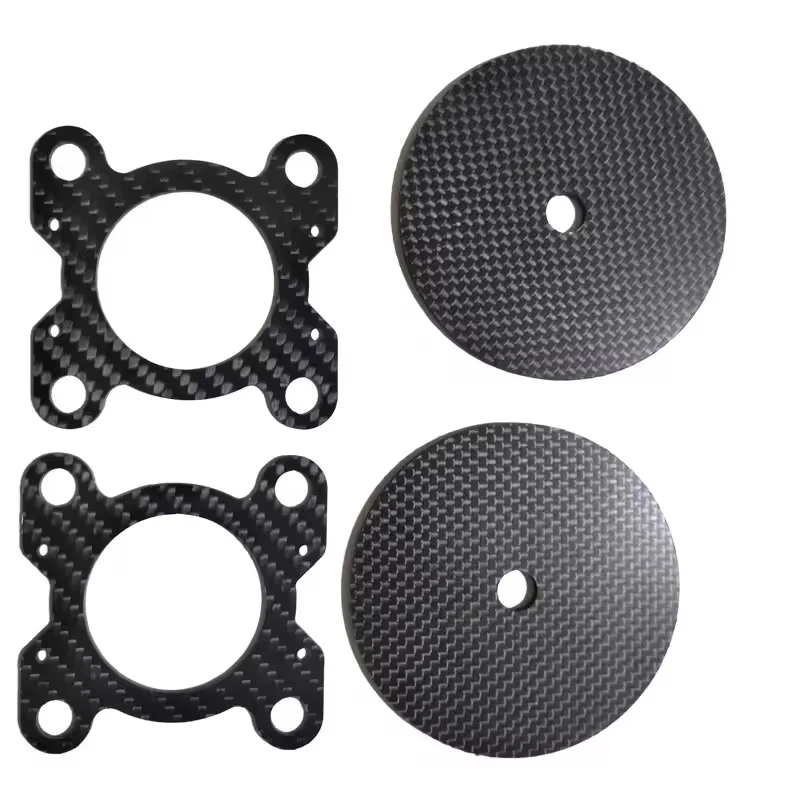
Koolstofvezelplaten en -vellen
Vlak laminaatmateriaal voor CNC-snijden en lichtgewicht constructieonderdelen.
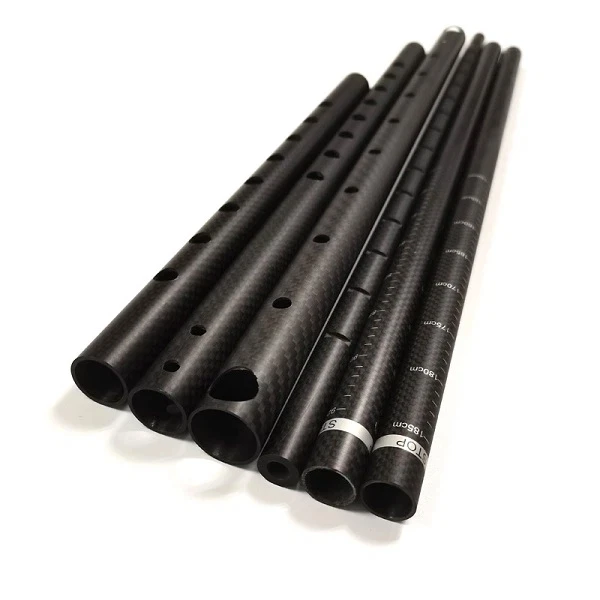
Composietstaven
Staafvormige composietproducten voor industriële toepassingen en OEM-assemblages.
