
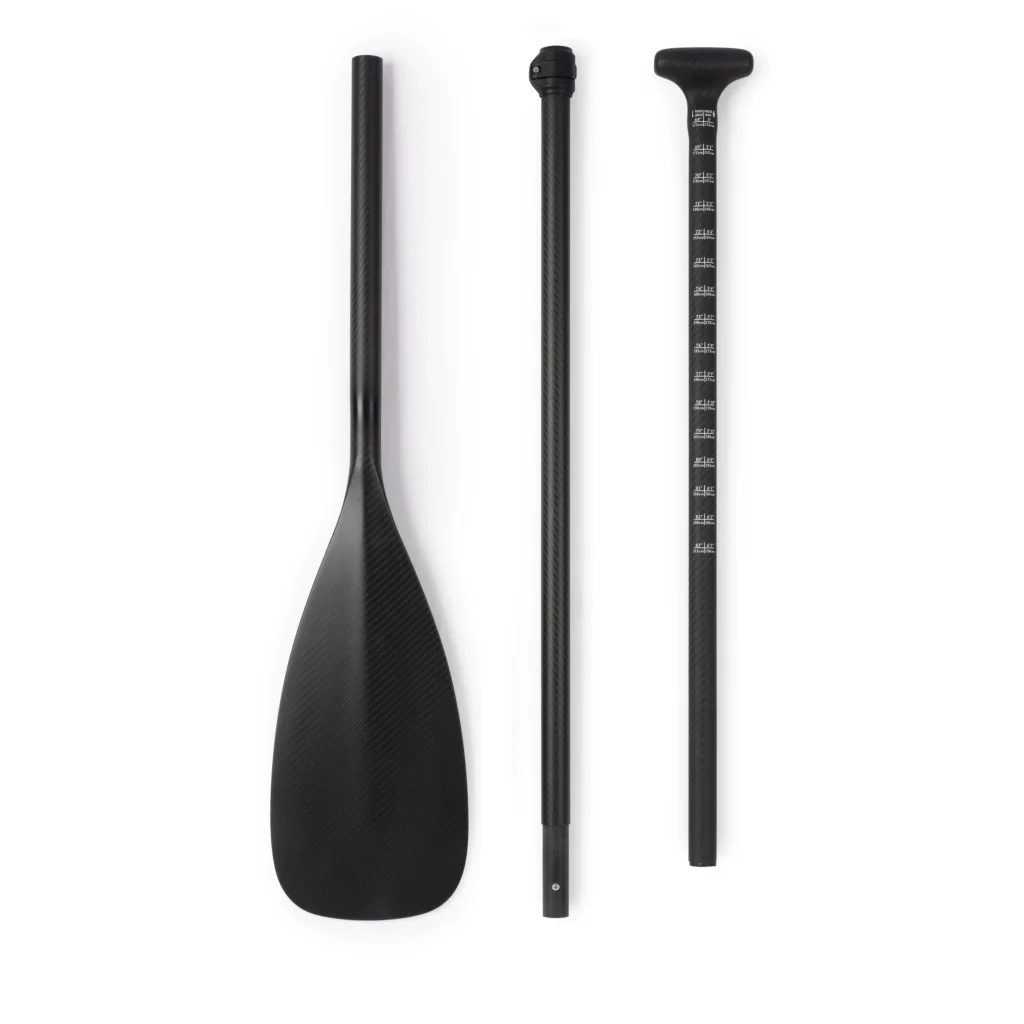
A carbon fiber SUP paddle usually costs more than an aluminum or fiberglass paddle because of its composite materials, controlled manufacturing process, lightweight construction, and performance-focused design.
However, carbon fiber alone does not guarantee a better paddle. Shaft stiffness, blade geometry, construction quality, and connection design all influence how a paddle performs on the water.
For SUP brands, distributors, and OEM buyers, understanding these factors is essential when developing a paddle that balances performance, durability, and manufacturing cost.
This guide explains what makes carbon fiber paddles different, where the additional costs come from, and how to evaluate the right construction for your product line.
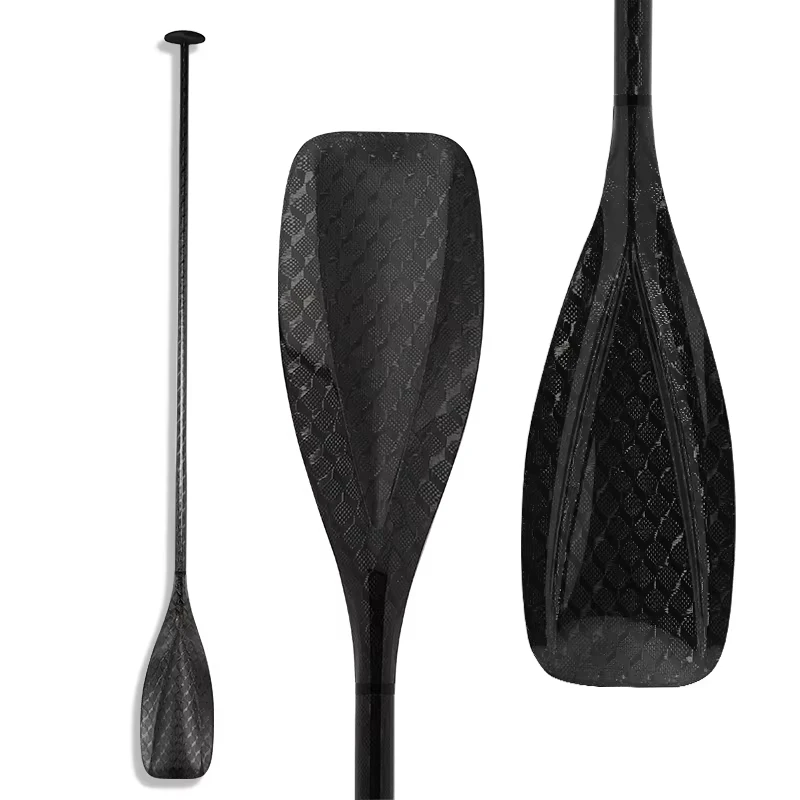
Why Are SUP Paddles So Expensive?
The price of a SUP paddle depends on much more than the material used for its shaft.
A paddle is a complete mechanical assembly consisting of a shaft, blade, handle, and, in adjustable models, one or more connection systems.
Each component influences manufacturing complexity and finished performance.
The main cost factors include:
-
Materials: Carbon fiber reinforcement and composite resin systems generally cost more than basic aluminum and plastic components.
-
Manufacturing: Composite shafts and blades require controlled layup, curing, trimming, and finishing.
-
Weight optimization: Reducing unnecessary material while maintaining strength requires appropriate structural design.
-
Blade development: Different blade shapes, angles, and reinforcement structures may need dedicated tooling.
-
Connection systems: Adjustable and multi-piece paddles require secure, accurately fitted joints.
-
Quality control: Finished paddles need consistent dimensions, weight, appearance, and assembly performance.
A more expensive paddle is not automatically better. Its value depends on whether these design decisions provide meaningful benefits to the intended paddler.
For manufacturers, this distinction is important when developing products for different price segments.
Do Paddle Board Paddles Make a Difference?
Yes. Paddle construction can influence stroke feel, handling, fatigue, and power transfer.
During paddle boarding, the user repeatedly lifts, plants, pulls, and recovers the paddle. Even small differences in weight, flex, and blade behavior can affect the experience over a longer session.
1. Paddle Weight and Handling
A lightweight SUP paddle can reduce the amount of mass the paddler moves during every stroke.
The benefit becomes more noticeable during repeated paddling, particularly for touring and performance-oriented applications.
However, paddle weight should always be considered together with the structural design.
Removing too much material from high-load areas can reduce durability.
2. Shaft Stiffness and Power Transfer
The shaft bends under load during a paddle stroke.
A relatively stiff shaft can provide a more direct response, while a more flexible shaft changes the way force is transferred.
Neither extreme is suitable for every user.
For example, a performance-oriented paddler may prefer a different stiffness profile from someone using a paddle for recreational touring.
Carbon fiber allows manufacturers to modify shaft behavior through fiber orientation, laminate thickness, and reinforcement placement.
3. Blade Shape and Water Engagement
The blade determines how the paddle interacts with the water.
Blade area, outline, angle, and cross-sectional profile influence water engagement, stroke resistance, and stability.
A larger blade does not automatically deliver better performance. It can also require more force during each stroke.
Blade design should therefore match the intended application rather than simply maximizing surface area.
Carbon Fiber vs Fiberglass vs Aluminum SUP Paddles
Different paddle materials provide different combinations of stiffness, weight, durability, and production cost.
The following comparison reflects general construction tendencies, not guaranteed performance specifications.
| Feature | Carbon Fiber | Fiberglass | Aluminum |
|---|---|---|---|
| Weight potential | Very good | Good | Generally less optimized |
| Shaft stiffness | Highly tunable | Tunable, often more flexible | Depends on tube design |
| Composite layup control | Excellent | Good | Not applicable |
| Production cost | Higher | Moderate | Typically lower |
| Performance positioning | Premium / performance | Recreational / mid-range | Entry-level / recreational |
| Customization | Extensive | Extensive | Size and component options |
| Common buying priority | Weight and performance | Cost-performance balance | Affordability |
When Carbon Fiber Makes Sense
Carbon fiber is particularly suitable for products targeting low weight and controlled shaft stiffness.
It also offers substantial design flexibility for premium SUP equipment.
For example, an OEM brand may use a carbon fiber shaft with a tailored laminate to develop distinct stiffness characteristics for touring and performance models.
When Fiberglass Is a Better Option
Fiberglass can be appropriate when price and durability are more important than achieving the lowest possible weight.
It may also be useful for entry-level or mid-range product collections where a more flexible shaft response is desirable.
What About Hybrid Construction?
Some paddles combine a carbon fiber shaft with a fiberglass, composite, or reinforced polymer blade.
This approach can help control cost while retaining selected advantages of a carbon shaft.
However, buyers should confirm exactly which components contain carbon fiber.
Terms such as “carbon paddle” or “full carbon” should be supported by an accurate bill of materials rather than treated as complete engineering specifications.
For a broader comparison of material performance, see our carbon fiber strength-to-weight comparison.
What Determines the Cost of a Carbon Fiber SUP Paddle?
For OEM manufacturing, several structural and production decisions have a direct influence on the final quotation.
Carbon Fiber Grade and Laminate Design
Carbon fiber products are made by combining reinforcing fibers with a polymer resin system.
The finished mechanical properties depend on more than the fiber grade.
Fiber orientation, fiber volume, laminate thickness, resin quality, and curing conditions all contribute to the final structure.
A higher-priced fiber grade is not necessarily required for every SUP paddle.
The most suitable construction should be selected according to the target stiffness, strength, weight, and durability.
Carbon Fiber Shaft Manufacturing
The shaft must provide an appropriate balance of bending stiffness, strength, diameter, and weight.
Carbon fiber shaft construction can use different fiber architectures and wall thicknesses to control mechanical performance.
For OEM projects, custom carbon fiber tubes can be developed around specific dimensions and layup requirements.
Additional processing may be needed for tapered sections, grip interfaces, adjustable connections, or blade attachment.
Blade Materials and Mold Complexity
Carbon fiber blades may require shaped tooling, multiple reinforcement layers, trimming, surface finishing, and bonding.
The complexity depends on the required blade geometry and internal construction.
Additional reinforcement may be needed around the shaft-to-blade connection or other heavily loaded areas.
Changing the blade outline or profile can also affect tooling requirements and manufacturing cost.
Adjustable Joints and Locking Systems
A fixed-length paddle does not require a length-adjustment mechanism.
An adjustable or multi-piece paddle introduces additional components and fitting operations.
These can include:
-
Adjustment clamps
-
Connection sleeves
-
Positioning pins
-
Anti-rotation features
-
Bonded inserts
-
Grip and handle assemblies
The fit between components matters. Excessive clearance may cause movement, vibration, or unwanted rotation during use.
Surface Finish and Branding
Visible carbon weave, matte or gloss coatings, painted graphics, logos, and retail packaging can influence the final cost.
For private-label paddle collections, appearance is an important commercial factor.
However, decorative finishing should not be confused with structural performance.
For further details on manufacturing economics, read our guide to custom carbon fiber cost and pricing factors.
One-Piece vs Adjustable vs 3-Piece Carbon SUP Paddles
Paddle construction influences portability, assembly complexity, weight, and the user’s experience.
| Construction | Main Advantage | Main Trade-Off | Common Application |
|---|---|---|---|
| One-piece | No adjustment joints in the shaft | Fixed length and less compact | Racing and performance |
| Adjustable | Accommodates different user heights | Added locking mechanism | Recreational and rental |
| 3-piece | Compact transportation and storage | More joints and assembly requirements | Inflatable SUP packages and travel |
One-Piece Carbon Fiber SUP Paddles
A one-piece paddle provides a continuous fixed-length structure without adjustment joints in the shaft.
This reduces the number of mechanical connection points and can support a simpler performance-focused design.
It is particularly relevant when the intended user already knows the required paddle length.
Adjustable Carbon Fiber SUP Paddles
An adjustable paddle allows the length to be changed for different users or paddling conditions.
The adjustment system must maintain secure clamping and shaft alignment throughout use.
OEM buyers should evaluate not only the adjustment range but also the durability and repeatability of the locking mechanism.
3-Piece Carbon SUP Paddles
A 3 piece carbon SUP paddle separates into shorter sections for storage and transportation.
It is a practical option for inflatable SUP board packages and travel-oriented products.
However, the joints introduce additional engineering considerations.
Manufacturers should carefully evaluate connection clearance, anti-rotation design, assembly cycles, and joint security.
Brands developing custom carbon fiber SUP paddles can select between one-piece, adjustable, and multi-piece constructions according to their target users and packaging requirements.
How Can OEM Buyers Reduce SUP Paddle Costs Without Sacrificing Quality?
Cost reduction should focus on manufacturing efficiency rather than simply removing material.
Standardize Components Across Models
A brand may develop multiple paddle configurations using a shared shaft diameter, handle system, or adjustment mechanism.
Where engineering requirements allow, standardizing components can reduce tooling complexity and simplify inventory management.
Select Materials According to the Target Market
Not every paddle requires the most expensive carbon fiber construction.
A premium racing model may prioritize minimum weight and specific stiffness characteristics.
A recreational model may benefit more from an appropriate carbon-composite or fiberglass configuration.
The correct material choice depends on the intended selling price and user requirements.
Avoid Unnecessary Cosmetic Complexity
Complex graphics, multiple coatings, and very demanding cosmetic standards can increase processing and inspection time.
Define the appearance that matters to customers and avoid specifications that do not improve functional performance or brand positioning.
Validate Samples Before Production
A prototype should be used to evaluate real assembly and performance requirements.
If the initial sample identifies a problem with shaft flex, blade geometry, or connector fit, correcting the design before batch production can reduce downstream quality risks.
Our guide to how custom carbon fiber parts are made explains the broader process from drawings and material selection to production.
What Should Brands Test Before Ordering Carbon Fiber SUP Paddles?
The lowest quotation does not necessarily represent the lowest long-term purchasing cost.
For brands and OEM buyers, consistent quality across production batches is just as important as the first prototype.
A technical evaluation should cover the following requirements.
| Inspection Item | What to Verify | Why It Matters |
|---|---|---|
| Finished weight | Total mass under defined conditions | Consistent product positioning |
| Paddle length | Fixed length or adjustment range | User fit and accuracy |
| Shaft stiffness | Deflection under a defined test load | Repeatable paddle feel |
| Blade geometry | Area, angle, profile, dimensions | Consistent water engagement |
| Joint fit | Clearance, alignment, rotation | Stability during paddling |
| Locking system | Clamp security and repeated operation | Adjustable paddle reliability |
| Blade attachment | Bonding and connection integrity | Structural reliability |
| Surface finish | Coating, appearance and defects | Retail quality |
For adjustable and multi-piece constructions, brands may also require repeated assembly, clamp cycling, and water-exposure evaluations.
Any acceptance limits should be agreed upon before production.
A useful OEM test specification identifies the measurement method, test conditions, acceptable tolerances, and sampling frequency rather than simply requesting a “strong” or “lightweight” paddle.
These considerations are relevant across many types of carbon fiber sports equipment.
Developing a Custom Carbon Fiber SUP Paddle With an OEM Manufacturer
Before requesting an accurate manufacturing quotation, a brand should prepare a clear product brief.
Ideally, the brief should identify:
-
Target application: recreational, touring, surfing, or performance paddling.
-
Paddle construction: fixed-length, adjustable, two-piece, or three-piece.
-
Shaft requirements: length, diameter, stiffness, and preferred laminate.
-
Blade requirements: outline, area, angle, material, and reinforcement.
-
Component requirements: handle, locking system, and connection design.
-
Finished product targets: weight, appearance, packaging, and branding.
-
Commercial requirements: estimated order quantity, target price, and inspection expectations.
Not every project starts with a finished CAD drawing.
An existing paddle sample, reference dimensions, or preliminary technical requirements can also provide a useful starting point for development.
At WeiHai LongHe Composite, we support OEM carbon fiber shaft and paddle development, including custom laminate structures, blade designs, connection systems, surface finishes, and private-label requirements.
The objective is to define a manufacturable product specification before moving into repeat production.
Frequently Asked Questions
Why are SUP paddles so expensive?
SUP paddle prices depend on materials, manufacturing complexity, blade design, connection systems, and quality requirements. Carbon fiber paddles generally have higher material and processing costs than basic aluminum designs.
Do paddle board paddles make a difference?
Yes. Paddle weight, shaft flex, blade geometry, and handle design influence handling and stroke feel. The right combination depends on the paddler and the intended application.
Is a carbon fiber SUP paddle better than fiberglass?
Carbon fiber typically offers greater potential for lightweight, stiff construction, while fiberglass can provide a useful balance of flexibility and affordability. Neither material is automatically superior for every paddler.
Is a 3-piece carbon SUP paddle as good as a one-piece paddle?
A well-designed three-piece paddle can provide practical performance with easier storage and transportation. However, joint fit and connection durability require additional attention compared with a fixed one-piece shaft.
Is a full carbon fiber SUP paddle always worth the extra cost?
Not necessarily. Full-carbon construction can be valuable when low weight and specific stiffness characteristics are priorities. Hybrid or fiberglass designs may offer better value for recreational products with different performance targets.
What should an OEM buyer compare between two carbon SUP paddle quotations?
Compare the actual shaft and blade materials, finished weight, dimensions, locking hardware, construction method, inspection requirements, tooling, packaging, and production quantities. Similar-looking paddles may have substantially different manufacturing specifications.
Conclusion: Choose Performance and Manufacturing Quality, Not Just Carbon Fiber Content
Carbon fiber SUP paddles cost more because they combine specialized composite materials with manufacturing processes designed to achieve particular weight, stiffness, and structural requirements.
For performance-oriented products, these advantages may justify the additional cost.
For recreational products, a carefully designed hybrid or fiberglass paddle can sometimes provide a more suitable commercial solution.
For OEM buyers, the most effective approach is to define the intended user, target performance, and quality requirements before selecting the materials and construction.
Planning a custom SUP paddle collection?
Explore our Carbon Fiber SUP Paddle OEM Manufacturing solutions or contact WeiHai LongHe Composite with your drawings, samples, target specifications, and estimated order quantity.
We can review the technical requirements and discuss suitable construction options for your project.
