
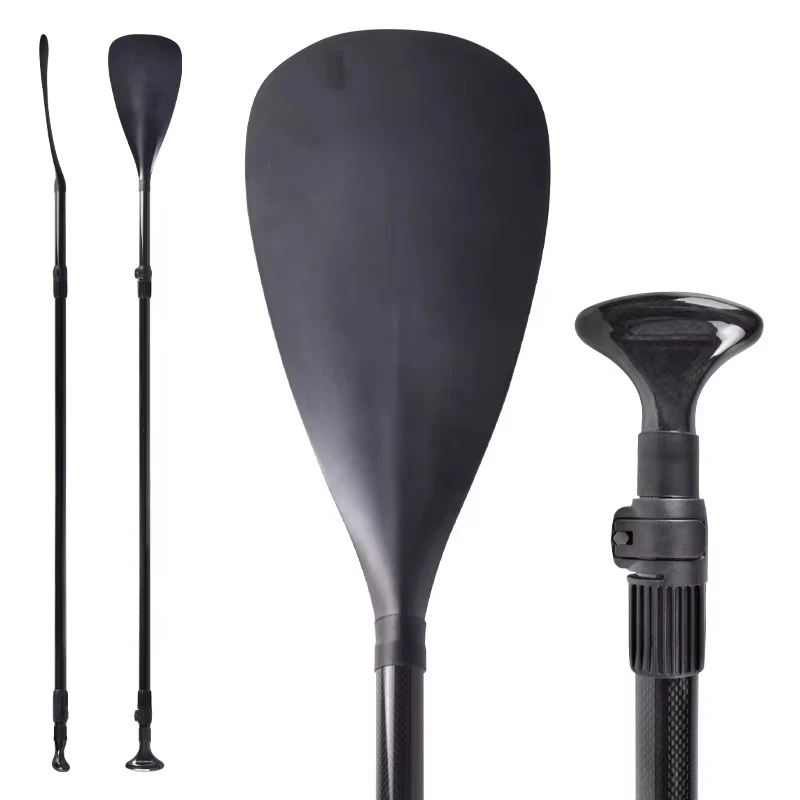
Choosing between a 3-piece SUP paddle, a 2-piece adjustable paddle, and a one-piece paddle involves more than deciding how many sections the shaft should have.
Each design offers a different balance of portability, weight, shaft stiffness, connection stability, and convenience.
A one-piece paddle is often preferred for performance-focused paddling. A 2-piece adjustable paddle provides flexibility for different users, while a 3-piece paddle offers compact storage and easy transportation.
However, a well-engineered multi-piece carbon fiber paddle can also deliver excellent performance. The quality of the shaft, connection system, and blade matters just as much as the number of sections.
For SUP brands and OEM buyers, understanding these structural differences is essential when developing paddles for recreational, touring, travel, and racing markets.
This guide compares the three constructions and explains how to select the right design for your product requirements.
What Is the Difference Between 1-Piece, 2-Piece, and 3-Piece SUP Paddles?
The main difference is the number of sections in the paddle assembly.
However, the number of pieces and the ability to adjust paddle length are two separate design features.
For example, a 3-piece paddle can also be adjustable, while a one-piece paddle normally has a fixed length.
| Feature | One-Piece SUP Paddle | 2-Piece Adjustable SUP Paddle | 3-Piece SUP Paddle |
|---|---|---|---|
| Shaft construction | Continuous fixed-length shaft | Two main sections | Three detachable sections |
| Length adjustment | Generally no | Yes | Optional; common in travel models |
| Portability | Limited | Moderate | Excellent |
| Number of shaft joints | No adjustment joints | Usually one | Usually two |
| Weight potential | Lowest for equivalent designs | Moderate | Additional connection weight |
| Connection complexity | Low | Moderate | Higher |
| Typical applications | Racing, performance | Touring, recreational | Travel, inflatable SUP |
| OEM design priority | Weight and flex | Adjustment and locking | Compactness and joint reliability |
Comparison assumes broadly equivalent blade dimensions, materials, and performance requirements. Actual characteristics vary by design.
The best paddle is therefore not determined by its number of pieces alone.
It depends on the paddler, expected usage, and quality of the complete assembly.
One-Piece Carbon Fiber SUP Paddles: Best for Performance?
A one-piece SUP paddle normally uses a continuous shaft with a fixed overall length.
Because the shaft does not require adjustable or detachable joints, the structure can be optimized around weight, bending stiffness, and a consistent response under load.
Advantages of One-Piece SUP Paddles
1. Lower structural complexity
Without adjustable shaft connections, fewer mechanical components are required.
This reduces the number of interfaces that must be fitted, secured, and maintained.
2. Lightweight design potential
A one-piece paddle does not need additional telescoping sections or intermediate locking hardware.
For comparable construction and strength requirements, this creates opportunities to reduce finished weight.
3. Consistent shaft response
A continuous shaft allows the laminate structure to be designed without intermediate joint stiffness changes.
This can be particularly useful when controlling shaft flex for specific paddling styles.
4. Simple operation
There is no need to adjust the length or assemble separate shaft sections before use.
Limitations of One-Piece SUP Paddles
The main disadvantage is limited flexibility.
A fixed-length paddle cannot easily accommodate users of different heights.
Its full length also makes transportation and storage less convenient.
Best Applications
One-piece paddles are commonly suitable for:
-
SUP racing
-
Performance touring
-
Experienced paddlers
-
Individual users with established length preferences
-
Premium lightweight paddle collections
For brands developing high-performance equipment, a custom carbon fiber shaft can be engineered around specific bending, weight, and diameter requirements.
Learn more about our custom carbon fiber tubes for lightweight structural applications.
2-Piece Adjustable SUP Paddles: The Balance Between Performance and Flexibility
A 2-piece adjustable SUP paddle typically combines a main shaft and blade assembly with an adjustable upper shaft and handle.
The upper section slides into the main shaft and is secured by a locking mechanism.
This design allows users to change the overall length without requiring a completely separate paddle.
Advantages of Adjustable SUP Paddles
1. Flexible paddle length
An adjustable paddle can accommodate different paddler heights and preferences.
It is suitable for equipment shared by family members, recreational users, and rental customers.
2. Convenient transportation
Although it is generally less compact than a three-piece paddle, a two-piece design is easier to store than a fixed-length paddle.
3. Performance and convenience
A properly engineered adjustable paddle can offer a useful balance between shaft stiffness, weight, and adjustability.
4. Broad market suitability
The design can serve recreational paddlers, regular touring users, and customers seeking an upgrade from basic entry-level equipment.
Important Design Considerations
The adjustable connection is a critical functional area.
Common features include:
-
External clamp locking systems
-
Internal positioning features
-
Anti-rotation profiles
-
Telescoping shaft interfaces
-
Reinforced clamping areas
The connection must keep the shaft securely positioned without creating excessive movement.
Poor connection accuracy can lead to unwanted rotation, noise, or changes in paddle length during use.
Best Applications
Two-piece adjustable paddles are often suitable for:
-
Recreational SUP boards
-
Touring equipment
-
Shared family paddles
-
Rental fleets
-
Mid-range and premium adjustable paddle lines
For OEM brands, the adjustment range and locking system should be defined together with the shaft dimensions.
A good design balances convenient adjustment with reliable assembly performance.
3-Piece Carbon Fiber SUP Paddles: Why Are They Popular for Travel?
A 3-piece carbon SUP paddle is designed to separate into three shorter sections.
A common configuration includes:
-
An upper shaft section with the handle.
-
A middle shaft section.
-
A lower shaft section connected to the blade.
Many three-piece designs also allow length adjustment through the upper section.
The key advantage is the ability to transport a full-size paddle in a much smaller package.
Advantages of 3-Piece SUP Paddles
Compact storage
The separated sections can be packed inside an inflatable SUP board bag or a dedicated paddle bag, provided the packed dimensions are compatible.
Travel convenience
Three-piece paddles are easier to handle during travel and storage than full-length one-piece designs.
Flexible product configurations
Manufacturers can combine a detachable lower section with an adjustable upper shaft to create a versatile paddle.
Compatibility with inflatable SUP packages
Compact paddle construction makes three-piece designs particularly useful for board brands selling complete inflatable SUP packages.
Limitations of 3-Piece SUP Paddles
A three-piece paddle introduces additional mechanical interfaces.
These may increase weight and require more attention to connection accuracy, shaft alignment, and assembly quality.
Potential problems include:
-
Movement between connected sections
-
Joint rotation under paddling loads
-
Loose locking hardware
-
Uneven shaft alignment
-
Sand or debris entering the connections
-
Wear caused by repeated assembly
These are engineering risks rather than unavoidable problems.
A well-designed connection system can minimize unwanted movement while maintaining convenient assembly.
Best Applications
Three-piece paddles are especially suitable for:
-
Inflatable SUP board packages
-
Travel-oriented SUP equipment
-
Recreational paddle collections
-
Rental and outdoor adventure products
-
Compact retail packaging
Brands developing a travel paddle should consider the packed dimensions alongside the paddle’s assembled performance.
Our carbon fiber SUP paddle OEM solutions cover fixed-length, adjustable, and multi-piece configurations.
How Does Paddle Construction Affect Weight, Flex, and Performance?
The construction of a SUP paddle influences more than storage convenience.
Its shaft structure, blade, and connection systems determine how the complete paddle responds during use.
Paddle Weight: Is One-Piece Always Lighter?
A one-piece paddle generally offers the greatest opportunity for weight reduction because it does not need intermediate joints or adjustable hardware.
However, a one-piece fiberglass paddle can still weigh more than a well-engineered multi-piece carbon fiber paddle.
The comparison must consider:
-
Shaft material and laminate
-
Blade material and geometry
-
Wall thickness
-
Handle construction
-
Connection sleeves
-
Locking hardware
-
Surface finish
For an accurate comparison, OEM buyers should evaluate the finished paddle weight rather than shaft weight alone.
Shaft Flex: Do Multiple Sections Make a Paddle Less Stiff?
Additional connections can change the stiffness distribution of a paddle.
However, this does not mean every three-piece paddle is less stiff than every one-piece model.
A carbon fiber shaft’s bending response depends on its laminate structure, diameter, wall thickness, and reinforcement arrangement.
Connection sleeves can also create localized stiffness changes.
A multi-piece paddle may feel different under load because the joints and surrounding laminate behave differently from the continuous shaft sections.
Manufacturers should therefore evaluate the complete assembled paddle rather than testing the carbon shaft material alone.
Joint Stability: Why Connection Accuracy Matters
A small amount of clearance may be necessary for assembly.
However, excessive clearance can create movement between shaft sections.
Under repeated paddling loads, unwanted movement can affect handling and perceived product quality.
The connection should provide:
-
Consistent assembly
-
Secure engagement
-
Reliable blade-to-handle alignment
-
Resistance to unintended rotation
-
Suitable strength under bending and torsion
-
Acceptable operation after repeated assembly
The most appropriate joint design depends on the paddle’s structure and intended use.
SUP Paddle Connection Systems: What Should OEM Buyers Evaluate?
Connection engineering is one of the main differences between manufacturing a simple carbon fiber tube and producing a complete adjustable paddle.
For 2-piece and 3-piece designs, several components need to function together.
1. Clamp Locking Systems
A clamp secures the adjustable upper shaft at the selected length.
It should provide sufficient holding force without damaging the composite tube.
Design considerations include clamp geometry, contact pressure, material selection, and reinforcement around the clamping area.
2. Push-Pin Connections
Push-pin systems are commonly used in detachable paddle sections.
They provide a positive engagement feature to help maintain the assembled connection.
However, pin position, hole geometry, surrounding reinforcement, and assembly clearance should be evaluated carefully.
3. Anti-Rotation Design
Anti-rotation features help maintain blade and handle alignment.
Depending on the construction, these features may use keyed profiles, shaped interfaces, grooves, or other mechanical designs.
Maintaining consistent orientation can improve the user’s confidence in the paddle assembly.
4. Joint Reinforcement
The loads transferred through a shaft connection may differ from those in the surrounding tube.
Local carbon fiber reinforcement, appropriate sleeve length, and suitable bonding or fastening details can help distribute these loads.
This is especially important when developing lightweight multi-piece paddles.
For additional background on laminate design, tooling, bonding, and production, see How Custom Carbon Fiber Parts Are Made.
How to Choose the Right SUP Paddle for Different Applications
The best construction depends on what the paddle is expected to do.
| Target Application | Recommended Starting Point | Main Selection Priority |
|---|---|---|
| SUP racing | One-piece carbon fiber | Weight, stiffness, blade response |
| Performance touring | One-piece or 2-piece carbon fiber | Stroke feel, weight, comfort |
| Recreational paddling | 2-piece adjustable | Length flexibility and convenience |
| Inflatable SUP packages | 3-piece adjustable | Packed dimensions and reliable joints |
| Family and shared equipment | 2-piece or 3-piece adjustable | Usable length range |
| Travel and adventure | 3-piece carbon or hybrid | Portability and durability |
| Rental equipment | Adjustable 2-piece or 3-piece | Durability and ease of operation |
These recommendations are starting points rather than universal rules.
A well-designed three-piece paddle may be suitable for demanding touring applications, while some recreational users may prefer a simple fixed-length paddle.
The correct configuration depends on the intended price segment, customer expectations, and performance targets.
OEM Manufacturing: How to Develop a Reliable Carbon Fiber SUP Paddle
For SUP brands and distributors, choosing the paddle structure is only the beginning.
Successful OEM development requires the shaft, blade, handle, and connection systems to be designed as a complete assembly.
Define the Product Specifications
Before manufacturing samples, the buyer should identify the main product requirements.
| Specification | Information to Confirm |
|---|---|
| Paddle construction | One-piece / 2-piece / 3-piece |
| Overall length | Fixed length or adjustable range |
| Shaft diameter | Outer and inner dimensions |
| Carbon construction | Fiber type, layup, stiffness requirements |
| Blade dimensions | Area, shape, angle, thickness |
| Finished weight | Target and acceptable tolerance |
| Joint construction | Clamp, pin, sleeve, anti-rotation |
| Packed dimensions | Maximum section length and package size |
| Surface appearance | Woven carbon, matte, gloss, graphics |
| Branding | Logo, labels, retail packaging |
| Order quantity | Prototype and production volume |
Not every project needs completely new tooling.
Where suitable, existing components may be evaluated for compatibility with the proposed construction.
However, changing a shaft diameter, blade profile, or connection system may require corresponding adjustments to other components.
Validate the Sample Before Mass Production
For a new OEM paddle, physical sample evaluation is important.
A practical validation plan should include:
Dimensional inspection
Check the overall paddle length, shaft dimensions, blade geometry, connection fit, and other critical assembly dimensions.
Weight measurement
Record the finished product weight using the agreed measurement conditions.
Bending evaluation
Measure shaft or assembled paddle deflection under a defined load and test setup.
Connection security
Check for unwanted movement, rotation, or separation under specified loads.
Repeated assembly testing
Assess whether joints and adjustment systems continue to operate correctly after repeated use.
Environmental evaluation
Where relevant, evaluate the effects of water, sand, salt exposure, and UV aging on the connection hardware and surface finish.
Appearance inspection
Check carbon weave, coatings, blade finish, branding, and visible defects against approved samples.
Acceptance limits and test methods should be agreed upon between the brand and manufacturer before production.
Testing the complete assembly is particularly important for multi-piece paddles because individual component quality does not automatically guarantee reliable joint performance.
Standardize Parts Across an OEM Paddle Collection
A brand may offer several paddle models that share compatible components.
For example, a product collection could include:
-
A one-piece performance carbon paddle
-
A 2-piece adjustable touring paddle
-
A 3-piece travel paddle
Where the technical design permits, these models may share selected shaft dimensions, blade tooling, handles, or connection components.
Component standardization can simplify sourcing, inspection, inventory, and repeat production.
However, interchangeable components must still be validated for each intended configuration.
Working With a Carbon Fiber SUP Paddle Manufacturer
WeiHai LongHe Composite supports custom carbon fiber paddle development for brands, distributors, and OEM projects.
Depending on the product requirements, development options can include:
-
Custom carbon fiber shaft dimensions and laminate structures
-
One-piece, adjustable, and multi-piece paddle configurations
-
Customized blade shapes and carbon composite construction
-
Connection and locking system development
-
Local reinforcement around joints
-
Matte, gloss, and visible carbon finishes
-
Logo printing and private-label requirements
-
Prototype evaluation and batch production planning
For a new project, buyers can provide an existing paddle, technical drawing, CAD model, or preliminary product specification.
The proposed design can then be reviewed for manufacturing feasibility, component fit, and production requirements.
We also provide carbon fiber solutions for sports equipment where weight, stiffness, and repeatable structural performance are important.
Frequently Asked Questions
Is a 3-piece SUP paddle better than a 2-piece paddle?
A three-piece SUP paddle is generally more convenient for travel and compact storage. A two-piece adjustable paddle has fewer detachable connections and may be preferable when portability is less important. The better choice depends on the intended use and construction quality.
Are 3-piece carbon fiber SUP paddles strong enough for regular use?
A properly engineered three-piece carbon fiber paddle can be suitable for regular paddling. Its reliability depends on the shaft laminate, joint reinforcement, connection design, and manufacturing quality. Structural performance should be validated against the intended loading conditions.
Can a 3-piece SUP paddle also be adjustable?
Yes. Many three-piece SUP paddles include an adjustable upper shaft section. The lower sections can be detached for transportation while the upper section allows the user to adjust the assembled paddle length.
What is the difference between a fixed and adjustable SUP paddle?
A fixed paddle maintains one overall length and typically uses a continuous shaft. An adjustable paddle includes a sliding shaft section and locking mechanism so the length can be changed for different users or paddling preferences.
Is a one-piece carbon fiber paddle always better for racing?
A one-piece carbon paddle is commonly favored for racing because it can be optimized for low weight and consistent shaft response. However, blade geometry, shaft flex, paddle length, and the athlete’s technique also influence performance.
What is the most important quality issue in a 3-piece SUP paddle?
Joint reliability is one of the most important considerations. Buyers should evaluate connection fit, alignment, rotation resistance, mechanical security, and performance after repeated assembly. Shaft and blade construction must also satisfy the overall product requirements.
Can an OEM manufacturer customize a carbon fiber SUP paddle?
Yes. Carbon fiber SUP paddles can be developed with customized lengths, shaft diameters, laminate structures, blade geometries, adjustment systems, finishes, and branding. The final design should be reviewed and validated before repeat production.
Conclusion: Which SUP Paddle Construction Should You Choose?
There is no single paddle construction that works best for every SUP application.
A one-piece carbon fiber SUP paddle offers a straightforward structure for weight-sensitive, performance-oriented designs.
A 2-piece adjustable SUP paddle provides a practical balance between performance, convenience, and length flexibility.
A 3-piece SUP paddle prioritizes portability and is especially suitable for inflatable SUP packages and travel equipment.
For OEM buyers, the number of sections is only one part of the decision.
Shaft laminate, blade design, connection accuracy, finished weight, and quality control ultimately determine whether the paddle meets its intended requirements.
Developing a Custom Carbon Fiber SUP Paddle?
Explore our Carbon Fiber SUP Paddle Manufacturing capabilities or contact WeiHai LongHe Composite to discuss your specifications.
Send us your paddle drawings, reference samples, preferred construction, and estimated order quantity so we can review suitable manufacturing options for your OEM project.
