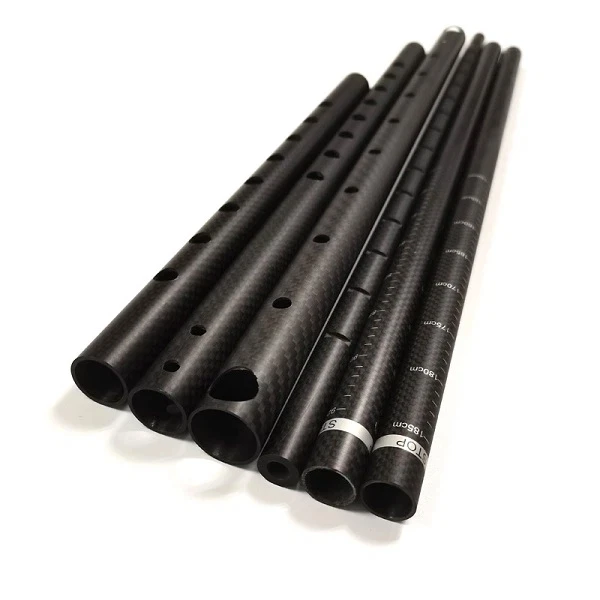
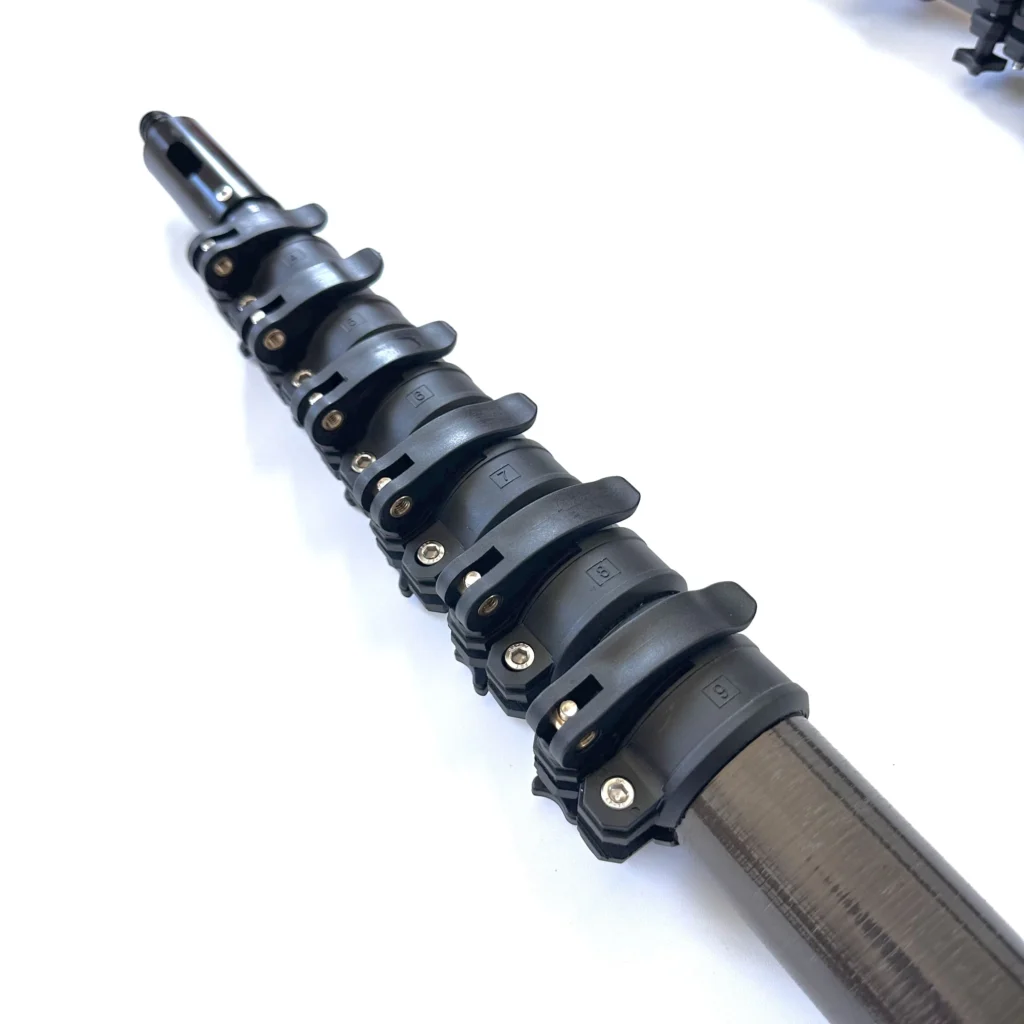
Carbon Fiber Tube Clamps: A Practical Guide for 20–40mm Tube Assemblies
Carbon fiber tubes are often chosen because they are light, stiff, and clean in appearance. But in many real products, the tube itself is only one part of the structure. The way the tube is fixed, adjusted, locked, or connected can decide whether the final assembly works well or causes problems later.
That is why carbon fiber tube clamps are important.
A good clamp should hold the tube securely without crushing the tube wall. It should also make assembly easier, support adjustment when needed, and keep the structure stable during use. For telescopic poles, support arms, camera systems, industrial tools, outdoor equipment, and custom OEM products, the clamp is not just a small accessory. It is part of the design.
Our carbon fiber tube clamps are mainly suitable for tubes with outside diameters from 20mm to 40mm. For projects with different tube sizes, special shapes, wall thicknesses, or assembly needs, we can also provide custom clamp solutions based on customer requirements.
What Are Carbon Fiber Tube Clamps?
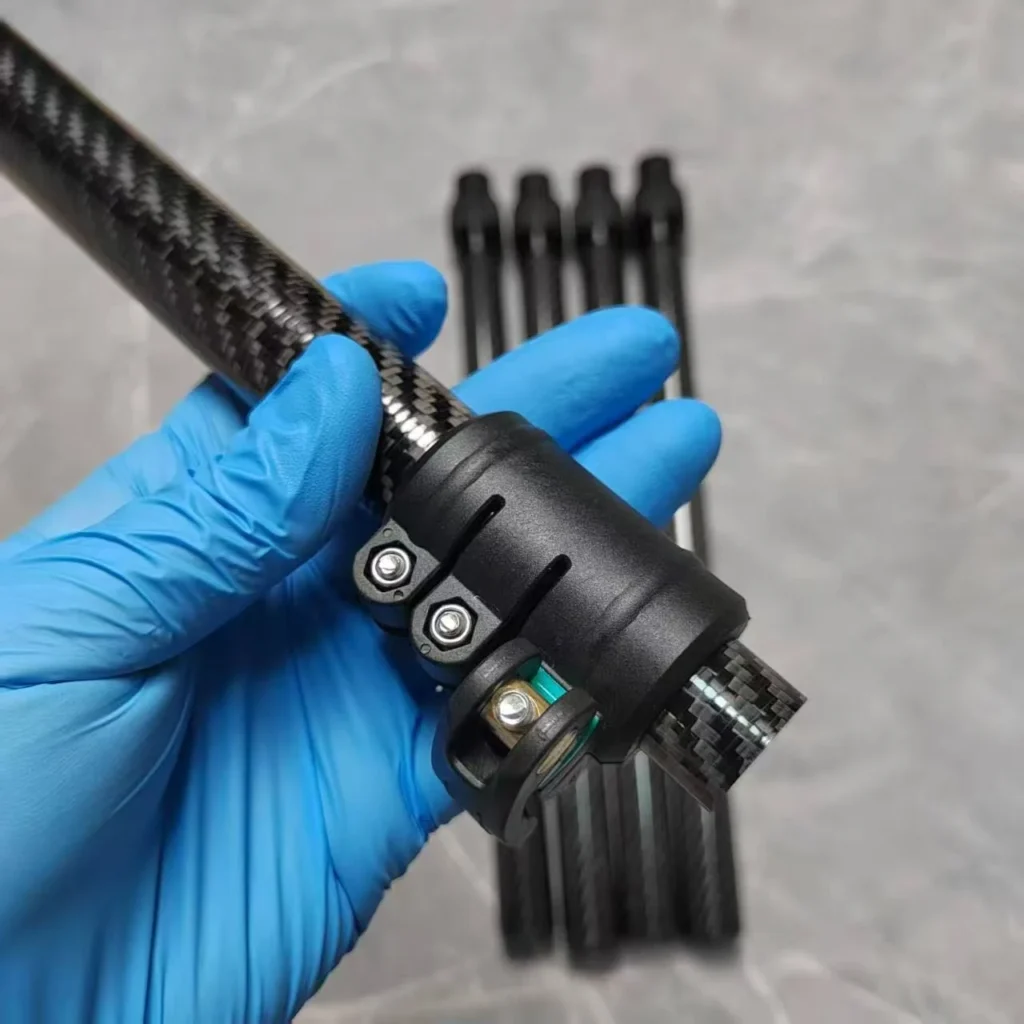
Carbon fiber tube clamps are mechanical parts used to hold, lock, or connect carbon fiber tubes. They usually wrap around the outside of the tube and apply controlled pressure to keep the tube in position.
Unlike bonded joints, clamps can often be removed, adjusted, or reused. This makes them useful for products that need length adjustment, quick assembly, maintenance, or transport.
In simple terms, a clamp helps solve questions like:
- How do I lock a telescopic carbon fiber tube?
- How do I connect a tube without glue?
- How do I make a carbon fiber pole adjustable?
- How do I hold a tube in place without drilling through it?
- How do I design a removable joint for a carbon fiber assembly?
For many buyers, the goal is not just to buy a clamp. The real goal is to make the final product easier to use, safer to assemble, and more reliable in the field.
Why Clamp Design Matters for Carbon Fiber Tubes
Carbon fiber is strong, but it is different from metal. A metal tube can often accept high local pressure better than a thin-wall composite tube. Carbon fiber tubes can be damaged if the clamp pressure is too high, too narrow, or uneven.
A poor clamp design may cause:
- local crushing on the tube surface
- slipping during use
- surface marks or wear
- poor alignment
- difficult adjustment
- reduced service life
A good carbon fiber tube clamp should spread the pressure over a suitable contact area. It should fit the tube diameter correctly and match the tube wall thickness, surface finish, and load requirement.
This is especially important for tubes with thin walls. A clamp that looks strong from the outside may still damage the tube if the inner contact shape is not correct.
For this reason, we usually suggest that buyers consider the tube and clamp together instead of choosing them separately.
Standard Size Range: Suitable for 20–40mm Carbon Fiber Tubes
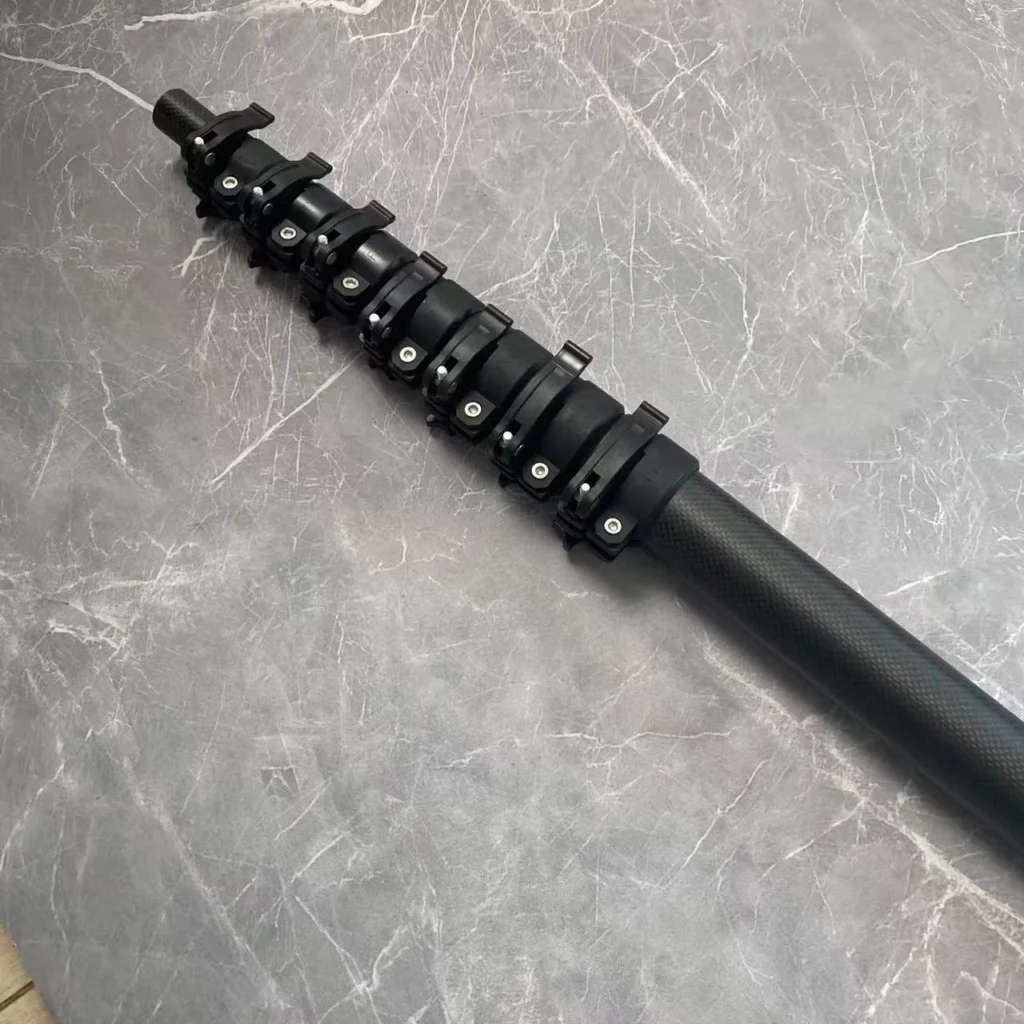
Our standard carbon fiber tube clamps are mainly designed for tubes in the 20mm to 40mm outside diameter range. This size range is commonly used in many lightweight structures, including poles, frames, support arms, equipment handles, and portable systems.
Typical tube sizes may include:
| Tube Outside Diameter | Common Use Case | Clamp Design Focus |
|---|---|---|
| 20mm | Small support poles, compact tools, light frames | Low weight and clean locking |
| 25mm | Portable poles, outdoor tools, camera supports | Easy adjustment and stable holding |
| 30mm | Medium-duty telescopic systems, industrial tools | Stronger grip and good alignment |
| 35mm | Larger support tubes and structural assemblies | Higher contact area and load support |
| 40mm | Heavy-duty poles, larger frames, custom equipment | Strong clamping force with tube protection |
This table is only a general guide. The best clamp size still depends on the tube’s actual outside diameter tolerance, wall thickness, surface finish, and working load.
For example, two carbon fiber tubes may both be 30mm OD, but one may have a thin wall for lightweight use while another may have a thicker wall for industrial use. These two tubes may need different clamp details.
When Should You Use Carbon Fiber Tube Clamps?
Carbon fiber tube clamps are a good choice when the tube assembly needs to be adjustable, removable, or serviceable.
They are often used when glue is not the best option. Bonding can be strong, but it is usually permanent. If the product must be opened, adjusted, packed, repaired, or replaced, a clamp-based connection may be more practical.
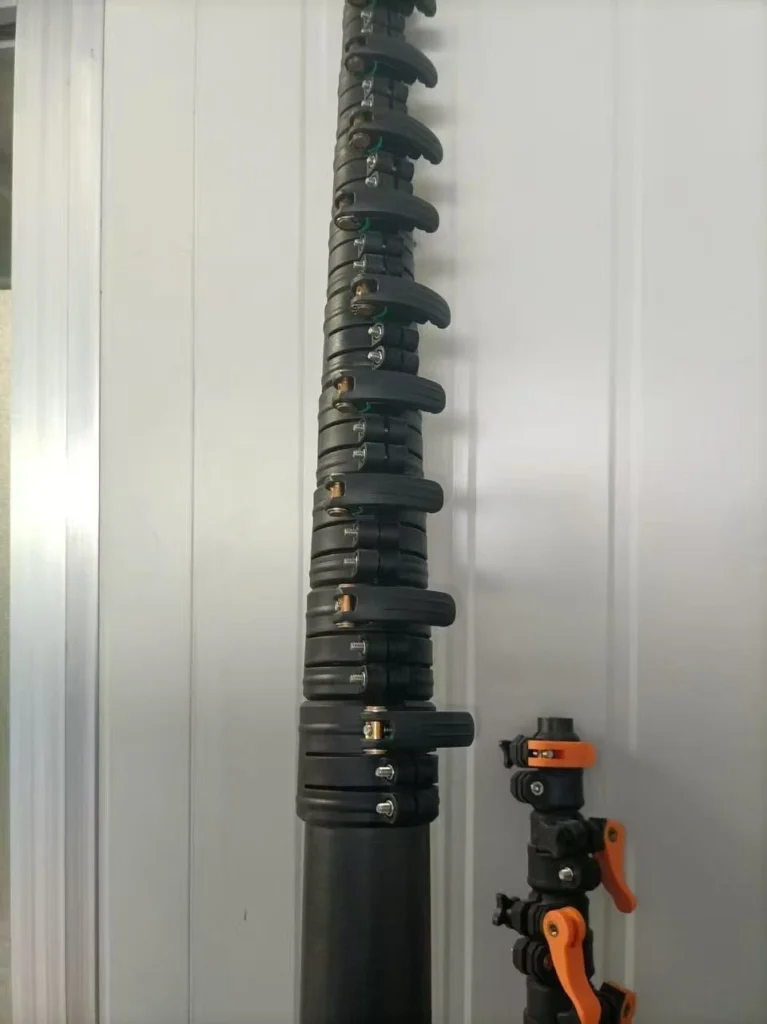
1. Telescopic Carbon Fiber Poles
Telescopic poles need a locking system between tube sections. A clamp can hold one tube section at the required length and allow the user to adjust it again later.
This is common in:
- inspection poles
- camera poles
- cleaning poles
- measuring poles
- outdoor field tools
- portable support structures
- water fed pole
For these products, the clamp should be easy to operate by hand and should not damage the tube after repeated use.
2. Adjustable Support Arms
Some equipment needs a tube to slide, rotate, or adjust before being locked in place. A clamp allows this movement during setup and provides holding force during operation.
This can be useful for camera equipment, sensor mounts, robotic supports, industrial arms, and lightweight fixtures.
3. Removable Tube Assemblies
If the final product must be packed into a small size for shipping or transport, removable clamps can be helpful. The user can assemble the structure when needed and take it apart after use.
This is common in portable equipment and outdoor products.
4. Prototype and Testing Projects
During product development, customers may need to test different tube lengths, positions, or layouts. Clamps make the prototype easier to adjust before the final design is confirmed.
After testing, the clamp design can be improved for batch production.
Carbon Fiber Tube Clamp vs Bonded Joint
Both clamps and bonded joints are useful, but they solve different problems.
A bonded joint is usually better when the connection must be permanent, compact, and clean. A clamp is usually better when the connection must be adjustable, removable, or easy to service.
| Connection Method | Best For | Main Advantage | Main Limitation |
|---|---|---|---|
| Tube clamp | Adjustable or removable assemblies | Easy to adjust and reuse | Adds external size |
| Bonded insert | Permanent tube-to-hardware connection | Strong and compact | Not easy to remove |
| Internal sleeve | Straight tube-to-tube joining | Clean appearance | Usually needs adhesive |
| Threaded fitting | Modular systems | Easy installation | Requires insert design |
| Spring button | Quick locking poles | Fast operation | Lower load in many cases |
For many OEM products, the best solution may also be a combination. For example, a telescopic carbon fiber pole may use clamps for length adjustment and bonded inserts at the tube ends for accessories or handles.
Key Points When Choosing Carbon Fiber Tube Clamps
Choosing the right clamp is not only about the tube diameter. A good clamp should match the full working condition of the product.
Here are the most important points to check.
1. Tube Outside Diameter
The clamp must match the actual tube OD. Even a small mismatch can cause slipping or uneven pressure.
For standard projects, our clamps are suitable for 20–40mm tubes. For non-standard sizes, we can develop custom clamp dimensions.
2. Tube Wall Thickness
Wall thickness affects how much clamping force the tube can safely accept. Thin-wall tubes need more careful pressure control. Thick-wall tubes may allow a stronger clamp design.
3. Surface Finish
Glossy, matte, painted, sanded, or wrapped carbon fiber surfaces may behave differently under clamping pressure. Some surfaces need more protection to avoid visible marks.
4. Load Direction
The clamp may need to resist pulling, bending, twisting, vibration, or repeated movement. Different load directions require different clamp structure.
5. Adjustment Frequency
If the clamp is used many times per day, the design should focus on user comfort, repeatability, and long-term wear. If it is only adjusted occasionally, the design can be simpler.
6. Working Environment
Outdoor use, water, dust, salt air, temperature change, and impact can all affect the clamp material and design. For outdoor or industrial use, durability should be considered early.
Common Mistakes When Using Clamps on Carbon Fiber Tubes
Many clamp problems are not caused by poor tube quality. They are caused by the wrong clamp choice or poor assembly design.
Mistake 1: Choosing by Diameter Only
A 30mm clamp does not automatically work well on every 30mm carbon fiber tube. Wall thickness, tolerance, surface finish, and load all matter.
Mistake 2: Over-Clamping the Tube
More force is not always better. Too much pressure can damage the tube wall, especially on thin-wall carbon fiber tubes.
Mistake 3: Using a Narrow Contact Area
If the clamp contact area is too small, the pressure becomes concentrated. A wider and better-shaped contact area can help protect the tube.
Mistake 4: Ignoring Tube Tolerance
Carbon fiber tubes may have manufacturing tolerance. If the clamp has no allowance for real production variation, assembly may become too tight or too loose.
Mistake 5: Designing the Clamp Too Late
The clamp should be considered early in the design process. If the tube size is already fixed and the product space is limited, the clamp design may become more difficult.
Custom Carbon Fiber Tube Clamps for OEM Projects
Standard clamps are useful when the tube size and working conditions are common. But many OEM projects need custom clamp solutions.
A custom carbon fiber tube clamp may be needed when:
- the tube diameter is outside 20–40mm
- the tube shape is not round
- the tube wall is very thin or very thick
- the product needs a special locking style
- the clamp must connect to another part
- the appearance must match the final product
- the clamp needs a special color, finish, or logo
- the assembly must pass repeated field use
- the project requires better fit for batch production
Customization can include clamp size, shape, material, locking method, screw position, hinge design, surface finish, and connection features.
For OEM buyers, the most important point is not only whether the clamp can be made. It is whether the clamp, tube, and final assembly can work together in real use.
That is why we recommend sharing drawings, tube dimensions, wall thickness, application photos, and load requirements when asking for a custom clamp solution.
Typical Applications of Carbon Fiber Tube Clamps
Carbon fiber tube clamps can be used in many lightweight product assemblies. The most common applications include:
Sports Equipments
For sports equipments, the clamp locks each tube section at the required length. The design should be easy to operate and should not scratch or crush the tube.
Industrial Tools
Inspection tools, cleaning tools, measuring tools, and portable support equipment can benefit from strong but lightweight tube clamp systems.
Outdoor and Field Equipment
Outdoor products often need fast assembly, corrosion resistance, and good handling. A suitable clamp can improve user experience and reduce assembly problems.
Robotics and Automation
In lightweight robotic arms or support frames, clamps can help position tubes during testing or allow modular adjustment.
Custom OEM Products
Many customer projects do not fit standard hardware. For these cases, a custom clamp can make the product cleaner, safer, and easier to produce in batches.
FAQ About Carbon Fiber Tube Clamps
Can you clamp carbon fiber tubes?
Yes, carbon fiber tubes can be clamped, but the clamp must be designed correctly. The clamp should apply even pressure and match the tube diameter, wall thickness, and working load.
What size carbon fiber tube clamps do you offer?
Our standard clamp range is mainly suitable for carbon fiber tubes with outside diameters from 20mm to 40mm. We can also customize clamps for other sizes based on customer requirements.
Will a clamp damage a carbon fiber tube?
A poor clamp can damage the tube if the pressure is too high or too concentrated. A well-designed clamp helps spread the force and reduce the risk of local crushing.
Are carbon fiber tube clamps reusable?
Yes. Many clamp systems are reusable, especially for telescopic poles, adjustable supports, and portable equipment. The design should match the expected number of open-close cycles.
Can you make custom carbon fiber tube clamps?
Yes. We can customize clamp size, shape, structure, material, finish, and locking method based on the tube and final application.
What is better, a clamp or a bonded joint?
It depends on the product. A clamp is better for adjustable or removable assemblies. A bonded joint is better for permanent and compact connections.
Conclusion
Carbon fiber tube clamps are small parts, but they have a big effect on the final product. A good clamp can make a carbon fiber tube assembly easier to adjust, safer to use, and more reliable over time.
For most standard projects, our carbon fiber tube clamps are suitable for tubes with outside diameters from 20mm to 40mm. For special tube sizes, shapes, wall thicknesses, or OEM structures, we can also develop custom clamp solutions according to your requirements.
If you want to learn about other ways to connect carbon fiber tubes, such as internal sleeves, bonded inserts, threaded fittings, and quick-release joints, please read this guide:
https://lhcarbonsolutions.com/blog-list/how-to-connect-carbon-fiber-tubes/
You may also like

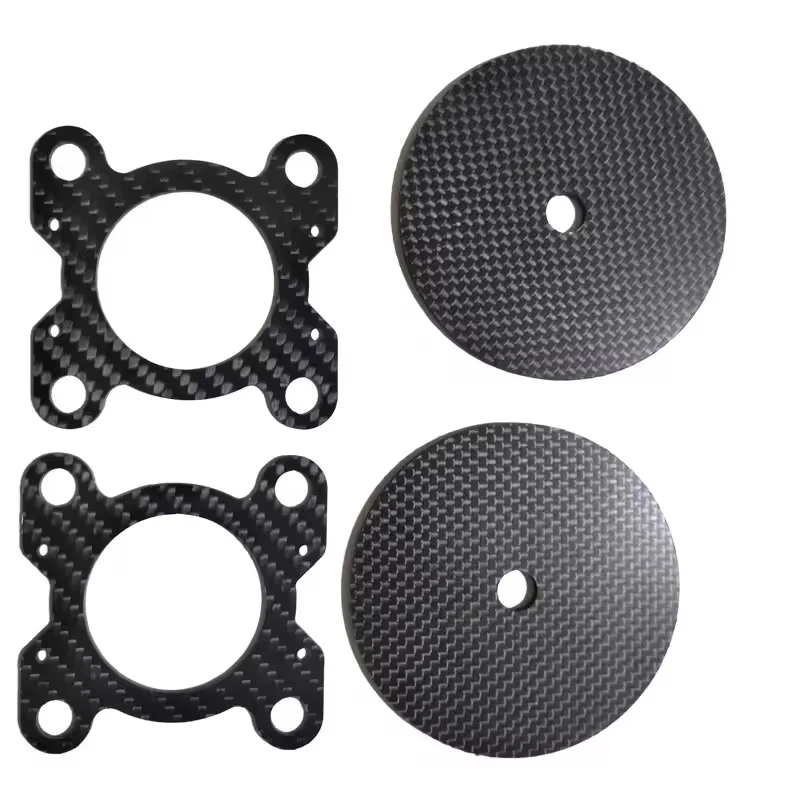
Carbon Fiber Sheets & Plates
Flat laminate stock for CNC cutting and lightweight structural components.