A good carbon fiber pool cue is not only about looking modern. Buyers should compare the shaft, joint, tip, weight, balance, finish, and supplier capability before making a decision.
Carbon fiber pool cues have become more popular in recent years because they offer stable performance, a smooth feel, and lower maintenance compared with many traditional wooden cues. For players, the main question is simple: does a carbon fiber cue help me play better? For brands, distributors, and cue makers, the question is a little different: how do I choose the right carbon fiber pool cue or shaft for my market?
The answer depends on more than one feature. A cue can look good but feel too stiff. A shaft can be low-deflection but not match the customer’s joint type. A price may look attractive, but the surface finish, straightness control, and consistency may not meet long-term needs.
This guide explains what buyers should compare before choosing the best carbon fiber pool cues. It is written for players, cue brands, distributors, and OEM buyers who want a clear and practical way to evaluate carbon fiber cue options.

What Makes the Best Carbon Fiber Pool Cue Different?
The best carbon fiber pool cue should match the player’s style, not just use carbon fiber as a selling point.
When people search for the best carbon fiber pool cues, they often expect one simple answer. In reality, there is no single cue that fits every player or every market. A beginner, a league player, a cue brand, and a distributor may all need different specifications.
A good carbon fiber pool cue usually has several important features:
- Stable shaft straightness
- Smooth and clean surface finish
- Suitable shaft diameter
- Reliable joint connection
- Good weight and balance
- Controlled deflection
- Durable tip and ferrule setup
- Consistent production quality
Carbon fiber itself is not enough. The structure, layup, taper, surface treatment, and assembly all affect how the cue performs.
For example, two carbon fiber cue shafts may both use a similar outside diameter. But if one has better internal structure control, better joint assembly, and better finish quality, it may feel more stable and perform more consistently.
For B2B buyers, the word “best” should also include production reliability. A cue that looks good in one sample is not enough. The supplier must be able to repeat the same quality in bulk production.
That is why buyers should compare carbon fiber pool cues from both sides: playing performance and manufacturing consistency.
Carbon Fiber Pool Cue vs Carbon Fiber Cue Shaft: Know What You Are Buying
Many buyers search for carbon fiber pool cues, but they may actually need a carbon fiber cue shaft.
This is one of the most common points of confusion. A carbon fiber pool cue and a carbon fiber cue shaft are not always the same product.
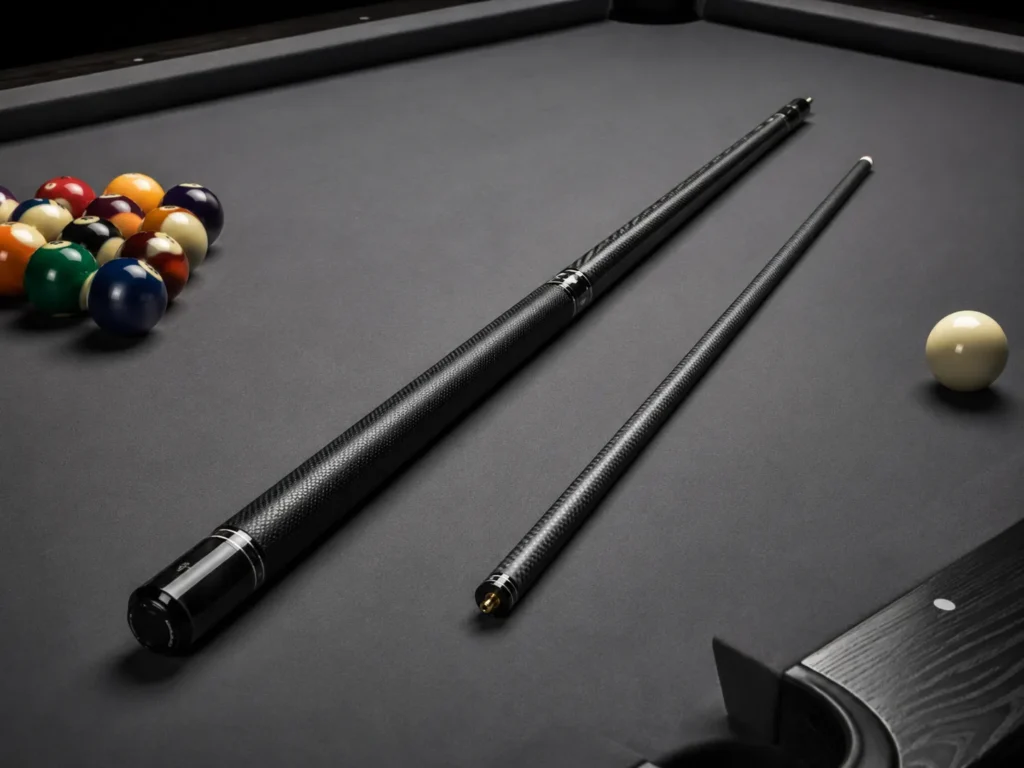
A full carbon fiber pool cue usually includes both the shaft and the butt. A carbon fiber cue shaft only replaces the front part of the cue. Many players still use a wooden butt and upgrade only the shaft to carbon fiber.
For many markets, carbon fiber cue shafts are more popular than full carbon fiber cues because they are easier to match with existing pool cues. If the joint type is correct, the player can keep the cue butt they already like and only upgrade the shaft.
Here is a simple comparison:
| Product Type | What It Includes | Best For | Key Buying Point |
|---|---|---|---|
| Carbon fiber cue shaft | Shaft only | Players upgrading an existing cue | Joint type, diameter, taper, tip |
| Full carbon fiber pool cue | Shaft and butt | Buyers wanting a complete modern cue | Weight, balance, design, full cue feel |
| Carbon fiber break cue | Built for breaking | Players needing power and durability | Tip hardness, weight, stiffness |
| Custom carbon fiber cue | Made to buyer specs | Brands, distributors, cue makers | OEM design, logo, finish, packaging |
Before buying, you should confirm whether your target customer wants a full cue or only a carbon fiber shaft. This decision affects cost, packaging, MOQ, joint design, and marketing.
For OEM buyers, carbon fiber cue shafts can be a good starting point because they are easier to customize and easier to ship than complete cues. Full carbon fiber pool cues may offer better branding value, but they usually require more design decisions.
Key Buying Factors: Diameter, Tip, Joint, Weight, and Balance
The best carbon fiber pool cue should be selected by specification, not only by price or appearance.
If you are comparing different carbon fiber pool cues, start with the features that directly affect use. These are the details buyers should check first.
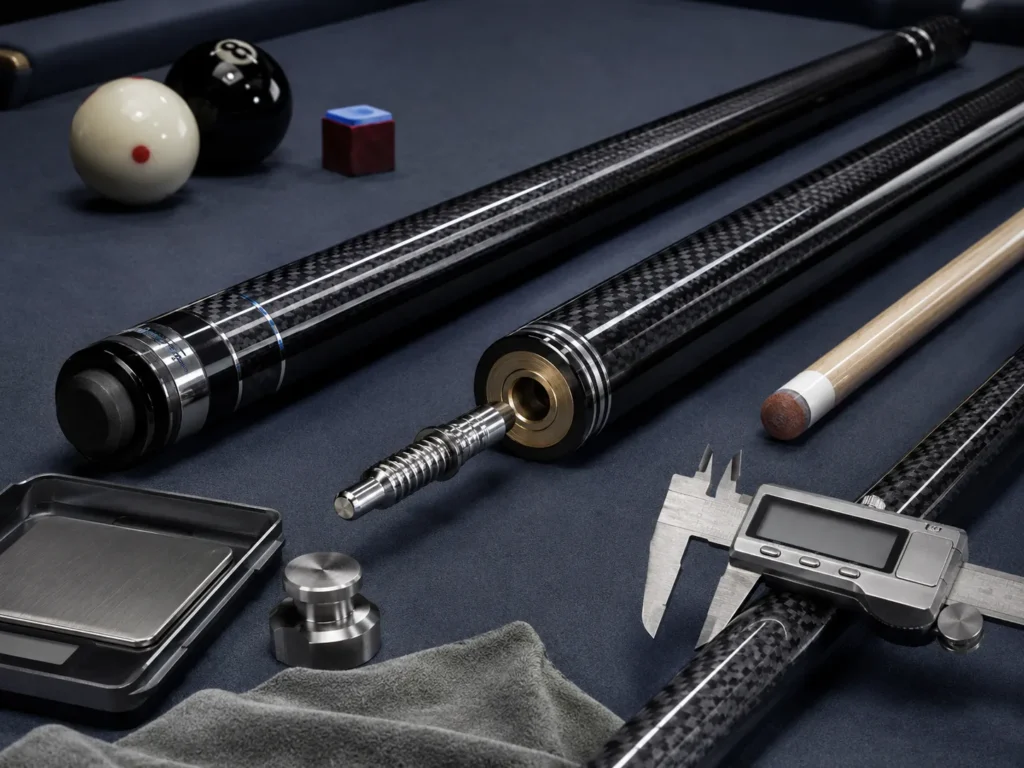
- Shaft diameter
Common pool cue shaft diameters include 11.75 mm, 12.4 mm, 12.5 mm, and 12.75 mm. A smaller diameter may feel more precise for some players, while a larger diameter may feel more stable and familiar.
There is no single best diameter for every player. A 11.75 mm carbon fiber shaft may suit players who prefer a thinner front-end feel. A 12.4 mm or 12.5 mm shaft may suit players who want a more balanced feel.
For distributors, it is often better to offer two or three common sizes instead of too many options at the beginning.
- Joint type
Joint compatibility is very important for carbon fiber cue shafts. If the joint does not match, the shaft cannot fit the buyer’s cue butt.
Common joint options may include:
- 5/16×18
- 5/16×14
- 3/8×10
- Radial
- Uni-Loc
- Custom joint inserts
For OEM orders, the joint system should be confirmed before production. Even a small mismatch can create after-sales problems.
- Tip choice
The cue tip affects feel, spin, control, and sound. Carbon fiber shafts are often paired with soft, medium, or hard tips depending on the player’s style.
A soft tip may give more feel and grip. A medium tip is a balanced choice for many players. A hard tip may be better for break cues or players who prefer a firm hit.
- Weight and balance
Weight and balance affect comfort. A cue that is too front-heavy or too light may not suit all players. For full carbon fiber pool cues, balance should be checked together with butt design and shaft weight.
For B2B buyers, it is helpful to define a standard weight range before placing bulk orders.
- Surface finish
A good carbon fiber cue shaft should feel smooth in the bridge hand. The surface should not feel sticky, rough, or uneven. Some buyers prefer a matte finish, while others prefer a cleaner satin or semi-gloss look.
For custom cue brands, surface finish is not only about appearance. It also affects hand feel and brand positioning.
Low-Deflection Performance: When It Matters
Low deflection is one of the main reasons players choose carbon fiber cue shafts.
In pool, deflection refers to how much the cue ball moves away from the aiming line when side spin is used. Many carbon fiber shafts are designed to reduce this effect. This is why the term “low-deflection carbon fiber shaft” appears often in buyer searches.
A low-deflection shaft can help some players aim more consistently, especially when using English. But this does not mean every player will instantly play better with carbon fiber. Players still need time to adjust to the feel, sound, and response of the shaft.
Low deflection matters most for:
- Players who use side spin often
- Players who want a more consistent aiming system
- Competitive players looking for stable performance
- Buyers comparing premium cue shaft options
However, low deflection is not the only factor. A shaft that has low deflection but poor feel may not be the best choice. A good carbon fiber pool cue should offer a balance of control, feedback, stiffness, and comfort.
For brands and distributors, it is better to describe performance honestly. Instead of saying “no deflection,” a more realistic claim is “designed for low deflection and stable control.” This sounds more professional and more trustworthy.
Carbon Fiber vs Wood Pool Cue: Main Differences
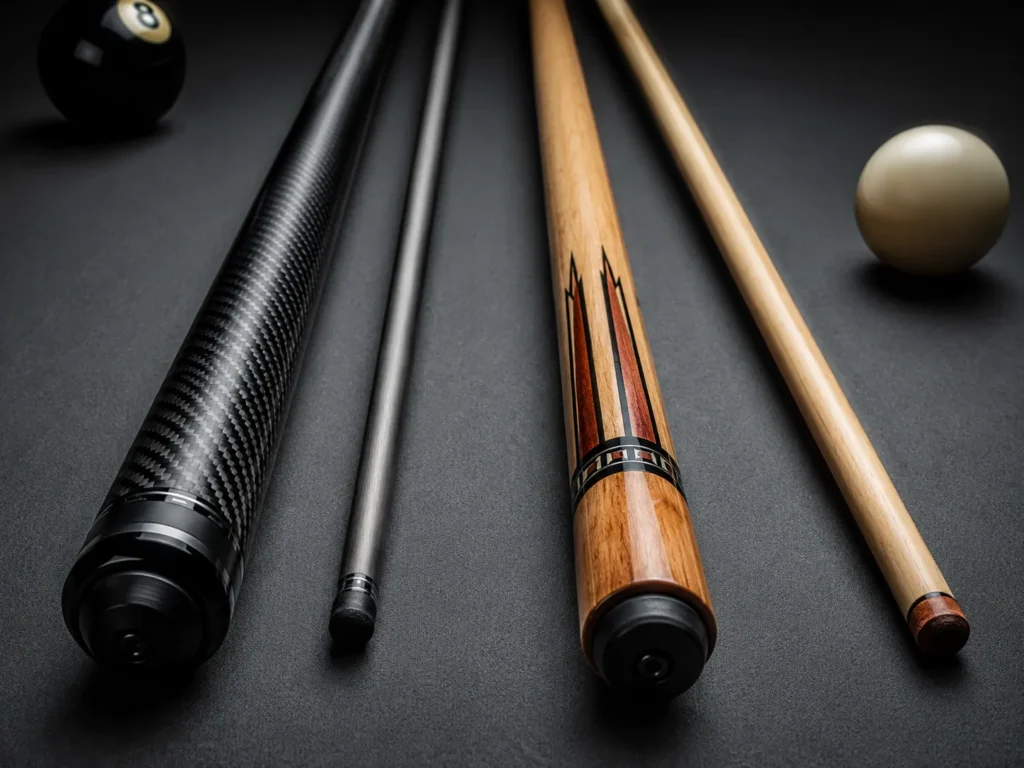
Carbon fiber and wood pool cues offer different playing experiences, and each material has its own advantages.
Wood has been used for pool cues for a long time. Many players still like the natural feel and sound of a wooden cue. Carbon fiber is newer and offers stronger stability, lower maintenance, and better resistance to warping.
Here is a simple comparison:
| Factor | Carbon Fiber Pool Cue | Wood Pool Cue |
| Stability | Very stable in many environments | Can be affected by humidity and temperature |
| Maintenance | Easier to clean and maintain | Needs more care |
| Feel | Smooth, firm, modern | Natural, warmer feedback |
| Deflection | Often designed for low deflection | Depends on shaft design |
| Appearance | Modern and technical | Traditional and classic |
| Best for | Players wanting consistency | Players who prefer classic feel |
Carbon fiber is not always better for every player. Some players love the natural feedback of wood. Others prefer the smoothness and consistency of carbon fiber.
For buyers, the right question is not “Which material is always better?” The better question is “Which material fits the player, market, and price level?”
If your customers are traditional players, a carbon fiber shaft with a wood butt may be easier to accept. If your customers like modern sports equipment, a full carbon fiber pool cue may be more attractive.
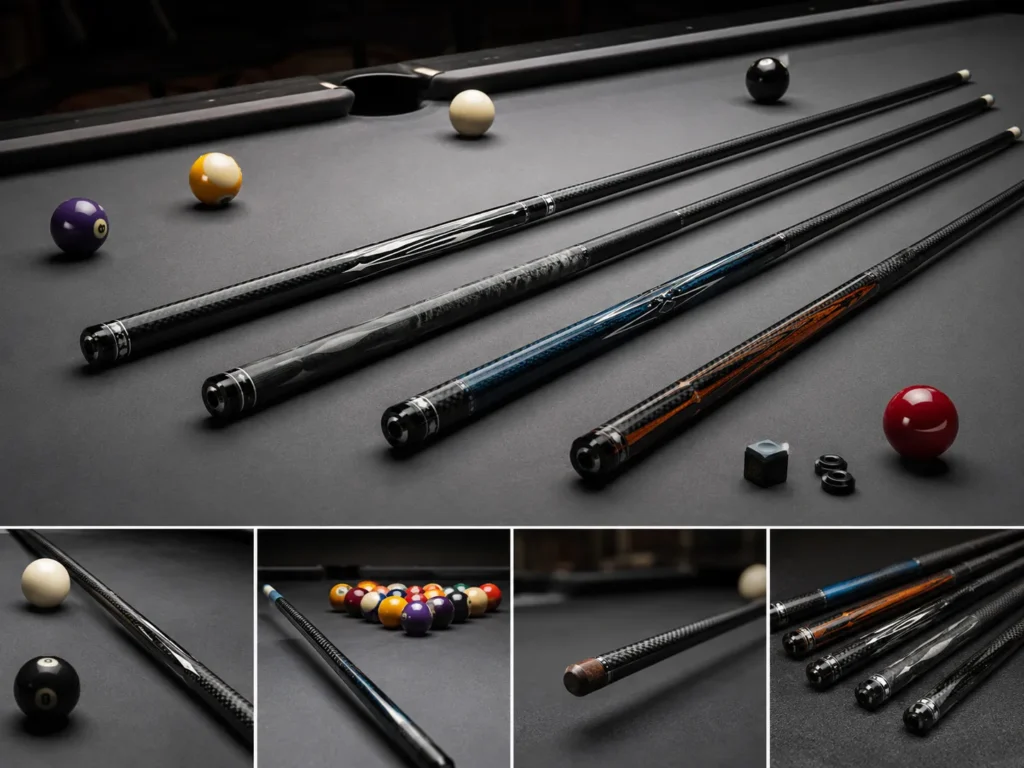
Best Carbon Fiber Pool Cues by Use Case
The best carbon fiber pool cue depends on how the cue will be used.
Different players and buyers need different products. A playing cue, break cue, jump cue, and OEM custom cue should not be designed in exactly the same way.
Playing cues
A carbon fiber playing cue should focus on control, comfort, and consistency. Shaft diameter, taper, tip, and balance are very important. Most players want a smooth stroke and predictable response.
For playing cues, buyers should not only ask whether the cue is carbon fiber. They should also check the shaft structure, surface finish, and joint accuracy.
Break cues
A carbon fiber break cue is made for power. It usually needs a stronger and stiffer setup. Tip hardness, weight, ferrule design, and shaft durability are more important than soft feel.
A break cue should feel solid and stable during impact. If the cue is too light or too flexible, it may not meet the needs of serious players.
Jump cues
A carbon fiber jump cue should be light, responsive, and easy to control. It is different from a playing cue and a break cue. The design should focus on quick lift and control.
Some buyers combine break and jump cue needs, but a dedicated jump cue may perform better for players who care about this part of the game.
OEM custom cues
For brands, distributors, and cue makers, the best carbon fiber pool cue is the one that fits the target market. This may include custom diameter, joint type, surface finish, logo, packaging, and product positioning.
An OEM buyer may care less about one single cue and more about repeatable quality across many pieces. That is why sampling, testing, and quality control are important before bulk orders.
Custom Carbon Fiber Pool Cues from a China Manufacturer
A China-based carbon fiber pool cue manufacturer can help brands and distributors develop custom cues based on market needs.
For many B2B buyers, standard products are not enough. They may need a private-label carbon fiber cue shaft, a custom joint system, a different surface finish, a branded logo, or a full cue design for their market.
As a China-based custom carbon fiber pool cue manufacturer, we help brands, distributors, and cue makers develop carbon fiber pool cues and cue shafts based on their required diameter, joint type, surface finish, weight, balance, and branding needs.
Instead of offering only standard models, we focus on OEM and custom production. This helps buyers match the cue design to their market and playing style.
Custom options may include:
- Carbon fiber cue shaft diameter
- Shaft length
- Joint insert type
- Tip and ferrule setup
- Matte, satin, or glossy finish
- Logo and branding
- Packaging design
- Full cue or shaft-only production
- Sample development before bulk order
For B2B buyers, the goal is not only to buy a product. The goal is to build a cue line that customers can trust. That requires stable production, clear communication, and realistic quality control.
This is also why supplier experience matters. A good manufacturer should understand both carbon fiber production and the needs of cue users. The product must not only be strong; it must also feel right in the hand.
What to Check Before Ordering Carbon Fiber Pool Cues in Bulk
Bulk buyers should check samples, specifications, and supplier capability before placing a larger order.
If you are buying carbon fiber pool cues for resale, private label, or brand development, do not choose a supplier only by the lowest price. A very low price may look attractive at first, but it can create problems later.
Before ordering in bulk, check these points carefully:
- Confirm the product type
Decide whether you need carbon fiber cue shafts, full carbon fiber pool cues, break cues, jump cues, or cue shaft blanks. Different products need different specifications.
- Check joint compatibility
Make sure the joint type matches your target market. For example, some customers may need 5/16×18, while others may prefer Radial or Uni-Loc. If your market already has popular joint standards, choose those first.
- Test the surface finish
The shaft should feel smooth and comfortable. The finish should not feel sticky or rough. If the surface is too glossy, some players may not like the hand feel. If it is too rough, it may feel unfinished.
- Check straightness and consistency
Straightness is one of the most important quality points for any cue shaft. For bulk production, the supplier should have a clear quality control process.
- Review logo and branding method
If you need private-label carbon fiber pool cues, confirm where the logo will be placed, how it will be protected, and whether it will affect the surface feel.
- Ask about MOQ and lead time
MOQ and lead time affect inventory planning. A good supplier should give realistic production time, not only a fast promise.
- Request samples before large orders
Samples help you check real feel, finish, diameter, joint fit, and packaging. For serious buyers, sample testing is a necessary step.
A good supplier should be willing to discuss specifications in detail. If a supplier only talks about price and avoids technical details, that can be a warning sign.
Common Mistakes When Choosing Carbon Fiber Pool Cues
Many buying mistakes happen because buyers compare price before comparing specifications.
Carbon fiber pool cues can look similar in photos, but the real difference is often in structure, finish, and consistency. Here are some common mistakes to avoid.
First, do not assume all carbon fiber shafts feel the same. The layup, taper, wall thickness, surface finish, and tip setup can all change the feel.
Second, do not choose only by outside appearance. A clean carbon fiber pattern is nice, but it does not prove the shaft has good performance.
Third, do not ignore joint type. A good shaft with the wrong joint is not useful for the customer.
Fourth, do not use unclear product names. If you sell to customers, make it clear whether the product is a full carbon fiber cue, a carbon fiber shaft, a break cue, or a jump cue.
Fifth, do not skip sample testing. Photos and descriptions are not enough for cue products. The hand feel and hit feedback should be checked.
For distributors and brands, avoiding these mistakes can reduce returns and improve customer satisfaction.
How to Choose the Best Carbon Fiber Pool Cue for Your Market
The best choice depends on your customer group, price level, and product plan.
If you are a player, choose based on comfort, joint fit, tip, shaft diameter, and playing style. If you are a distributor or cue brand, choose based on market demand, repeatable quality, and customization options.
For a simple buying process, you can follow this checklist:
- Decide whether you need a full cue or shaft only.
- Choose the common diameter for your market.
- Confirm the joint type.
- Select the tip and ferrule setup.
- Test the surface finish and hand feel.
- Check weight and balance.
- Review logo and packaging options.
- Test samples before bulk production.
For many buyers, the safest first step is to start with a carbon fiber cue shaft. It is easier to match with existing cue butts, easier to ship, and easier to test in different markets.
Once the shaft is accepted by customers, a full carbon fiber pool cue line can be developed later.
FAQ About Choosing the Best Carbon Fiber Pool Cues
Are carbon fiber pool cues good?
Yes. Carbon fiber pool cues can be a good choice for players who want stable performance, smooth feel, and easier maintenance. However, the quality depends on the shaft design, joint accuracy, tip, finish, and production control.
Are carbon fiber cue shafts worth it?
Yes, for many players they are worth it. A carbon fiber cue shaft can offer better stability and lower maintenance than many wooden shafts. But players who love the natural feel of wood may still prefer a traditional shaft.
What is the best diameter for a carbon fiber cue shaft?
There is no single best diameter for everyone. Common options include 11.75 mm, 12.4 mm, 12.5 mm, and 12.75 mm. Smaller diameters may feel more precise, while larger diameters may feel more stable.
Is a carbon fiber cue better than a wood cue?
Carbon fiber is more stable and easier to maintain, while wood gives a more traditional feel. The better choice depends on the player’s preference and the market you are selling to.
Can I use a carbon fiber shaft on my existing pool cue?
Yes, if the joint type matches. Before buying, check whether your cue uses 5/16×18, 5/16×14, 3/8×10, Radial, Uni-Loc, or another joint system.
Do carbon fiber pool cues need special cleaning?
They are usually easy to clean, but you should avoid harsh chemicals or rough abrasives. A soft cloth and suitable cleaner are often enough for regular care.
Can carbon fiber pool cues be customized?
Yes. A custom carbon fiber pool cue manufacturer can usually provide options for shaft diameter, length, joint type, surface finish, logo, packaging, and full cue design.
Final Thoughts
The best carbon fiber pool cue is not always the most expensive one. It is the cue that fits the player, the market, and the buying purpose.
For players, the key points are feel, control, joint fit, shaft diameter, and maintenance. For brands and distributors, the key points are consistent production, customization options, quality control, and supplier reliability.
Before choosing a carbon fiber pool cue, compare the full specification instead of only looking at the price or appearance. A good cue should offer stable performance, comfortable handling, and reliable quality over time.
If you are looking for custom carbon fiber pool cues or carbon fiber cue shafts for your brand, we can help develop OEM solutions based on your required diameter, joint type, finish, logo, and packaging needs.
If you want to read more info about carbon fiber pool cue pls click here :
Carbon Fiber Cue Shaft
