
A good carbon fiber cue shaft should match the player’s cue butt, bridge feel, tip preference, and playing style. This guide explains what buyers should compare before choosing or customizing a carbon fiber pool cue shaft.
Carbon fiber cue shafts are now one of the most popular upgrades in the pool cue market. Many players do not want to replace their whole cue. They already like the butt, weight, and design of their current cue. What they want is a shaft that feels smoother, stays straighter, and gives more stable performance.
That is why carbon fiber cue shafts are different from full carbon fiber pool cues. A full cue is a complete product. A cue shaft is a performance upgrade. It must fit the joint, match the player’s hand feel, and work well with the tip and ferrule.
For players, the main question is: which carbon fiber cue shaft should I choose? For cue brands, distributors, and OEM buyers, the question is: what specifications should we offer to our market?
This guide explains the key points buyers should compare before choosing the best carbon fiber cue shafts.
What Makes the Best Carbon Fiber Cue Shaft?
The best carbon fiber cue shaft is not always the most expensive one. It is the shaft that fits the player’s cue, stroke, and performance needs.
A good carbon fiber cue shaft should offer stable straightness, smooth surface feel, proper diameter, accurate joint connection, and consistent hit feedback. These points matter more than appearance alone.
Many shafts look similar in photos. They may all have a black carbon fiber pattern. But the real difference is in the details. The layup, taper, wall thickness, insert fit, surface coating, and final inspection all affect how the shaft feels during play.
A good carbon fiber pool cue shaft should be:
- Straight and stable
- Smooth in the bridge hand
- Comfortable for long play
- Matched to the correct joint type
- Designed with a suitable diameter
- Built with a reliable tip and ferrule setup
- Consistent from sample to bulk order
For individual players, the best shaft should feel natural after a short adjustment period. For B2B buyers, the best shaft should also be repeatable in production. One good sample is not enough. A supplier should be able to keep the same shaft quality across many pieces.
This is why buyers should not compare only price. A cheaper shaft may save money at first, but it can cause problems if the finish, joint fit, or straightness is not stable.
Carbon Fiber Cue Shaft Diameter Guide
Shaft diameter affects bridge feel, aiming comfort, control, and player preference.
One of the first things buyers should check is the shaft diameter. Common carbon fiber cue shaft diameters include 11.75 mm, 12.4 mm, 12.5 mm, and 12.75 mm. Some brands may also offer custom sizes.
There is no single best diameter for every player. A smaller diameter can feel more precise to some players. A larger diameter can feel more stable and familiar to others.
Here is a simple guide:
| Shaft Diameter | Common Use | Player Feel | Good For |
|---|---|---|---|
| 11.75 mm | Low-deflection playing shaft | Thin and precise | Players who like more cue ball control |
| 12.4 mm | Balanced playing shaft | Modern and comfortable | Many league and advanced players |
| 12.5 mm | Standard performance size | Stable and familiar | Players moving from wood to carbon fiber |
| 12.75 mm | Larger front-end feel | Solid and traditional | Players who prefer thicker shafts |
| Custom size | OEM or special market needs | Depends on design | Brands, cue makers, distributors |
For a player, the right diameter depends on hand feel and stroke style. A player who uses a closed bridge may prefer a different shaft size than a player who uses an open bridge. A player who likes a thin front-end feel may enjoy 11.75 mm. A player who wants a more traditional feel may choose 12.5 mm or 12.75 mm.
For distributors, it is usually better to start with popular sizes instead of offering too many options. Too many sizes can make inventory harder to manage. A good starting range may include 11.75 mm and 12.5 mm, or 12.4 mm and 12.75 mm, depending on the target market.
For OEM buyers, shaft diameter should be decided early. It affects tooling, taper, tip size, ferrule design, and final product positioning.
Joint Compatibility: 5/16×18, 3/8×10, Radial, and Uni-Loc
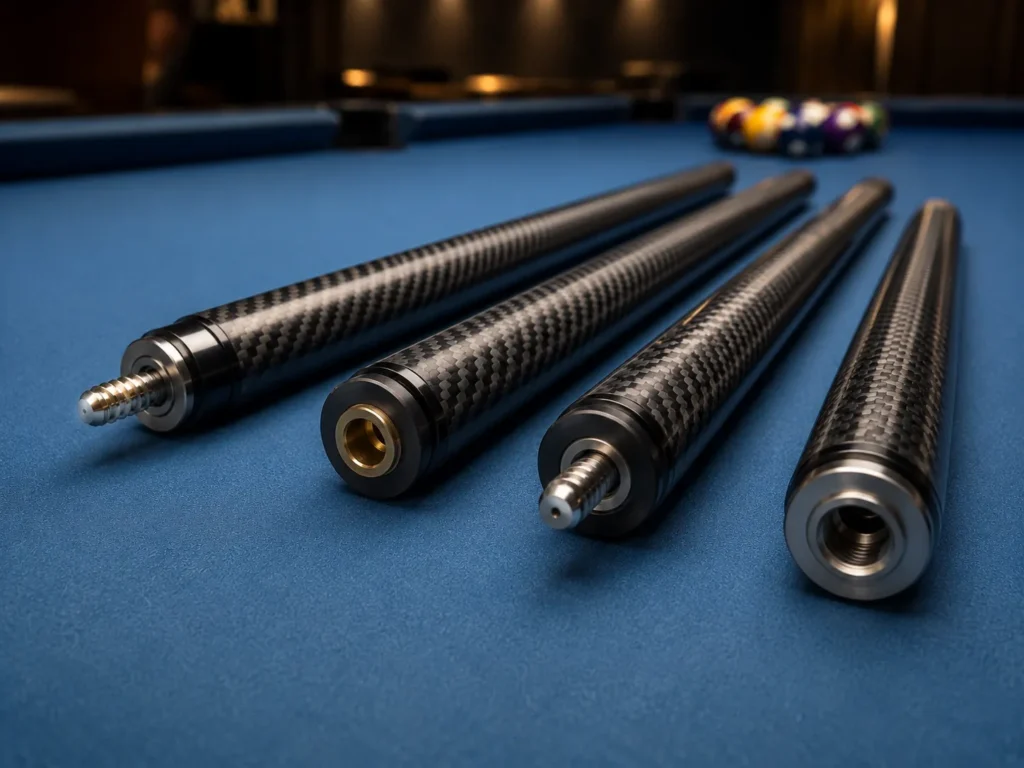
A carbon fiber cue shaft must match the cue butt, so joint compatibility is one of the most important buying points.
A shaft can have good performance, but if the joint does not fit the customer’s cue, the product is useless. This is especially important for replacement shafts.
Common pool cue joint types include:
- 5/16×18
- 5/16×14
- 3/8×10
- 3/8×11
- Radial
- Uni-Loc
- Custom joint systems
For individual players, the first step is to confirm the joint type of the existing cue butt. Do not guess only by looking at the pin. Some joints may look similar but have different threads or fit.
For B2B buyers, joint selection should be based on the market. If most of your customers use 5/16×18 or Uni-Loc, those should be your first options. If your customers are cue makers, custom joint inserts may also be needed.
Joint accuracy affects more than fit. It also affects the feel of the cue. A poor joint fit can create vibration, loose connection, bad sound, or an unstable hit.
Before bulk ordering carbon fiber cue shafts, buyers should confirm:
- The exact joint type
- Thread size and fit
- Insert material
- Shaft collar design
- Butt connection feel
- Sample fit with real cue butts
For OEM production, the joint system should be written clearly in the specification sheet. This helps avoid mistakes during production and reduces after-sales problems.
Tip and Ferrule Choices for Carbon Fiber Shafts
The tip and ferrule can change how a carbon fiber cue shaft feels, sounds, and controls the cue ball.
Many buyers focus on the carbon fiber tube, but the tip and ferrule are also important. They are the contact area between the shaft and the cue ball. Small changes here can make the shaft feel very different.
Cue tips are often grouped as soft, medium, and hard.
A soft tip can give more grip and feel. It may help players who like spin and control. But it may need more maintenance.
A medium tip is a balanced choice. Many players choose medium tips because they offer a mix of control, feel, and durability.
A hard tip can feel firmer and transfer power well. It may be suitable for break cues or players who like a crisp hit.
For playing shafts, many customers prefer soft or medium tips. For break shafts, harder tips are more common.
The ferrule is also important. On a carbon fiber cue shaft, the ferrule design must work with the shaft structure. It should be stable, clean, and well assembled. Poor ferrule work may affect sound, feel, or durability.
For cue brands, tip choice should match product positioning. A premium shaft should use a tip that supports its market image. A value-focused shaft may use a reliable but more cost-effective option.
For OEM buyers, it is best to confirm the tip brand, hardness, ferrule material, and assembly method before production. These details should not be left unclear.
Feel, Taper, and Bridge Hand Comfort
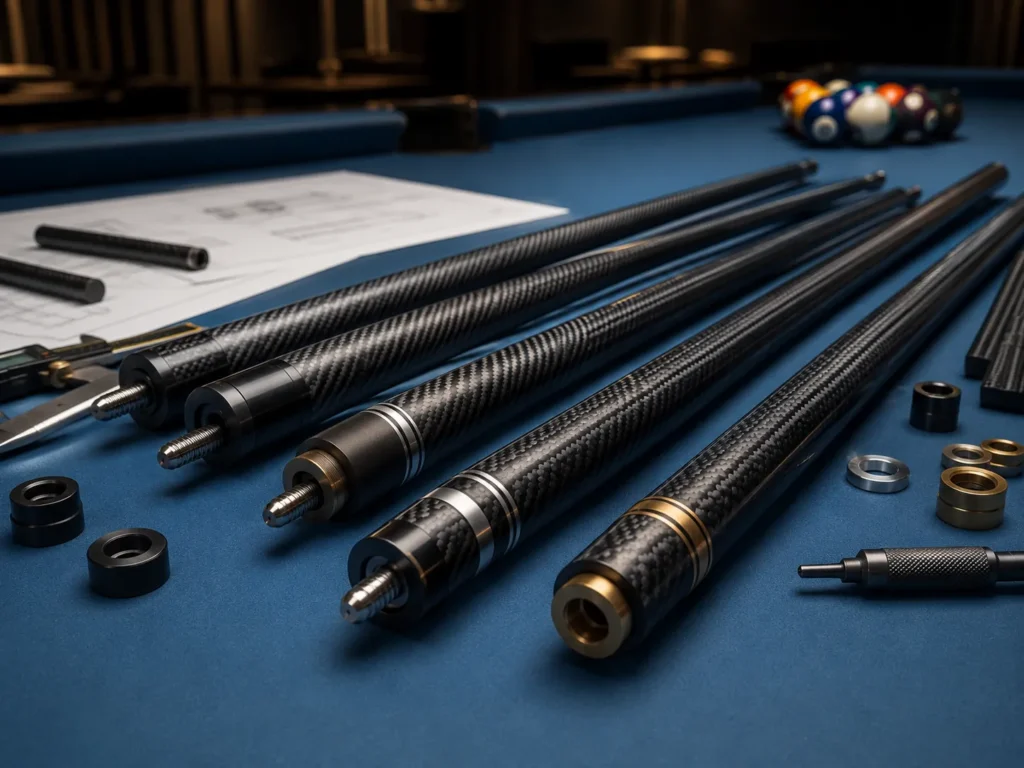
A carbon fiber cue shaft should feel smooth and comfortable during every stroke.
Feel is one of the hardest things to describe, but it is one of the most important things for players. Some players love carbon fiber because it feels smooth and stable. Others need time to adjust because it feels different from wood.
The surface finish affects bridge hand comfort. A good shaft should slide smoothly through the bridge hand. It should not feel sticky, rough, or uneven.
Common surface preferences include:
- Matte finish
- Satin finish
- Semi-gloss finish
- Very smooth low-friction finish
A very glossy finish may look attractive, but it may not always be the best for play. Some players prefer a smoother, less sticky feel. A matte or satin finish may be easier to accept for many users.
Taper is also important. The taper controls how the shaft changes diameter from the tip area to the joint area. A good taper should feel natural during stroke movement. If the taper feels too thick too soon, the shaft may feel uncomfortable. If it feels too thin, some players may feel less stable.
For replacement shafts, the goal is often to create a smooth upgrade experience. The player should feel the benefit of carbon fiber without feeling that the shaft is strange or hard to control.
For OEM buyers, taper and finish should be tested with real users. A shaft that looks good on paper may not feel right in play. Samples are important because cue products are very feel-based.
Low Deflection and End Mass: What Buyers Should Know
Low deflection is one of the main reasons players choose carbon fiber cue shafts.
When a player uses side spin, the cue ball can move away from the original aiming line. This is called deflection or squirt. Many carbon fiber cue shafts are designed to reduce this effect.
A low-deflection carbon fiber shaft can help players aim more consistently when using English. It does not mean the player will never miss. It means the shaft is designed to reduce unwanted cue ball movement.
End mass is one important factor. In simple words, end mass is the weight near the front part of the shaft. Lower front-end mass can help reduce deflection. But the design must still keep enough strength, stability, and good feel.
Buyers should understand that “low deflection” is not the only goal. If a shaft has low deflection but feels too hollow, too stiff, or too light, some players may not like it.
A good carbon fiber low-deflection shaft should balance:
- Cue ball control
- Hit feedback
- Front-end stability
- Smooth stroke feel
- Strength and durability
- Tip and ferrule performance
For marketing, it is better to use realistic language. Instead of saying “zero deflection,” say “designed for low deflection and stable cue ball control.” This is more believable and more professional.
For B2B buyers, low deflection can be a strong selling point. But the supplier should be able to explain how the shaft is designed, what diameter options are available, and how the product performs during sample testing.
Carbon Fiber Cue Shaft vs Wood Shaft
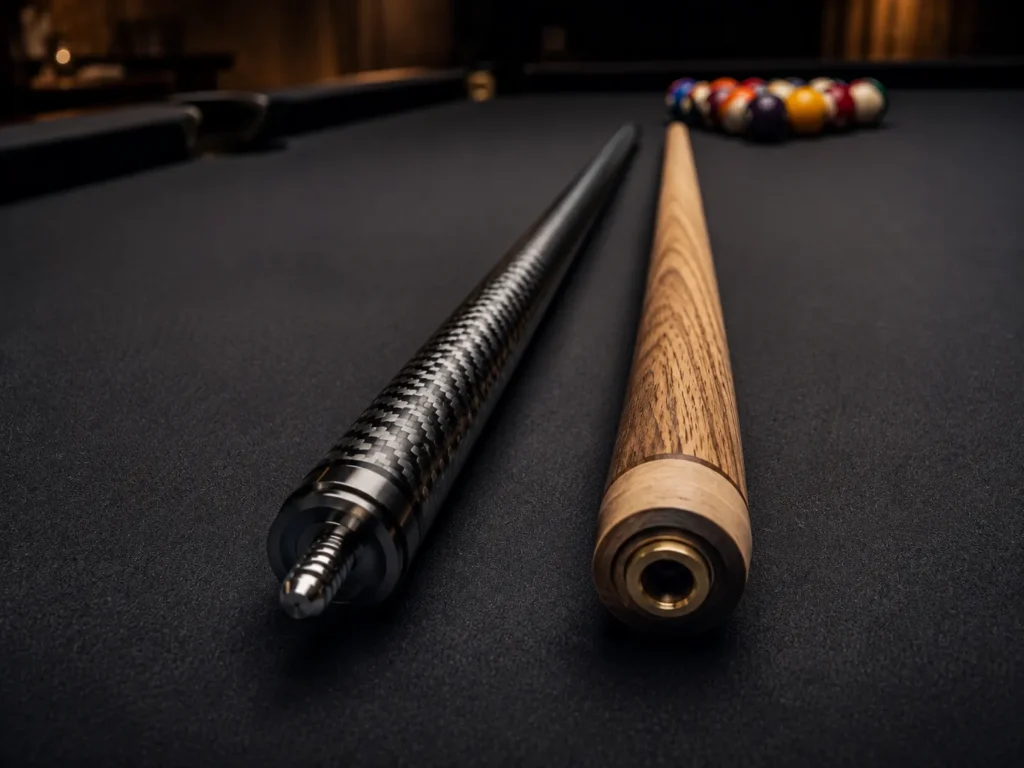
Carbon fiber cue shafts and wood shafts offer different playing experiences.
Wood shafts have been used for many years. Many players like the natural feedback, sound, and traditional feel of wood. Carbon fiber shafts are newer and offer better stability, easier maintenance, and stronger resistance to warping.
Here is a practical comparison:
| Factor | Carbon Fiber Cue Shaft | Wood Cue Shaft |
| Stability | Very stable in many conditions | Can change with humidity and temperature |
| Maintenance | Easy to clean | Needs more care |
| Feel | Smooth, firm, modern | Natural and warm |
| Deflection | Often designed for low deflection | Depends on shaft design |
| Appearance | Modern carbon pattern | Traditional wood grain |
| Durability | Strong and stable | Can dent or warp more easily |
| Player Type | Players wanting consistency | Players who prefer classic feedback |
Carbon fiber is not always better for every player. Some players prefer wood because it feels more natural. Other players prefer carbon fiber because it is easier to maintain and more stable over time.
For brands and distributors, the best strategy may be to offer carbon fiber shafts as an upgrade option, not as a replacement for all wood shafts. This gives customers more choice.
A carbon fiber cue shaft can also work with a traditional wood butt. This is one reason it is popular. Players can keep the look and balance of their favorite cue while upgrading the shaft performance.
Custom Carbon Fiber Cue Shafts for OEM Buyers
Custom carbon fiber cue shafts are a strong option for cue brands, distributors, and cue makers who need private-label products.
For B2B buyers, a standard shaft may not be enough. Different markets may need different diameters, joint types, finishes, logos, and packaging. A good manufacturer should help turn these needs into clear production specifications.
As a China-based custom carbon fiber cue shaft manufacturer, we help brands, distributors, and cue makers develop carbon fiber shafts based on their required diameter, joint type, tip, ferrule, finish, logo, and packaging needs.
Custom options may include:
- Shaft diameter
- Shaft length
- Joint insert type
- Tip hardness
- Ferrule design
- Surface finish
- Carbon fiber pattern
- Logo placement
- Private-label packaging
- Sample development
- Bulk production
For OEM buyers, the goal is not only to buy a shaft. The goal is to build a product line that customers can trust. This requires stable quality, clear specifications, and repeatable production.
A good supplier should be able to discuss technical details before production. They should not only ask for quantity and target price. They should also ask about joint type, diameter, finish, tip preference, market level, and packaging.
This is especially important for private-label products. If the first batch has unstable joint fit or poor finish, it can hurt the buyer’s brand. Sample testing and clear QC standards are necessary.
Carbon Fiber Cue Shaft Buying Checklist
A clear checklist helps buyers avoid mistakes before ordering samples or bulk production.
Before choosing a carbon fiber cue shaft, review the key points carefully.
- Decide the shaft diameter
Choose a diameter that fits the player group. Common sizes include 11.75 mm, 12.4 mm, 12.5 mm, and 12.75 mm.
- Confirm the joint type
Check whether the shaft needs 5/16×18, 5/16×14, 3/8×10, Radial, Uni-Loc, or another joint.
- Choose the tip
Decide whether the shaft should use a soft, medium, or hard tip. Match the tip to the player’s use.
- Check the ferrule
Confirm ferrule design, material, and assembly quality. This affects durability and feel.
- Test the surface finish
The shaft should feel smooth in the bridge hand. It should not feel sticky or rough.
- Review taper and feel
The taper should feel comfortable during the stroke. This is important for real player acceptance.
- Check straightness
Straightness is a basic quality requirement. It should be checked on samples and bulk goods.
- Ask about logo and packaging
For private-label orders, confirm logo method and packaging before production.
- Compare sample quality
Do not judge only by photos. Test real samples before placing a large order.
- Confirm lead time and MOQ
Make sure the supplier can meet your order plan and delivery schedule.
This checklist is useful for both players and B2B buyers. It helps buyers compare products by real specifications, not only by appearance or price.
Common Mistakes When Choosing Carbon Fiber Cue Shafts
Many problems happen because buyers skip the small details that affect real use.
One common mistake is choosing only by price. A low-cost carbon fiber cue shaft may look attractive, but poor joint fit, rough finish, or inconsistent straightness can create bigger problems later.
Another mistake is ignoring joint compatibility. A shaft with the wrong joint cannot be used. For replacement shafts, this is one of the most important details.
Some buyers also assume all carbon fiber shafts feel the same. This is not true. Diameter, taper, surface finish, tip, ferrule, and internal design all affect the final feel.
Another mistake is choosing too many SKUs at the beginning. For distributors, too many sizes and joint types can create inventory pressure. It may be better to start with the most common sizes and expand later.
For OEM buyers, a serious mistake is placing a bulk order without sample testing. Cue shafts are feel-based products. A product can look good in pictures but still feel wrong during play.
FAQ About Carbon Fiber Cue Shafts
Are carbon fiber cue shafts worth it?
Yes, they are worth it for many players who want stable performance, smooth feel, and easier maintenance. But players who love traditional wood feedback may still prefer a wood shaft.
What is the best carbon fiber cue shaft diameter?
There is no single best diameter. Common choices include 11.75 mm, 12.4 mm, 12.5 mm, and 12.75 mm. The right choice depends on the player’s bridge feel and control preference.
Can I put a carbon fiber shaft on any pool cue?
You can use a carbon fiber shaft on an existing pool cue if the joint type matches. Always confirm the joint before buying.
Is carbon fiber better than wood for cue shafts?
Carbon fiber is more stable and easier to maintain. Wood gives a more traditional feel. The better choice depends on the player’s preference.
Do carbon fiber cue shafts have low deflection?
Many carbon fiber cue shafts are designed for low deflection. However, performance depends on the shaft structure, diameter, tip, ferrule, and front-end design.
How do you clean a carbon fiber cue shaft?
Use a soft cloth and a suitable cleaner. Avoid harsh chemicals or rough abrasives because they may damage the surface finish.
Can carbon fiber cue shafts be customized?
Yes. Custom carbon fiber cue shafts can be made with different diameters, joint types, tips, ferrules, surface finishes, logos, and packaging.
Final Thoughts
The best carbon fiber cue shaft should fit the player, the cue butt, and the market need.
For players, the most important points are diameter, joint type, tip, feel, and low-deflection performance. For brands and distributors, the most important points are customization, quality control, repeatable production, and supplier reliability.
Do not choose a shaft only because it is carbon fiber. Compare the full specification. Check the diameter, joint, tip, ferrule, taper, finish, and sample quality.
A good carbon fiber pool cue shaft should feel smooth, fit correctly, and perform consistently. For OEM buyers, it should also be easy to reproduce in bulk and suitable for private-label branding.
If you are looking for custom carbon fiber cue shafts for your brand, we can help develop OEM options based on your required diameter, joint type, tip, finish, logo, and packaging needs.
If you want to see more carbon fiber cue shaft pls click:
Carbon Fiber Cue Shaft
