

Custom carbon fiber does not have one fixed price.
A standard carbon fiber tube, a CNC-cut carbon fiber sheet, a solid carbon fiber rod, and a molded carbon fiber part are priced in different ways. The cost depends on the material grade, size, wall thickness, tooling, machining, surface finish, tolerance, order quantity, and shipping method.
For B2B buyers, the most useful question is not only “How much does carbon fiber cost?”
The better question is:
What information does the factory need to give an accurate price?
This guide explains how custom carbon fiber products are priced and how you can reduce cost without choosing the wrong design.
How Much Does Carbon Fiber Cost?
Carbon fiber cost depends on the product type and the production requirements.
A simple standard carbon fiber tube is usually easier to quote than a custom molded part. A plain sheet is easier to price than a CNC-cut plate with holes, slots, countersinks, and tight tolerance.
For most custom carbon fiber products, the factory does not calculate the price only by weight. The final cost usually includes material, production setup, tooling, layup labor, machining, finishing, inspection, packing, and shipping.
Here is a simple way to understand the cost level:
| Type de produit | Typical Cost Level | Why the Price Changes | Common B2B Applications |
|---|---|---|---|
| Standard carbon fiber tube | Plus bas | Existing mandrels and simple process | Poles, handles, frames, supports |
| Custom carbon fiber tube | Medium | Custom size, wall thickness, finish, or tolerance | OEM tools, telescopic poles, equipment parts |
| Carbon fiber sheet or plate | Medium | Thickness, size, layup, and surface finish | Drone frames, panels, brackets, covers |
| CNC-cut carbon fiber plate | Medium to high | Cutting time, holes, slots, and tolerance | UAV frames, machine plates, fixtures |
| Carbon fiber rod | Lower to medium | Diameter, length, straightness, and finish | Supports, frames, sports parts, tools |
| Telescopic carbon fiber pole | Medium to high | Multiple tube sections and fit control | Cleaning poles, rescue poles, camera poles |
| Molded carbon fiber part | Haut | Mold, layup, trimming, surface, and assembly | Covers, shells, housings, custom parts |
| Carbon fiber assembly | Haut | Inserts, bonding, hardware, and QC | Mounts, brackets, tool systems |
If you need a fast quotation, the most important details are product type, dimensions, quantity, finish, tolerance, and application.
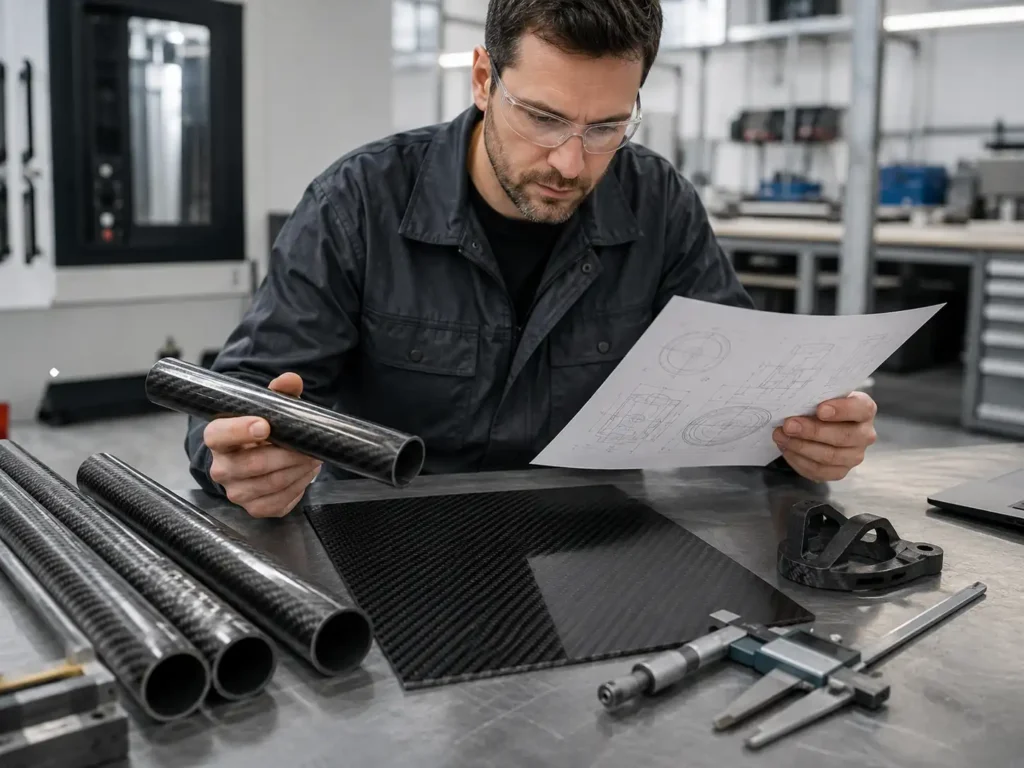
Why Is Carbon Fiber So Expensive?
Fibre de carbone is usually more expensive than aluminum, steel, fiberglass, or plastic because the material and process are more complex.
Steel and aluminum can be cut, bent, welded, extruded, or machined with mature high-speed processes. Carbon fiber usually needs fiber preparation, resin control, layup, curing, trimming, sanding, and inspection.
The cost comes from several areas.
Raw carbon fiber material
Carbon fiber starts from a precursor material. The precursor must be converted into carbon fiber through controlled heating and processing. This process needs special equipment, energy, time, and quality control.
Higher-grade carbon fiber normally costs more. But higher grade is not always necessary. For many commercial, outdoor, sports, and industrial parts, the right layup design is often more important than simply choosing the most expensive fiber.
Resin and layup design
Carbon fiber is not used alone. It is combined with resin to make a composite structure.
The layup design controls strength, stiffness, bending performance, impact resistance, and appearance. A simple layup is easier to produce. A complex layup with different fiber directions takes more time and costs more.
Labor and production time
Many custom carbon fiber products still need skilled labor.
This is especially true for:
- Small batch orders
- Visible 3K surface parts
- Custom tube layups
- Molded parts
- Parts with inserts
- Parts with drilling or trimming
- Cosmetic-grade products
Even if the part is small, the labor cost can be high if the process is complex.
Tooling and setup
Custom carbon fiber parts may need mandrels, molds, fixtures, or CNC programs.
A standard tube may use an existing mandrel. A custom tube size may need a new mandrel. A molded part usually needs a mold. A CNC-cut plate needs a cutting file and machine setup.
For small orders, setup cost is spread across fewer pieces, so the unit price is higher.
Machining and finishing
Carbon fiber is strong and abrasive. Cutting and drilling require proper tools, dust control, and careful inspection.
If the part needs holes, slots, countersinks, bonding, inserts, sanding, clear coating, or painting, the price will increase.
How Factories Calculate Custom Carbon Fiber Cost
A factory normally looks at the whole project, not just the carbon fiber weight.
The quotation may include material cost, tooling cost, setup cost, labor cost, machining cost, finishing cost, inspection cost, packing cost, and shipping cost.
A simple formula is:
Final cost = material + tooling + production setup + layup labor + machining + finishing + QC + packing + shipping
For repeated orders, tooling and setup costs can be spread across more pieces. This is why the unit price usually drops when order quantity increases.
| Cost Item | What It Means | When It Becomes Expensive |
| Matériau | Carbon fiber fabric, UD fiber, resin | Higher grade fiber, thicker wall, more layers |
| Tooling | Mandrel, mold, fixture, cutting setup | Custom diameter, special shape, molded part |
| Labor | Layup, wrapping, sanding, trimming | Small batch, visible surface, complex shape |
| Usinage | Cutting, drilling, CNC, countersink | Many holes, tight tolerance, complex DXF |
| Finition de la surface | Matte, glossy, 3K, painting, logo | Cosmetic surface, clear coat, custom color |
| Assembly | Inserts, threads, end caps, locks | Bonding, alignment, hardware fitting |
| L'inspection | Dimension, surface, fit, straightness | Tight tolerance, assembly parts, premium finish |
| Packing | Cartons, foam, tubes, wooden box | Long tubes, fragile parts, individual packing |
| Shipping | Air, sea, express, oversize freight | Long poles, large sheets, urgent delivery |
This is why a small molded cover can cost more than a larger standard tube. The price is not only about weight. It is about manufacturing difficulty.
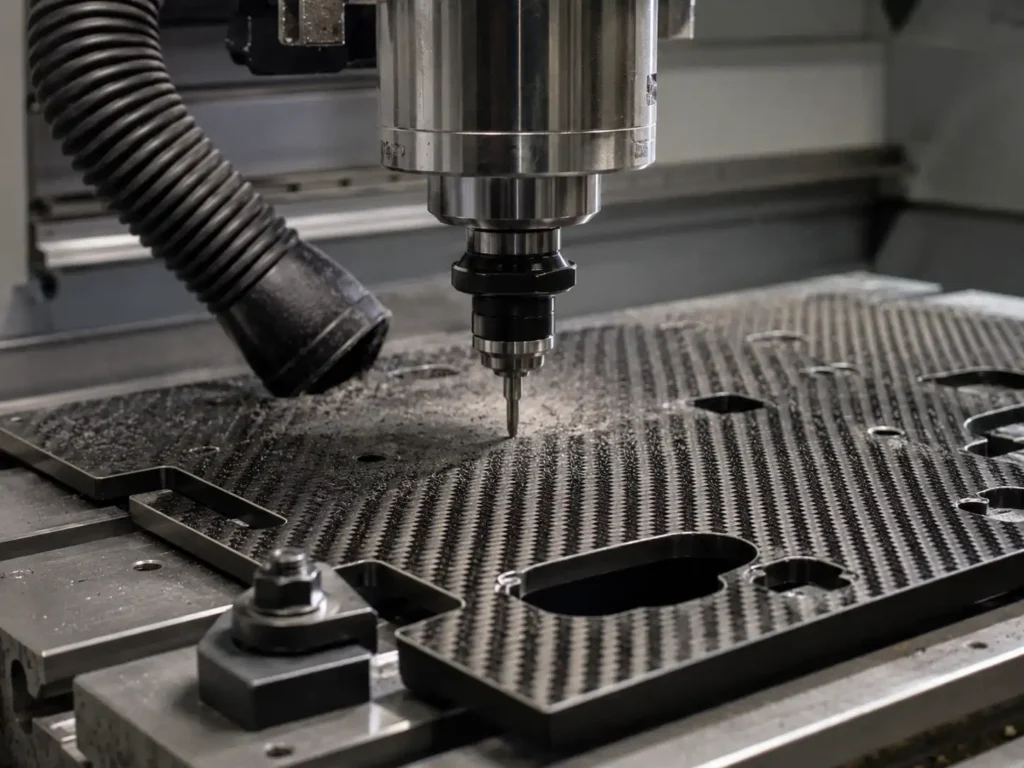
What Affects the Cost of Custom Carbon Fiber Products?
The main cost drivers are material grade, product type, size, wall thickness, tolerance, finish, machining, tooling, and quantity.
If you understand these factors, you can control the cost better.
Carbon fiber grade
Common carbon fiber grades include T300, T700, T800, and higher-performance fibers.
For many B2B projects, T300 or T700 can be enough. Higher grades may be useful for special applications, but they are not always needed.
The right choice depends on the application.
| Application | Main Requirement | Practical Material Direction |
| Cleaning pole | Light weight and stiffness | Standard carbon fiber tube or mixed layup |
| Drone frame | Low weight and stiffness | Carbon fiber sheet or CNC plate |
| Pool cue shaft | Feel, straightness, consistency | Custom tube layup and surface control |
| Industrial bracket | Stiffness and mounting accuracy | CNC carbon fiber plate or molded part |
| Camera pole | Light weight and section fit | Custom tube with proper tolerance |
| Rescue pole | Stiffness, reach, durability | Multi-section carbon fiber tube |
| Automotive trim | Appearance and fit | Visible woven carbon fiber surface |
Do not choose the highest grade only because it sounds better. Choose the grade based on load, stiffness, weight, and working environment.
Product type
Product type has a major effect on price.
Round tubes are usually more cost-effective than square or tapered tubes. Flat sheets are usually easier than curved molded parts. A CNC-cut plate costs more than a plain sheet because it needs machining time.
If your design can use a standard tube, sheet, or rod, the cost is usually easier to control.
Size and wall thickness
Larger parts usually use more material. Thicker walls and thicker sheets also increase cost.
For carbon fiber tubes, price is affected by:
- Diamètre extérieur
- Diamètre intérieur
- Épaisseur de la paroi
- Longueur
- Rectitude
- Fit tolerance
For carbon fiber sheets, price is affected by:
- Longueur
- Largeur
- Épaisseur
- Layup
- Flatness
- Finition de la surface
- Cutting shape
However, thicker is not always better. A thicker part may be heavier and more expensive than necessary. A good design should balance strength, stiffness, weight, and cost.
Tolerance
Tolerance can change the price a lot.
A general tolerance is easier to produce. A tight tolerance needs more control, more inspection, and sometimes more machining.
Tight tolerance may be needed for:
- Telescopic tube sections
- Metal inserts
- Mounting holes
- Sliding fits
- Assembly parts
- Châssis de drones
- Bras robotiques
- Machine fixtures
If a dimension is not critical, do not make the tolerance too tight. This can reduce cost and improve production stability.
Finition de la surface
Surface finish affects both price and lead time.
Common finishes include:
- Finition mate
- Glossy finish
- 3K woven finish
- UD carbon finish
- Sanded finish
- Painted surface
- Clear coat
- Logo printing
- Custom color coating
- UV-resistant coating
A simple matte finish is usually more cost-effective. A glossy 3K cosmetic finish usually costs more because it needs more surface work and stricter inspection.
If the part is hidden inside equipment, an industrial finish may be enough. If the part is visible to the end user, a better surface may be worth the extra cost.
Holes, inserts, CNC cutting, and assembly
Post-processing adds cost.
A plain carbon fiber tube is one product. A carbon fiber tube with drilled holes, glued rings, bonded inserts, and logo printing is a different product.
Common post-processing includes:
- Drilling holes
- CNC cutting
- Slot cutting
- Countersinking
- Edge polishing
- Sanding
- Bonding aluminum inserts
- Adding threaded connectors
- Adding end caps
- Installing locks
- Gluing parts
- Logo printing
- Individual packing
Each step needs labor, fixtures, tools, and inspection.
If you need holes or inserts, send a drawing. The drawing should show hole diameter, hole center position, distance from edge, insert material, and tolerance.
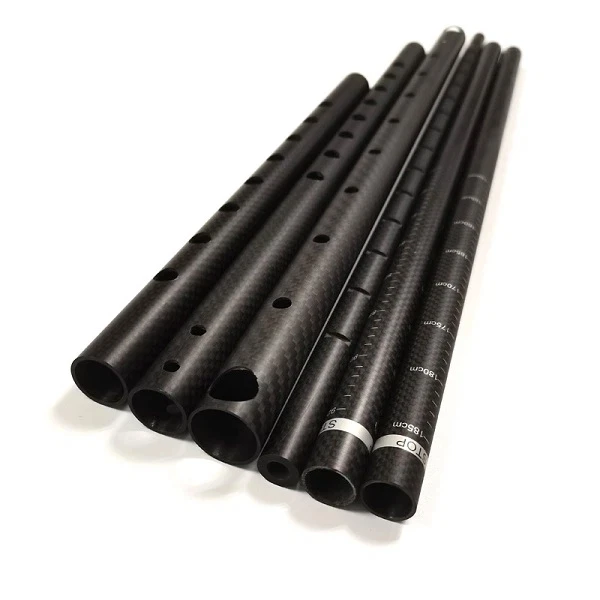
How Much Does a Carbon Fiber Tube Cost?
Carbon fiber tube cost depends on diameter, wall thickness, length, layup, finish, tolerance, drilling, and quantity.
Round carbon fiber tubes are usually the most cost-effective. They are easier to produce, easier to inspect, and easier to pack.
Square, rectangular, oval, and tapered tubes usually cost more because the shape is harder to make.
Standard tube vs custom tube
A standard carbon fiber tube uses existing tooling and a known process. This helps reduce cost and lead time.
A custom tube may need:
- Custom mandrel
- Special wall thickness
- Special fiber layup
- Tight OD or ID tolerance
- Custom surface finish
- Drilling or cutting
- Logo printing
- Special packing
If a standard size can meet your requirement, it is usually the best choice for cost control.
Round tube vs square or tapered tube
Round tubes are usually easier and cheaper.
Square, rectangular, oval, or tapered carbon fiber tubes may be needed for special structures or product designs. But they are harder to lay up and demold, so the cost is higher.
If the shape is not critical, choose round tube.
Long carbon fiber tubes and shipping cost
Long carbon fiber tubes can be expensive to ship.
A 3-meter tube is light, but it may be charged as oversize freight. The shipping cost can sometimes be higher than expected.
For long products, it may be better to design the tube in sections.
This is common for:
- Perches à alimentation en eau
- Rescue poles
- Fruit picker poles
- Perches pour caméra
- Perches d'inspection
- Cleaning tools
Before confirming a long tube design, check both production cost and shipping cost.
How Much Does a Carbon Fiber Sheet Cost?
Carbon fiber sheet cost depends on thickness, size, layup, surface finish, flatness, CNC cutting, and quantity.
A plain rectangular sheet is easier to quote. A custom CNC-cut plate with many holes and tight tolerance costs more.
Épaisseur
Thicker sheets use more carbon fiber and resin. They also take more time to produce.
But thicker does not always mean better.
For example, a 5 mm plate may not be needed if a 3 mm plate can meet the load requirement. Choosing the right thickness helps control both cost and weight.
Sheet size
Large sheets use more material and can be harder to pack. Small custom parts may also create material waste if the shape is complex.
If you need many small parts, send a DXF file. The factory can arrange nesting to reduce waste.
CNC cutting
CNC cutting is often needed for drone frames, machine plates, brackets, fixtures, and custom panels.
The machining cost depends on:
- Total cutting length
- Number of holes
- Diamètre du trou
- Slot shape
- Countersinks
- Internal corners
- Tolerance
- Edge finish
- Tool wear
Carbon fiber is abrasive. Cutting tools wear faster than when machining many plastics or soft metals.
To reduce cost, avoid unnecessary complex shapes, too many small holes, and sharp internal corners.
Finition de la surface
Carbon fiber sheets can have different surfaces.
Common options include:
- Matte 3K
- Glossy 3K
- Matte UD
- Glossy UD
- Industrial surface
- Sanded surface
- Custom coating
A visible glossy 3K sheet usually costs more than an industrial sheet because the appearance standard is higher.
If the plate is used inside a machine, under a cover, or as a fixture, an industrial finish may be enough.
How Much Does a Carbon Fiber Rod Cost?
Carbon fiber rod cost depends on diameter, length, straightness, surface finish, tolerance, and quantity.
A solid carbon fiber rod is usually easier to quote than a custom tube or molded part. But the cost can still increase if the buyer needs a special diameter, tight straightness, polished surface, or custom cutting.
Solid rod vs hollow tube
A solid rod is simple and strong, but it is usually heavier than a hollow tube.
A hollow carbon fiber tube can provide better stiffness-to-weight performance in many structural applications.
Use a solid rod when you need a small support, pin-like part, frame element, or simple reinforcement. Use a tube when you need lower weight and better bending stiffness.
Cut-to-length rods
Cutting rods to special lengths adds labor and inspection.
If many rods need the same length, batch cutting is more efficient. For a fast quote, send diameter, length, quantity, tolerance, surface finish, and application.
Why Do Custom Carbon Fiber Parts Cost More?
Custom carbon fiber parts cost more because they often need design review, tooling, layup planning, sample production, trimming, machining, finishing, and inspection.
A custom part is not just material. It is a manufacturing project.
Mold cost
Molded carbon fiber parts usually need a mold.
Mold cost depends on:
- Part size
- Shape complexity
- Surface requirement
- Production quantity
- Tolerance
- One-side or two-side finish
- Prototype or production tool
A simple prototype mold may be enough for early testing. A production mold for a high-quality visible surface costs more.
If your project is still in the design stage, it may be better to start with a lower-cost sample mold or simplified structure.
Trimming and finishing
After molding, the part may need trimming, sanding, drilling, painting, clear coating, or polishing.
These steps increase cost because they require skilled labor and quality inspection.
Assembly work
Some custom carbon fiber parts include other materials.
Par exemple :
- Aluminum inserts
- Stainless screws
- Plastic parts
- Rubber parts
- End caps
- Threaded connectors
- Locks
- Bonded brackets
Assembly adds cost because the supplier must control fit, bonding strength, alignment, and final inspection.
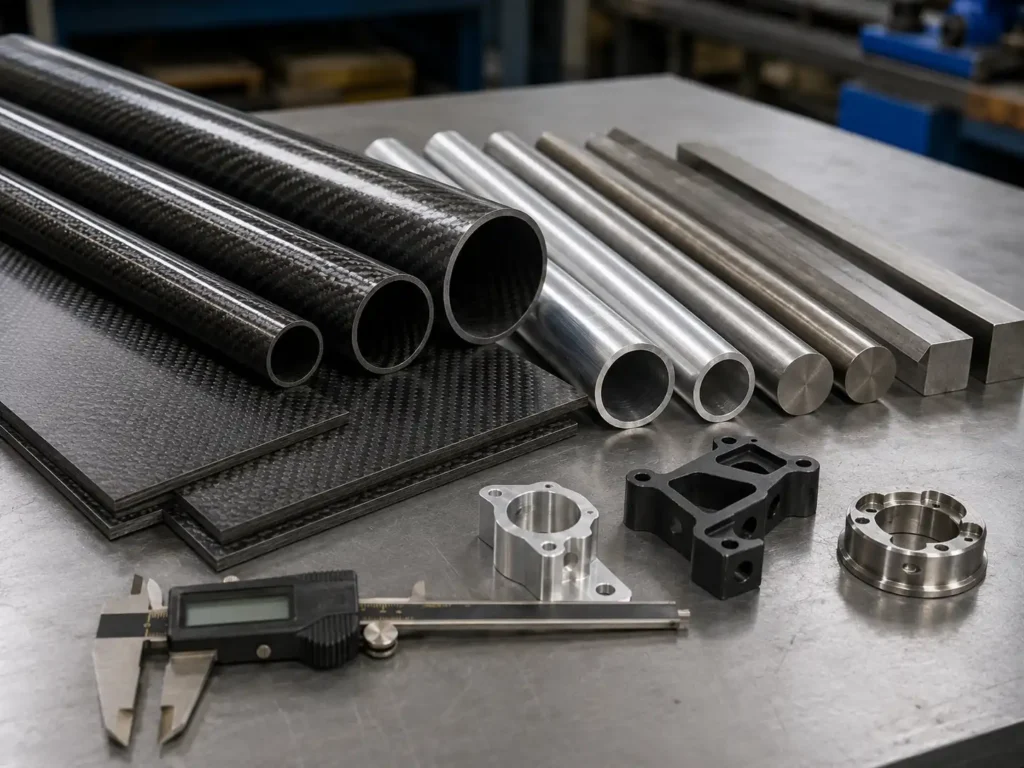
Is Carbon Fiber More Expensive Than Aluminum, Steel, or Fiberglass?
Yes. Carbon fiber is usually more expensive than aluminum, steel, and fiberglass.
But the better question is whether carbon fiber gives enough value for the application.
| Matériau | Cost Level | Poids | Rigidité | Résistance à la corrosion | Utilisation optimale |
| Steel | Faible | Heavy | Haut | Needs protection | Strong low-cost structures |
| Aluminium | Medium | Medium | Medium | Bon | Frames, brackets, machined parts |
| Fibre de verre | Low to medium | Medium | Lower than carbon fiber | Bon | Cost-sensitive composite parts |
| Fibre de carbone | Haut | Very light | Haut | Excellent | Lightweight and stiff parts |
Carbon fiber is not always the cheapest choice. It is useful when weight, stiffness, corrosion resistance, or premium appearance matters.
Carbon fiber vs aluminum
Aluminum is cheaper and easier to machine. It is a good material for many brackets, frames, housings, and mechanical parts.
Carbon fiber is better when weight reduction and stiffness-to-weight ratio are important.
For example, a carbon fiber pole may cost more than an aluminum pole, but it can be lighter and easier to use for long working hours.
Carbon fiber vs steel
Steel is strong and cost-effective, but it is heavy.
Carbon fiber is useful when the part must be light, stiff, and corrosion resistant.
This is important for moving parts, handheld tools, long poles, drone parts, and sports equipment.
Carbon fiber vs fiberglass
Fiberglass is usually cheaper than carbon fiber. It also has good corrosion resistance and electrical insulation.
Carbon fiber is better when the product needs lower weight, higher stiffness, or a premium look.
If cost is the main concern and stiffness is not critical, fiberglass may be a better option.
Is Carbon Fiber Worth the Cost?
Carbon fiber is worth the cost when it solves a real product problem.
It may not be worth it if the only goal is a cheap part. But it can be a strong choice when the product needs better performance, lower weight, or higher value.
Carbon fiber may be worth the cost when you need:
- Poids réduit
- Higher stiffness
- Better strength-to-weight ratio
- Résistance à la corrosion
- Better fatigue performance
- Une allure haut de gamme
- Easier handling
- Lower moving mass
- Long-term outdoor use
- Better user experience
For B2B products, carbon fiber is often worth the cost in:
- Perches télescopiques
- Châssis de drones
- Bras robotiques
- Camera equipment
- Sports equipment
- Rescue tools
- Perches de nettoyage
- Industrial fixtures
- Lightweight machine parts
- Premium covers
The key is to design the part correctly.
If the part is overbuilt, the cost will be too high. If the part is too weak, it may fail. A good supplier should help you balance weight, strength, stiffness, appearance, and cost.
How to Reduce Custom Carbon Fiber Cost
The best way to reduce cost is not always to use cheaper material. The better way is to make the design easier to manufacture.
Use standard sizes when possible
Standard tube diameters, wall thicknesses, sheet thicknesses, and rod diameters are usually more cost-effective.
If a standard size can meet your requirement, use it.
Avoid unnecessary cosmetic finish
If the part is hidden, do not require a perfect glossy 3K surface.
A matte finish or industrial finish may be enough.
Simplify the shape
Simple shapes are easier to produce.
Avoid unnecessary curves, small details, sharp internal corners, and complex undercuts.
Reduce unnecessary holes
Every hole adds machining time.
If holes are needed, make the position clear. Avoid very small holes close to the edge unless they are necessary.
Use reasonable tolerance
Tight tolerance increases cost.
Only apply tight tolerance to critical dimensions, such as sliding fits, insert areas, mounting holes, and assembly points.
Separate prototype and production requirements
A prototype should first confirm size, fit, function, and basic performance.
It does not always need final cosmetic quality. After the design is approved, the production version can be optimized.
Increase order quantity after approval
Small orders have higher unit prices because setup time is spread across fewer pieces.
Once the sample is approved, a larger batch can reduce the unit price.
Small Batch vs Mass Production Cost
Quantity has a big effect on carbon fiber pricing.
A sample order is usually more expensive per piece than a production order. This is normal because the supplier still needs to review drawings, prepare material, set up production, make parts, inspect them, and pack them.
Sample order
A sample order is used to confirm:
- Size
- Fit
- Surface
- Force
- Assembly
- User experience
- Design direction
Samples are important, but the unit price is usually high.
Small batch order
A small batch is useful for market testing, product development, or pre-production.
The cost is usually lower than a sample order but higher than mass production.
Mass production order
Mass production is more cost-effective because material planning, labor planning, tooling use, and inspection become more stable.
For a better quote, send both trial quantity and future quantity.
| Stage | Quantity Example | Purpose |
| Sample | 1–5 pcs | Test size and function |
| Small batch | 20–100 pcs | Pre-production or market test |
| Production | 300–1,000+ pcs | Stable supply |
| Annual demand | 1,000–10,000+ pcs | Long-term price planning |
If you only ask for one sample, the unit price may look high. But if you also share your expected production quantity, the supplier can give a better pricing plan.
Before Asking for a Price, Prepare These Details
A clear RFQ helps the supplier quote faster and more accurately.
If the information is incomplete, the supplier must guess. This often leads to rough pricing or later price changes.
Here is what you should prepare before asking for a custom carbon fiber quote:
| If You Need | Please Send | Pourquoi est-ce important ? |
| Carbon fiber tube | OD, ID, wall thickness, length, quantity, finish | Determines material, tooling, and process |
| Carbon fiber sheet | Length, width, thickness, surface, quantity | Determines material and production cost |
| CNC carbon fiber plate | DXF file, hole size, tolerance, quantity | Determines machining time |
| Carbon fiber rod | Diameter, length, tolerance, quantity | Determines material and cutting work |
| Telescopic pole | Each section size, total length, lock type, use case | Determines tube fit and assembly |
| Molded carbon fiber part | 3D file, surface side, quantity, sample photo | Determines mold and layup cost |
| Carbon fiber assembly | Drawing, inserts, threads, hardware, bonding area | Determines assembly and QC cost |
Best files to send
The best files are:
- 2D drawing
- 3D CAD file
- DXF file
- STEP file
- Product photo
- Sample photo
- Hand sketch with dimensions
Even a simple sketch is better than only writing a general description.
Details for carbon fiber tubes
For tubes, send:
- Diamètre extérieur
- Inner diameter or wall thickness
- Longueur
- Quantité
- Finition de la surface
- Hole position if needed
- Tolerance
- Application
- Load requirement if known
Details for carbon fiber sheets
For sheets or plates, send:
- Longueur
- Largeur
- Épaisseur
- Quantité
- Finition de la surface
- CNC drawing if needed
- Hole position
- Tolerance
- Application
Details for molded parts
For molded parts, send:
- 3D file
- Product size
- Surface requirement
- Visible side
- Quantité
- Assembly method
- Metal or plastic inserts if needed
- Target weight if important
The more complete your RFQ is, the faster the supplier can give a serious quotation.
Common Mistakes When Asking for Carbon Fiber Prices
Many buyers make the same mistakes when asking for custom carbon fiber prices.
Avoiding these mistakes can save time and cost.
Asking only “How much per piece?”
The supplier cannot quote accurately without size, quantity, finish, tolerance, and application.
A better question is:
Can you quote this carbon fiber part based on the attached drawing, quantity, finish, and application?
Comparing prices without checking what is included
One supplier may include tooling, drilling, packing, and inspection. Another supplier may only quote the basic part.
Always check what is included in the price.
Choosing the highest carbon fiber grade without reason
Higher grade material costs more.
If the application does not need it, the extra cost may be wasted.
A hidden part does not need cosmetic-grade finish.
Use an industrial finish when appearance is not important.
Ignoring shipping size
Long tubes and large sheets may have high shipping costs.
For long products, discuss packing and shipping early.
Sending unclear drawings
Unclear drawings create misunderstandings.
Make sure the drawing includes dimensions, tolerance, holes, finish, and quantity.
How LH Carbon Solutions Helps With Custom Carbon Fiber Projects
LH Carbon Solutions manufactures custom carbon fiber tubes, sheets, rods, plates, telescopic poles, and composite parts for B2B customers.
We can help with:
- Tubes en fibre de carbone sur mesure
- Carbon fiber sheets and plates
- Carbon fiber rods
- Telescopic carbon fiber poles
- CNC-cut carbon fiber plates
- Custom wall thickness
- Matte, glossy, UD, and 3K finishes
- Drilling and machining
- Logo printing
- Carbon fiber parts based on drawings or samples
- Small batch and production orders
We work with customers in outdoor tools, sports equipment, drones, industrial products, rescue tools, cleaning poles, camera equipment, and other custom applications.
If you are not sure which material or structure is suitable, send us your drawing or product idea. We can review it from a manufacturing point of view and suggest a practical solution.
For a faster quote, please send your drawing, dimensions, quantity, application, surface finish, and tolerance requirements.
FAQ About Carbon Fiber Cost
How much does carbon fiber cost per pound?
Carbon fiber cost per pound depends on fiber grade, tow size, supplier, market condition, and purchase quantity. For custom parts, the final price is not based only on raw fiber weight. Tooling, layup, curing, machining, finishing, inspection, packing, and shipping also affect the cost.
How much does carbon fiber cost per square foot?
Carbon fiber sheet cost per square foot depends on thickness, layup, surface finish, size, and quantity. A thin industrial sheet is not priced the same as a thick glossy 3K plate or a CNC-cut custom panel.
How much does a carbon fiber tube cost?
A carbon fiber tube cost depends on diameter, wall thickness, length, layup, finish, tolerance, holes, and quantity. Standard round tubes are usually more cost-effective than custom square, oval, or tapered tubes.
Why does custom carbon fiber cost more than standard parts?
Custom carbon fiber costs more because it may need design review, special tooling, material planning, sample setup, machining, finishing, and inspection. Standard parts are cheaper because the process is already fixed.
Is carbon fiber more expensive than aluminum?
Yes, carbon fiber is usually more expensive than aluminum. But it is much lighter and can offer better stiffness-to-weight performance. It is often chosen when weight reduction, stiffness, or premium appearance is important.
Is carbon fiber more expensive than fiberglass?
Yes, carbon fiber is usually more expensive than fiberglass. Fiberglass is a better low-cost option for some applications. Carbon fiber is better when stiffness, low weight, and appearance matter more.
Does order quantity affect carbon fiber price?
Yes. Small orders usually have higher unit prices because setup and production preparation are spread across fewer pieces. Larger orders usually reduce the unit cost.
Can I reduce the cost by changing the design?
Yes. You can reduce cost by using standard sizes, simplifying the shape, avoiding unnecessary cosmetic finish, reducing machining work, and using reasonable tolerances.
Do I need a mold for custom carbon fiber parts?
It depends on the part. Simple tubes, rods, and flat sheets may not need a new mold. Curved, molded, or special-shaped parts usually need tooling.
What should I send to get a fast carbon fiber quote?
Send drawings, dimensions, quantity, application, finish, tolerance, and machining details. CAD files, DXF files, photos, or samples are also helpful.
Conclusion
Custom carbon fiber cost depends on much more than material weight.
The final price is affected by product type, size, material grade, layup, tooling, machining, finish, tolerance, quantity, packing, and shipping.
For B2B buyers, the fastest way to get an accurate quote is to send clear drawings, application details, and expected quantity. This allows the supplier to recommend the right structure instead of overbuilding the product or quoting blindly.
If you need custom carbon fiber tubes, sheets, rods, plates, telescopic poles, or molded parts, LH Carbon Solutions can help review your requirements and provide a practical quotation based on your design and application.
Cela pourrait également vous intéresser

Tubes composites
L'accent est mis sur une rigidité élevée et un faible poids pour les structures axées sur la performance.
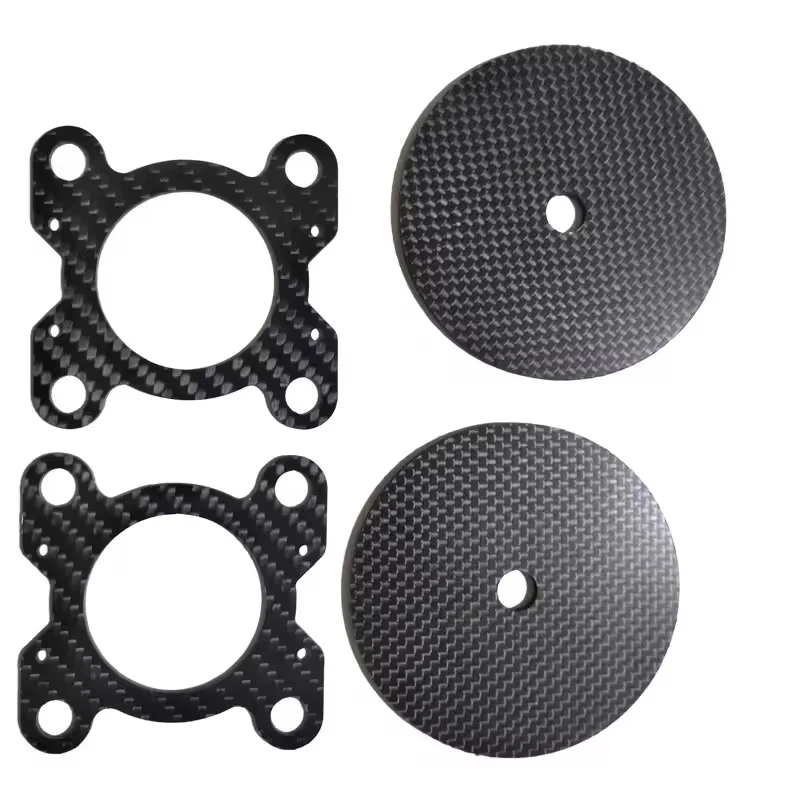
Feuilles et plaques en fibre de carbone
Plaques stratifiées plates destinées à la découpe CNC et à la fabrication d'éléments structurels légers.
Tiges en composite
Produits composites en forme de tige destinés aux assemblages industriels et aux équipementiers.
