
Soccer is receiving worldwide attention again in 2026. With the FIFA World Cup creating stronger interest in training, coaching, youth development, and sports equipment, many brands and product developers are looking for ways to improve soccer-related products.
Behind every match, there is a complete training system.
Players need agility drills, speed training, passing practice, goalkeeper reaction work, shooting targets, tactical analysis, and repeated field sessions. Coaches need equipment that is easy to move, fast to set up, strong enough for daily use, and suitable for outdoor conditions.
This creates a clear question for sports equipment brands and clubs:
Can better materials help make soccer training equipment lighter, stronger, and more professional?
For some products, the answer is yes. Carbon fiber can be a useful material for upgraded soccer training equipment, especially when lightweight structure, stiffness, portability, durability, and premium appearance are important.
Carbon fiber is not meant to replace every soccer product. Plastic cones, steel goals, aluminum frames, and fiberglass poles still have their own advantages. But for premium training poles, portable frames, video analysis poles, rebounders, target frames, and custom protective parts, carbon fiber can create real product value.
Why Material Choice Matters in Soccer Training Equipment
Soccer training equipment is used in a demanding environment.
It may be carried from storage rooms to fields, placed on wet grass, exposed to sunlight, hit by balls, packed into bags, loaded into vehicles, and used repeatedly by different players and coaches.
For simple entry-level products, low-cost plastic or fiberglass may be enough. But professional clubs, academies, training centers, and premium sports brands often need equipment that performs better and lasts longer.
Important requirements include:
- Lightweight structure for easy transport
- Good stiffness for stable training use
- Weather resistance for outdoor fields
- Strong structure for repeated setup and use
- Clean appearance for professional branding
- Custom sizes for different training systems
- Reliable connection methods for quick assembly
This is where carbon fiber becomes interesting.
Fibre de carbone has a high strength-to-weight ratio, good stiffness, corrosion resistance, and a premium appearance. These properties make it suitable for selected soccer training products where performance and product positioning matter more than the lowest possible cost.
Where Can Carbon Fiber Be Used in Soccer Training?
Carbon fiber is most useful when a soccer product includes tubes, rods, panels, poles, frames, or lightweight structural parts.
Below are practical application areas for brands, clubs, academies, and product developers.
Carbon Fiber Agility Poles
Agility poles are one of the most common tools in soccer training. Coaches use them for dribbling, slalom runs, footwork, reaction drills, and change-of-direction training.
Traditional agility poles are usually made from plastic, fiberglass, or simple metal tubes. These materials are affordable and easy to produce, but they may bend, age, crack, or look too basic for premium training equipment.
Carbon fiber agility poles can offer a more professional option.
They are suitable for:
- Dribbling drills
- Speed and agility training
- Ball control exercises
- Goalkeeper movement training
- Youth academy coaching
- Portable training kits
- Club-branded training equipment
The biggest benefit is lightweight handling. Coaches often need to set up and collect training equipment many times during a session. A lighter pole helps reduce effort and makes field setup faster.
Carbon fiber also provides good stiffness. Compared with many plastic or fiberglass poles, a carbon fiber pole can feel more stable and premium. This is useful for training products positioned above entry-level equipment.
For OEM projects, carbon fiber agility poles can be customized by length, diameter, wall thickness, finish, color details, logo, and connection method.
Carbon Fiber Portable Soccer Goal Frames
Large fixed soccer goals are usually made from aluminum or steel because they need to meet specific structural and safety requirements. Carbon fiber is not always the best choice for large permanent match goals.
However, carbon fiber can be useful for portable soccer training goals.
Portable goals are used in many situations:
- Youth training
- Small-sided games
- Five-a-side soccer
- Indoor soccer practice
- Backyard training
- Soccer camps
- Temporary training fields
- Academy drills
For these products, weight is a key factor. A portable goal should be easy to carry, assemble, move, and store.
Compared with steel, carbon fiber can greatly reduce weight. Compared with low-cost plastic, it can provide a more premium appearance and stronger product positioning. Compared with aluminum, it can offer a lightweight structure with good corrosion resistance.
A carbon fiber portable goal frame is not designed for the cheapest market. It is better suited for premium training brands, clubs, academies, and customers who want lightweight and professional portable equipment.
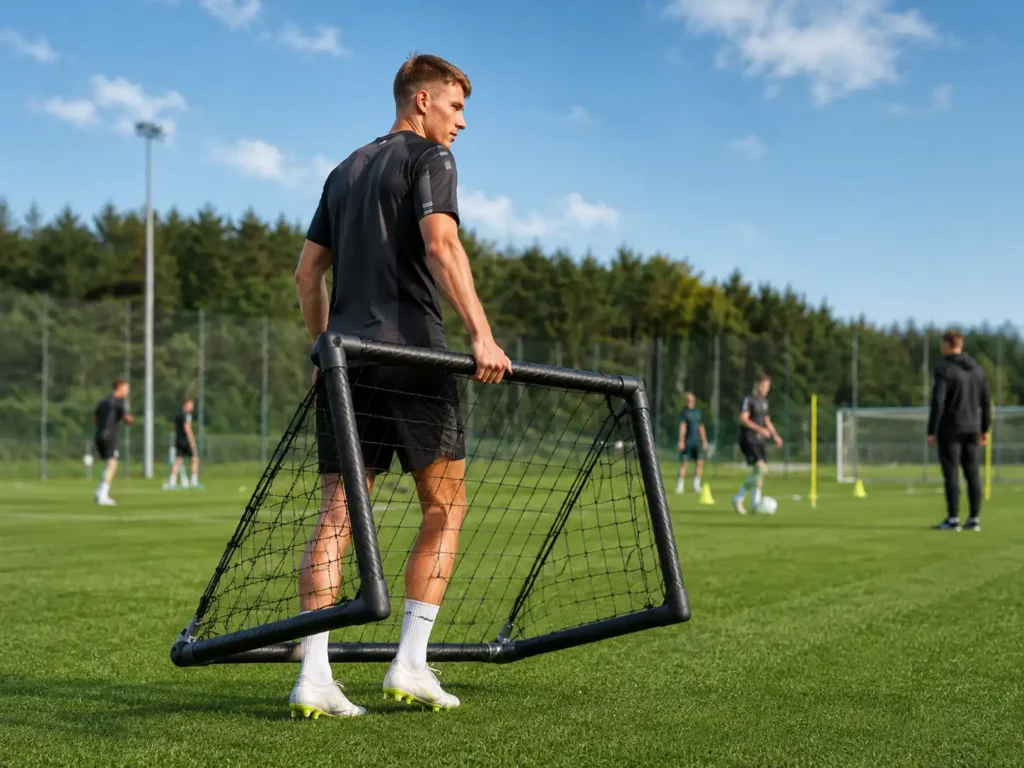
Carbon Fiber Rebounder Frames
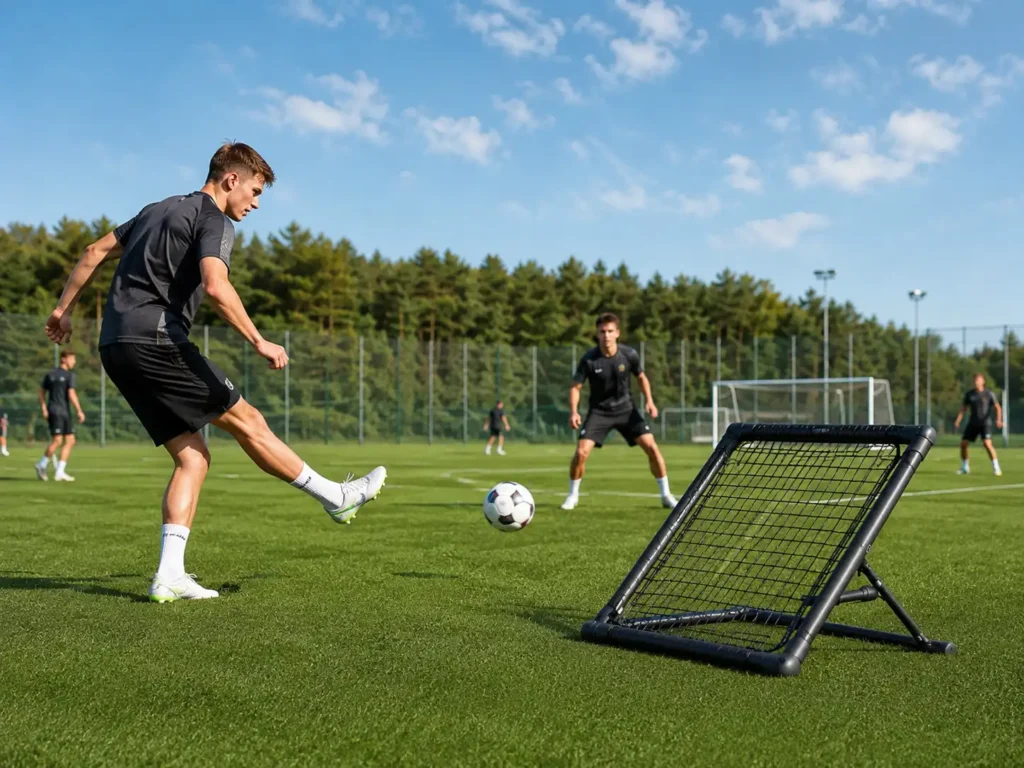
Soccer rebounders are used for passing practice, shooting drills, first-touch training, goalkeeper reaction drills, and individual training.
A rebounder frame needs to support the net, stay stable, and handle repeated ball contact. If the frame is too heavy, it becomes difficult to move. If it is too weak, it may bend or become unstable during training.
Carbon fiber tubes can be used to develop lightweight rebounder frames for premium soccer training equipment.
Possible benefits include:
- Reduced carrying weight
- Easier field setup
- Good frame stiffness
- No rust in outdoor environments
- Cleaner premium appearance
- Custom frame design options
This is one of the more practical product directions for carbon fiber because rebounders naturally benefit from lightweight structure and repeated-use durability.
For sports brands, a carbon fiber rebounder can become a higher-end product line for clubs, academies, and serious individual players.
Carbon Fiber Camera Poles for Soccer Video Analysis
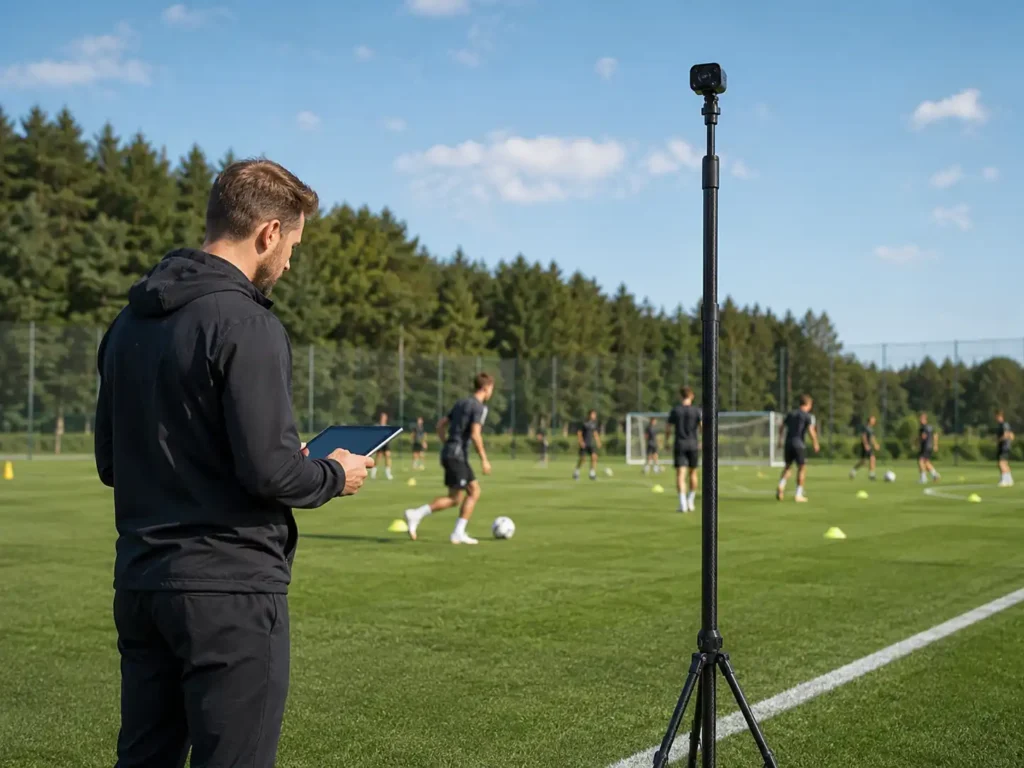
Video analysis is now an important part of soccer training. Coaches and analysts use video to study positioning, passing patterns, defensive shape, pressing structure, player movement, and tactical decisions.
To capture better video angles, many teams use elevated camera poles, tripod systems, or sideline recording supports.
Carbon fiber is especially suitable for this application.
A carbon fiber camera pole for soccer can be used for:
- Match recording
- Training session filming
- Tactical video analysis
- AI camera support
- Sideline video systems
- Portable coaching kits
Compared with aluminum, carbon fiber can reduce carrying weight and improve portability. For long telescopic poles, proper carbon fiber tube design can also help improve stiffness and reduce excessive bending.
This application is very suitable for product developers because the demand is not only from traditional soccer equipment brands. It can also come from sports technology companies, video analysis brands, coaching platforms, clubs, and academies.
Possible custom products include:
- Telescopic carbon fiber camera poles
- Carbon fiber tripod support tubes
- High-position video recording poles
- Carbon fiber poles with camera mounts
- Portable analysis equipment frames
- Custom tubes for AI sports camera systems
For a carbon fiber manufacturer, this is a strong direction because it connects directly with existing carbon fiber tube and telescopic pole capabilities.
Carbon Fiber Training Hurdles and Target Frames
Soccer training often uses hurdles, passing gates, shooting targets, and reaction frames. These products help players improve speed, coordination, passing accuracy, and finishing.
Many of these products are made from plastic or aluminum. For basic training kits, that may be enough. But for premium training systems, carbon fiber tubes can be used to create lighter and more professional frame structures.
Carbon fiber can be used in:
- Agility hurdles
- Passing target frames
- Shooting target frames
- Goalkeeper reaction frames
- Foldable training obstacles
- Lightweight positioning frames
These products can combine carbon fiber tubes with plastic connectors, aluminum inserts, fabric targets, elastic cords, or net systems.
This gives product developers more flexibility. They can create lightweight structures with customized dimensions, folding methods, and branding options.
Carbon Fiber Corner Flag Poles and Field Equipment
Corner flag poles and field markers are simple soccer field products, but they still need to be lightweight, durable, and weather-resistant.
Most corner flag poles are made from plastic, fiberglass, or aluminum. Carbon fiber may not be necessary for low-cost field equipment, but it can be used for premium or club-branded products.
Possible applications include:
- Corner flag poles
- Boundary poles
- Temporary event poles
- Field divider poles
- Lightweight signage supports
- Club-branded field equipment
This category may not have the highest technical difficulty, but it can be suitable for stadium suppliers, event companies, and professional club equipment packages.
Carbon Fiber Shin Guards and Protective Inserts
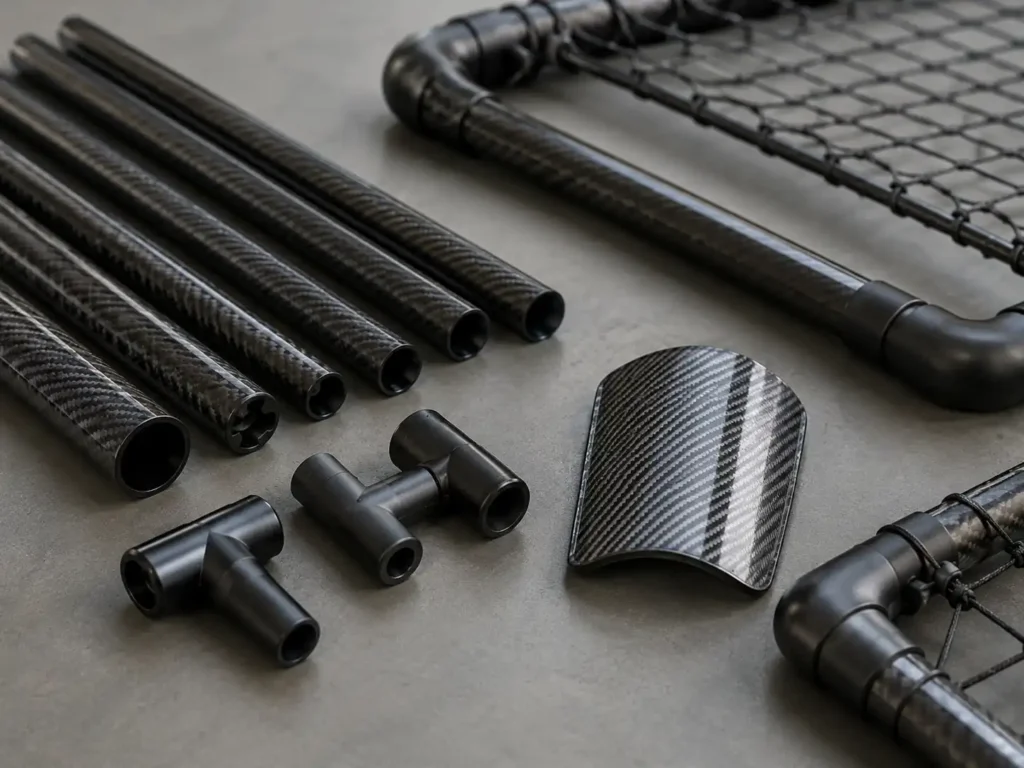
Carbon fiber sheets can also be used in certain soccer protective products.
One example is shin guards. A shin guard needs to be light, thin, and strong enough to help protect the player. Carbon fiber can provide stiffness and strength while keeping weight low.
Carbon fiber sheets may be used for:
- Shin guard inserts
- Lightweight protective plates
- Reinforcement parts
- Foot support components
- Custom sports protection parts
This type of product needs careful design. Carbon fiber can provide strength and stiffness, but comfort and impact absorption often require other materials such as foam, padding, fabric, or rubber.
For protective gear brands, carbon fiber can be used as part of a premium product structure.
Carbon Fiber vs Traditional Materials in Soccer Equipment
No single material is best for every soccer product. The right choice depends on product function, target market, budget, and expected use environment.
| Matériau | Main Advantages | Limitations | Suitable Soccer Applications |
|---|---|---|---|
| Steel | Strong, stable, cost-effective | Heavy, may rust if coating is damaged | Fixed goals, heavy-duty frames |
| Aluminium | Lighter than steel, easy to process | Can bend or dent under impact | Portable goals, frames, poles |
| Plastic | Low cost, easy to mold | Lower strength, aging risk, less premium | Cones, markers, entry-level kits |
| Fibre de verre | Lightweight, flexible, affordable | Lower stiffness, less premium appearance | Basic training poles, flexible rods |
| Fibre de carbone | Lightweight, stiff, strong, corrosion-resistant, premium look | Higher cost, needs proper design | Agility poles, camera poles, rebounder frames, portable structures, protective parts |
Carbon fiber is not the cheapest material. Its value is strongest when the product needs to be lighter, more durable, easier to transport, and positioned as a premium training solution.
What Benefits Can Carbon Fiber Bring to Soccer Training Equipment?
Carbon fiber can improve soccer training equipment in several practical ways.
Easier Transport and Faster Setup
Training equipment is moved frequently. Coaches may need to change drill layouts several times during one session.
Lighter equipment helps save time and effort.
Carbon fiber poles, frames, and telescopic structures can make it easier to carry equipment from storage to the field, set it up quickly, and pack it away after training.
This is especially useful for academies, camps, mobile coaching teams, and clubs that use multiple training areas.
Better Durability for Outdoor Use
Soccer equipment is often exposed to rain, sunlight, wet grass, dust, and mud.
Steel may rust when the coating is damaged. Some plastics may become brittle after long outdoor exposure. Aluminum performs well in many outdoor applications, but it can still dent or deform depending on structure and impact.
Carbon fiber does not rust and has good corrosion resistance. With the right surface finish and product design, it can be suitable for repeated outdoor use.
Improved Stiffness and Stability
For long poles, camera supports, target frames, and rebounder structures, stiffness is important.
If a camera pole bends too much, the video may become less stable. If a target frame deforms easily, the training experience becomes less professional. If a rebounder frame lacks stiffness, it may not perform consistently.
Carbon fiber can provide good stiffness while keeping weight low. This makes it useful for lightweight structures that still need stability.
Premium Product Appearance
Carbon fiber has a strong visual identity. The 3K twill pattern, plain weave surface, UD finish, matte coating, or glossy coating can make a product look more advanced.
For sports brands, this helps create market differentiation.
A carbon fiber training product can feel more premium than a standard plastic or aluminum product. This is important for brands selling to clubs, academies, serious players, or high-end consumers.
More Custom Design Options
Carbon fiber parts can be customized for different soccer equipment projects.
Common customization options include:
- Diamètre extérieur
- Diamètre intérieur
- Épaisseur de la paroi
- Longueur du tube
- Forme du tube
- Matte or glossy finish
- 3K twill, plain weave, or UD surface
- Cutting
- Drilling
- Slotting
- Telescopic design
- Metal or plastic connector assembly
- Logo and branding
- Custom packaging support
This makes carbon fiber suitable for OEM and ODM soccer training equipment projects.
Best Carbon Fiber Product Ideas for Soccer Brands and Clubs
For B2B customers, the most important question is not only whether carbon fiber can be used, but which products are worth developing.
Below are practical product ideas.
| Product Idea | Carbon Fiber Part | Potential Customer |
| Agility training pole | Carbon fiber tube | Soccer training brands, clubs, academies |
| Slalom training pole | Lightweight carbon fiber pole | Coaching equipment suppliers |
| Portable soccer goal | Carbon fiber frame tube | Youth academies, sports brands |
| Soccer rebounder | Carbon fiber support frame | Training equipment companies |
| Camera pole | Telescopic carbon fiber pole | Clubs, coaches, video analysis brands |
| Passing target frame | Carbon fiber tube frame | Soccer schools, training centers |
| Shooting target frame | Carbon fiber frame structure | Training product brands |
| Corner flag pole | Carbon fiber field pole | Stadium suppliers, event companies |
| Shin guard insert | Carbon fiber sheet | Protective gear brands |
| Custom training kit | Tubes, rods, sheets, connectors | OEM sports equipment developers |
Among these ideas, carbon fiber agility poles, soccer camera poles, rebounder frames, and portable training goal frames are especially worth considering.
They have clear use cases, visible lightweight benefits, and good potential for custom product development.
What Should Be Confirmed Before Developing a Carbon Fiber Soccer Product?
Before using carbon fiber in a soccer training product, the product structure should be evaluated carefully.
A good custom project should confirm the following details.
Product Function
The first question is simple: what will the product do?
A camera pole, rebounder frame, training pole, and portable goal frame all have different structural requirements. The carbon fiber design should match the real application.
Size and Structure
Tube length, diameter, wall thickness, and frame shape will affect weight, stiffness, cost, packaging, and shipping.
For long poles or large frames, structure design is especially important.
Load and Impact Requirement
Some products mainly need stiffness. Some need to handle repeated impact. Some need to support a net, a camera, or a frame structure.
The expected load and use environment should be discussed before production.
Méthode de connexion
Many soccer training products need connectors, locks, joints, or foldable structures.
Common connection options include:
- Spring button locks
- Threaded joints
- Aluminum inserts
- Plastic connectors
- Clamp systems
- Telescopic locks
- Quick-release structures
- Custom molded joints
The connection method can strongly affect product performance and user experience.
Finition de la surface
Surface finish affects appearance, grip, durability, and branding.
Common options include:
- Finition mate
- Glossy finish
- 3K twill surface
- Surface à armure toile
- UD surface
- Colored details
- Logo printing or labeling
For premium soccer equipment, appearance can be an important part of product value.
Packaging and Shipping
Portable soccer equipment is often sold as a set. Packaging should protect the parts and make the product easy to store and transport.
For long carbon fiber tubes, shipping length should also be considered during product design. In some cases, a detachable or telescopic structure may reduce packaging difficulty.
Sample Testing
For new product development, sample testing is important.
Testing can help confirm:
- Poids
- Rigidité
- Assembly method
- Connection strength
- Finition de la surface
- User experience
- Packaging method
- Real training performance
This helps reduce risk before bulk production.
Is Carbon Fiber Suitable for Every Soccer Product?
No. Carbon fiber is not necessary for every soccer product.
For low-cost cones, simple markers, basic children’s training kits, and entry-level accessories, plastic or fiberglass may be more cost-effective.
Carbon fiber is more suitable when the product requires:
- Structure légère
- High-end product positioning
- Good stiffness
- Outdoor durability
- Professional appearance
- Custom design
- Repeated training use
- Better transport convenience
In other words, carbon fiber is not mainly for the cheapest soccer products. It is better for upgraded, professional, portable, and custom soccer training equipment.
Custom Carbon Fiber Parts for Soccer Training Equipment
At LH Carbon Solutions, we manufacture custom carbon fiber tubes, rods, sheets, plates, and structural parts for sports, outdoor, industrial, and OEM applications.
For soccer training equipment, we can support brands, clubs, academies, and product developers with custom carbon fiber components such as:
- Carbon fiber agility poles
- Carbon fiber slalom poles
- Carbon fiber tubes for portable soccer goals
- Carbon fiber rebounder frame tubes
- Telescopic carbon fiber camera poles
- Carbon fiber target frame structures
- Carbon fiber field poles
- Carbon fiber sheets for protective parts
- Custom cut and drilled carbon fiber tubes
- OEM carbon fiber sports equipment parts
We can customize carbon fiber parts according to your project requirements, including size, wall thickness, length, surface finish, structure, cutting, drilling, assembly support, and branding needs.
If you are developing lightweight soccer training equipment, a portable frame, a video analysis pole, a rebounder system, or a custom sports product, we can help evaluate the structure and provide custom carbon fiber parts for your project.
FAQ
Can carbon fiber be used in soccer training equipment?
Yes. Carbon fiber can be used in soccer training poles, agility poles, portable goal frames, rebounder frames, camera poles, target frames, corner flag poles, protective inserts, and other lightweight training equipment.
Is carbon fiber better than aluminum for soccer equipment?
Carbon fiber is usually lighter and more corrosion-resistant than aluminum. It can also provide excellent stiffness for poles and frame structures. However, aluminum is usually cheaper and easier to process. The best choice depends on product function, budget, and target market.
Is carbon fiber suitable for portable soccer goals?
Carbon fiber can be suitable for portable soccer training goals, especially when lightweight structure, easy transport, and premium product positioning are important. For large fixed match goals, aluminum or steel may still be more practical.
What soccer products are best for carbon fiber?
Carbon fiber is best suited for premium agility poles, telescopic camera poles, rebounder frames, portable training structures, target frames, field poles, and lightweight protective parts.
Can carbon fiber soccer training equipment be customized?
Yes. Carbon fiber tubes, rods, and sheets can be customized by size, wall thickness, length, surface finish, connection method, drilling, cutting, logo, and packaging requirements.
Why use carbon fiber instead of plastic or fiberglass?
Plastic and fiberglass are suitable for low-cost training products. Carbon fiber is better for premium products that require lighter weight, higher stiffness, better durability, and a more professional appearance.
Is carbon fiber worth the higher cost?
Carbon fiber is worth considering when the product needs to be lightweight, durable, portable, and positioned as a premium product. It may not be suitable for very low-cost or disposable soccer accessories.
Conclusion
Soccer training equipment is becoming more professional. Clubs, academies, coaches, and sports brands need equipment that is easier to carry, faster to set up, more durable outdoors, and better suited for modern training systems.
Carbon fiber is not the right material for every soccer product. But for premium training poles, portable goal frames, rebounder structures, camera poles, target frames, and protective parts, it can offer clear advantages.
For brands and product developers, carbon fiber can also create new product opportunities. It allows lightweight structures, custom designs, premium appearance, and better differentiation from standard plastic, fiberglass, steel, or aluminum products.
If you are planning to develop custom soccer training equipment or lightweight sports products, LH Carbon Solutions can help you evaluate the structure and manufacture custom carbon fiber parts for your project.
