

Carbon fiber tubes and steel tubes are both strong structural materials, but they solve different problems. Steel is tough, affordable, and easy to weld. Carbon fiber is much lighter, corrosion-resistant, and strong for its weight.
So the real question is not “Which material is stronger?” The better question is: when does carbon fiber give enough value to replace steel?
This guide compares carbon fiber tubes and steel tubes from a buyer’s point of view, including weight, strength, stiffness, corrosion resistance, cost, machining, joining methods, and typical applications.
Overview: Carbon Fiber Tube and Steel Tube Are Built for Different Priorities
Carbon fiber tube and steel tube are not direct replacements in every situation.
Steel tubes are often used when cost, weldability, toughness, and easy processing are the main concerns. They are common in frames, supports, guards, machinery, welded structures, and general industrial products.
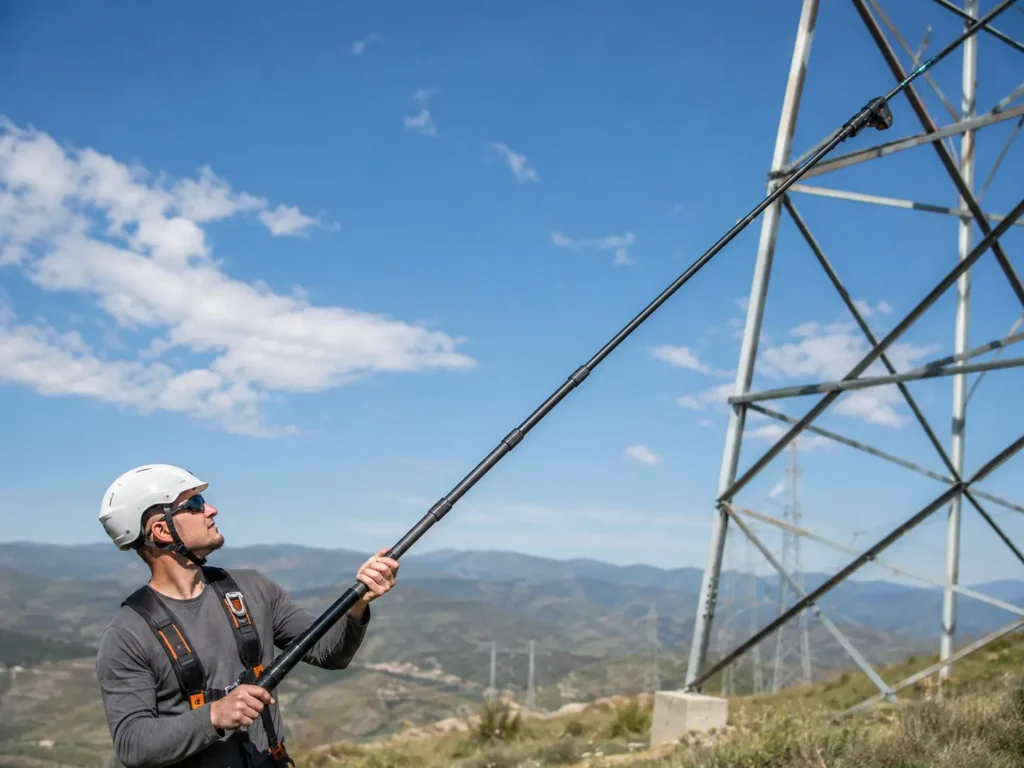
Carbon fiber tubes are usually chosen when weight reduction is important. They are often used in telescoping poles, drone arms, robotic arms, camera poles, sports equipment, rescue poles, inspection tools, outdoor tools, and lightweight industrial structures.
A carbon fiber tube is not simply a “lighter steel tube.” It is a composite structure. Its performance depends on fiber grade, fiber direction, wall thickness, resin system, tube diameter, and production method. A steel tube is more isotropic, which means its properties are more similar in different directions. A carbon fiber tube is more directional, which means it performs best when the fiber layup matches the load direction.
For buyers, this difference matters. If you only copy the size of a steel tube without checking the load direction, connection method, and impact risk, the result may not be ideal. But if the carbon fiber tube is designed correctly, it can reduce weight greatly while keeping strong structural performance.
Quick Comparison: Carbon Fiber Tube vs Steel Tube
The table below gives a practical comparison for buyers. The values are typical reference data, not final design values for every tube. Carbon fiber tube performance changes with layup, resin, fiber volume, and wall thickness.
| Factor | Tubo de fibra de carbono | Steel Tube | Mejor elección | Data / Source Note |
|---|---|---|---|---|
| Typical material density | About 1.6 g/cm³ for carbon/epoxy composite | About 7.87 g/cm³ for AISI 1020 steel | Fibra de carbono | Toray CFRP laminate data; AZoM carbon/epoxy composite data; AZoM AISI 1020 data |
| Weight for same tube size | Around 75–80% lighter than steel in many same-size tube comparisons | Much heavier for the same geometry | Fibra de carbono | Calculated from 1.60 g/cm³ CFRP and 7.87 g/cm³ steel density |
| Raw fiber tensile strength | T300: 3530 MPa; T700S: 4900 MPa | AISI 1020 steel ultimate tensile strength: about 394.72 MPa | Carbon fiber fiber data is higher | Toray T300 and T700S data sheets; AZoM AISI 1020 data |
| Composite tensile strength reference | Toray T300 composite: 1760 MPa; Toray T700S composite: 2550 MPa | AISI 1020 steel: about 394.72 MPa ultimate tensile strength | Carbon fiber composite can be higher, depending on layup | Toray composite data; AZoM AISI 1020 data |
| Young’s modulus / stiffness reference | Carbon/epoxy tube: about 110–120 GPa longitudinal; Toray CFRP laminate: 167 GPa | Steel: about 200 GPa | Steel has higher absolute modulus; carbon fiber has better stiffness-to-weight | AZoM carbon/epoxy tube data; Toray CFRP laminate data; AZoM steel data |
| Strength-to-weight ratio | Muy alta | Good, but limited by high density | Fibra de carbono | Calculated from strength and density references |
| Impact toughness | Good for designed loads, but can crack or delaminate under sharp impact | Better denting and impact toughness | Acero | Practical engineering comparison |
| Resistencia a la corrosión | Does not rust | Carbon steel can rust without coating | Fibra de carbono | Material behavior comparison |
| Outdoor use | Good with UV-resistant coating and proper resin | Needs paint, galvanizing, stainless grade, or coating | Fibra de carbono | Practical outdoor use comparison |
| Welding | Cannot be welded | Easy to weld | Acero | Manufacturing method comparison |
| Cutting and drilling | Possible, but needs diamond tools and dust control | Easier with standard metal tools | Acero | Manufacturing method comparison |
| Joining method | Adhesive bonding, clamps, screws, inserts, custom connectors | Welding, bolts, threaded inserts, brackets | Depends on design | Manufacturing method comparison |
| Coste | Higher material and processing cost | Lower material cost and easier sourcing | Acero | Cost comparison |
| Best use | Lightweight, portable, corrosion-resistant products | Low-cost, welded, high-impact structures | Depends on application | Buyer decision guide |
The simple answer is this: carbon fiber is usually better when weight matters; steel is usually better when cost, welding, and impact toughness matter more.
Weight Difference: Why Carbon Fiber Tubes Are Much Lighter Than Steel Tubes
Weight is the biggest reason buyers compare carbon fiber tubes with steel tubes.
A typical carbon/epoxy composite has a density of about 1.6 g/cm³. AISI 1020 steel has a density of about 7.87 g/cm³. That means steel is almost five times denser than carbon fiber composite before you even compare the tube design.
This does not always mean the final product will be five times heavier, because wall thickness and structure may change. But when the tube size is the same, carbon fiber can reduce weight by about 75–80%.
For handheld, portable, or moving products, this is a major difference.
A 3-meter steel pole may be strong, but it can feel heavy after long use. A carbon fiber pole of the same size can be much easier to carry, lift, extend, rotate, and control. This is why carbon fiber tubes are common in telescoping poles, rescue poles, camera poles, cleaning poles, fruit picker poles, and inspection tools.
Example Weight Calculation for 1-Meter Tubes
Calculation basis: round tube, 1 meter long, same outer diameter and wall thickness. Carbon fiber composite density is calculated as 1.60 g/cm³. Steel density is calculated as 7.87 g/cm³.
| Diámetro exterior | Espesor de pared | Carbon Fiber Tube Weight / m | Steel Tube Weight / m | Approx. Weight Saved | Weight Reduction |
| 20 mm | 1.0 mm | 0.096 kg | 0.470 kg | 0.374 kg | 79.7% |
| 25 mm | 1.0 mm | 0.121 kg | 0.594 kg | 0.473 kg | 79.7% |
| 30 mm | 1,5 mm | 0.215 kg | 1.058 kg | 0.843 kg | 79.7% |
| 30 mm | 2.0 mm | 0.281 kg | 1.384 kg | 1.103 kg | 79.7% |
| 35 mm | 2.0 mm | 0.332 kg | 1.633 kg | 1.301 kg | 79.7% |
| 40 mm | 2.0 mm | 0.382 kg | 1.881 kg | 1.499 kg | 79.7% |
| 40 mm | 3.0 mm | 0.558 kg | 2.746 kg | 2.188 kg | 79.7% |
| 50 mm | 2.0 mm | 0.482 kg | 2.378 kg | 1.896 kg | 79.7% |
| 50 mm | 3.0 mm | 0.709 kg | 3.489 kg | 2.780 kg | 79.7% |
| 60 mm | 3.0 mm | 0.859 kg | 4.228 kg | 3.369 kg | 79.7% |
This table shows why carbon fiber is attractive for long tubes. The longer the tube, the more weight you save.
For example, if a 1-meter 40 mm OD x 2 mm wall steel tube weighs about 1.881 kg, a 3-meter tube may weigh about 5.643 kg before adding connectors or accessories. The same size carbon fiber tube may weigh about 1.146 kg for 3 meters. That is a large difference for a pole that must be carried, lifted, or extended by hand.
Strength and Stiffness: Which Tube Is Stronger?
This is where many buyers get confused.
Carbon fiber is often described as “stronger than steel,” but that statement is too simple. The answer depends on what kind of strength you mean.
Carbon fiber has excellent tensile strength and a very high strength-to-weight ratio. Toray T300 carbon fiber has a tensile strength of 3530 MPa, and Toray T700S carbon fiber has a tensile strength of 4900 MPa. These values are much higher than many common carbon steels.
However, a finished carbon fiber tube is not only carbon fiber. It also includes resin. The tube performance depends on fiber volume, fiber angle, layup design, curing quality, and tube geometry.
Steel is more forgiving. It can bend, dent, and deform before failure. Carbon fiber is stiff and light, but it can crack, split, or delaminate if the load is too high, the impact is sharp, or the fiber direction is not designed for the real load.
Material Property Reference Table
| Propiedad | Carbon Fiber / CFRP Reference | Steel Reference | What It Means for Tube Buyers |
| T300 carbon fiber tensile strength | 3530 MPa | — | High raw fiber strength, good for standard structural composite tubes |
| T700S carbon fiber tensile strength | 4900 MPa | — | Higher fiber strength, often used when better performance is needed |
| T300 / T700S fiber modulus | 230 GPa | — | Raw fiber stiffness is similar to or higher than steel, but tube stiffness depends on layup |
| Carbon/epoxy tube longitudinal modulus | 110–120 GPa | — | Finished composite tube stiffness can be lower than steel in absolute terms |
| Toray CFRP laminate modulus | 167 GPa | — | CFRP can offer high stiffness at low density |
| AISI 1020 steel tensile strength | — | About 394.72 MPa | Common low carbon steel has much lower tensile strength than carbon fiber data |
| AISI 1020 steel yield strength | — | About 294.74 MPa | Steel begins permanent deformation around this value |
| Steel elastic modulus | — | About 200 GPa | Steel is very stiff in absolute terms |
| AHSS minimum tensile strength | — | At least 440 MPa | Advanced high-strength steels start at higher strength levels |
| Some UHSS naming thresholds | — | 980 MPa, 1180 MPa, or 1270 MPa depending on producer | Very high-strength steels can be much stronger than mild steel |
For tube buyers, the most important point is this:
Steel may have higher absolute stiffness and better impact toughness, but carbon fiber usually gives better strength and stiffness per unit weight.
If your product must be as light as possible, carbon fiber often wins. If your product must survive abuse, crushing, welding, or rough impact, steel may be safer.
Corrosion and Outdoor Durability
Carbon fiber tubes have a clear advantage in corrosion resistance. Carbon fiber does not rust like carbon steel.
Steel tubes can perform very well outdoors, but they need protection. Common protection methods include paint, powder coating, galvanizing, plating, oiling, or using stainless steel. If the coating is scratched, damaged, or poorly maintained, carbon steel can rust.
Carbon fiber tubes do not have this rust problem. This makes them suitable for outdoor tools, marine tools, cleaning poles, rescue poles, agricultural poles, inspection poles, and utility equipment.
However, carbon fiber is not maintenance-free in every environment. Outdoor carbon fiber tubes should use the right resin system and surface coating. UV exposure can affect the resin and surface finish over time. For long outdoor use, a UV-resistant clear coat, painted coating, or protective surface finish is recommended.
This is especially important for:
- Telescoping poles used outdoors
- Rescue poles exposed to sun and rain
- Marine or waterfront tools
- Agricultural tools
- Camera poles and inspection poles
- Palos de limpieza
- Utility and field service tools
If the product will stay outdoors for a long time, buyers should not only ask for “carbon fiber tube.” They should also confirm the resin, surface finish, UV protection, and connection method.
Cost Difference: Why Steel Tubes Are Cheaper
Steel tubes are usually much cheaper than carbon fiber tubes.
There are several reasons:
- Steel raw material is lower cost.
- Steel tube production is mature and highly automated.
- Steel tubes are available in many standard sizes.
- Steel is easy to cut, weld, drill, and form.
- Carbon fiber tube production needs fiber, resin, layup, curing, mold control, sanding, finishing, and inspection.
Carbon fiber tube cost depends on many details, including:
- Outer diameter and inner diameter
- Espesor de la pared
- Longitud del tubo
- Fiber grade, such as T300, T700, or higher modulus fiber
- Surface finish, such as matte, glossy, 3K twill, UD, or painted finish
- Production method, such as roll wrapped, pultruded, or filament wound
- Requisito de tolerancia
- Cantidad
- Connector or assembly requirement
- Custom mold requirement
So carbon fiber should not be chosen only to reduce cost. In most cases, it will not.
Carbon fiber should be chosen when the extra cost brings clear value. For example, if a lighter pole allows easier handling, longer working time, lower transport weight, better product feel, or higher selling price, the higher material cost may be reasonable.
If the product is a low-cost welded frame and weight does not matter, steel is usually the better choice.
Manufacturing and Processing Differences
Carbon fiber tubes and steel tubes are processed in very different ways. This matters when buyers need holes, slots, connectors, threaded parts, or assemblies.
Cutting and Drilling
Steel tubes are easier to cut and drill with standard metalworking tools. They can be sawed, drilled, tapped, welded, bent, and machined in many workshops.
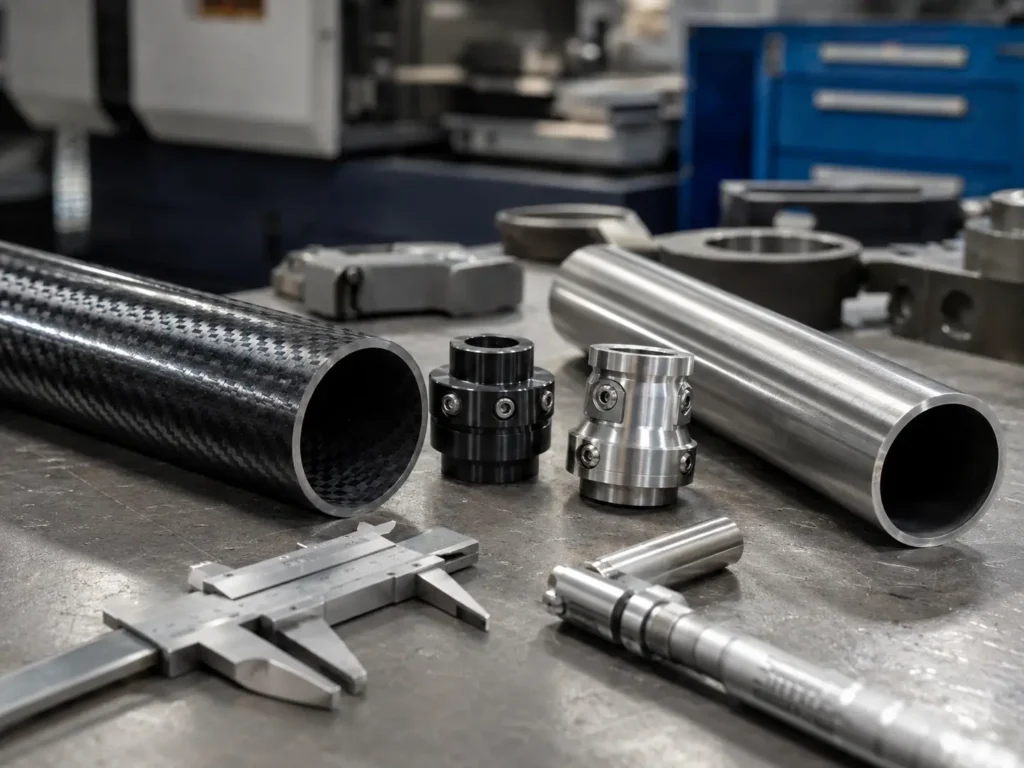
Carbon fiber tubes can also be cut and drilled, but the method is different. Carbon fiber is abrasive and can splinter if processed incorrectly. Diamond-coated tools, clean support, low vibration, dust control, and proper edge finishing are recommended.
For carbon fiber tubes, buyers should avoid rough cutting with unsuitable tools. Poor cutting may cause edge damage, fiber pull-out, or delamination.
Welding and Joining
Steel tubes can be welded directly. This is one of the biggest advantages of steel. For frames, guards, brackets, and heavy-duty structures, welding makes steel simple and economical.
Carbon fiber tubes cannot be welded. They are usually joined by:
- Adhesive bonding
- Aluminum or stainless inserts
- Tube clamps
- Screws and rivets with proper reinforcement
- Custom molded connectors
- External sleeves
- Internal plugs
- Mechanical locking systems
The connection design is very important. In many carbon fiber tube failures, the tube itself is not the only issue. The connector, hole, clamp pressure, or bonded area may be the weak point.
Surface Finishing
Steel tubes are commonly painted, powder coated, plated, galvanized, or polished.
Carbon fiber tubes can be supplied with several surface finishes:
- Glossy 3K twill finish
- Matte 3K twill finish
- UD matte finish
- Superficie pintada
- Colored coating
- Capa transparente
- Superficie de unión lijada
- Custom logo under clear coat
- Anti-scratch coating
If the tube needs bonding, the bonding area can be supplied with a roughened surface. If the tube needs premium appearance, a glossy or matte woven finish may be better.
When Should You Choose Carbon Fiber Tubes Instead of Steel Tubes?
Choose carbon fiber tube when weight reduction creates real value.
Here are the most common situations:
- Choose carbon fiber when the tube must be lightweight.
This is the main reason. If the tube is handheld, carried, lifted, extended, or moved often, carbon fiber can make the product easier to use. - Choose carbon fiber when the product is long.
Long tubes make weight more obvious. A 3-meter or 5-meter steel pole can become difficult to handle. Carbon fiber helps reduce user fatigue. - Choose carbon fiber when corrosion resistance matters.
For outdoor, marine, agricultural, cleaning, and rescue tools, carbon fiber avoids the rust problem of carbon steel. - Choose carbon fiber when strength-to-weight ratio matters.
Drones, robotics, sports equipment, camera rigs, and portable tools often need strong parts without adding weight. - Choose carbon fiber when appearance matters.
Carbon fiber has a premium look. Glossy 3K twill, matte twill, or painted carbon fiber can improve product value. - Choose carbon fiber when vibration damping is useful.
Carbon fiber composites can provide a different vibration feel compared with metal tubes. This can be useful in sports, camera supports, and some precision tools. - Choose carbon fiber when steel makes the final product too heavy.
If the current steel design works but is too heavy, carbon fiber may be a good upgrade.
Good examples include telescoping poles, fruit picker poles, rescue poles, drone arms, robotic arms, camera poles, sports equipment, lightweight machine parts, and outdoor inspection tools.
When Is Steel Tube Still the Better Choice?
Steel is still the better choice in many applications.
Choose steel tube when:
- The project is very cost-sensitive.
- Welding is required.
- The tube will face heavy impact, dents, or abuse.
- The structure needs to deform before failure.
- The environment has high heat that may not suit polymer resin.
- The product does not need to be lightweight.
- Standard tube sizes are enough.
- Field repair must be simple.
- The structure needs threaded, welded, or heavily machined joints.
Steel is a very practical material. It is strong, widely available, easy to fabricate, and familiar to most workshops. For many industrial frames, welded supports, protective guards, construction parts, and low-cost structural tubes, steel remains the smarter option.
A good material choice is not about choosing the most advanced material. It is about choosing the right material for the job.
Application Examples: Carbon Fiber Tube vs Steel Tube in Real Products
The table below shows how the material choice changes by application.
| Aplicación | Better Material | ¿Por qué? |
| Telescoping pole | Fibra de carbono | Lower weight makes the pole easier to extend, lift, and control |
| Fruit picker pole | Fibra de carbono | Long working length needs low weight and outdoor durability |
| Palo de rescate | Fibra de carbono | Lightweight structure helps fast handling in emergency use |
| Drone arm | Fibra de carbono | High strength-to-weight ratio improves flight efficiency |
| Mástil para cámara | Fibra de carbono | Lower weight and good stiffness help handling and stability |
| Robotic arm | Fibra de carbono | Reduces moving mass and improves response |
| Outdoor inspection pole | Fibra de carbono | No rust and easier to carry |
| Palo de limpieza | Fibra de carbono | Long reach with less user fatigue |
| Equipamiento deportivo | Fibra de carbono | Lightweight, stiff, and premium appearance |
| Marine tool handle | Fibra de carbono | Better corrosion resistance than carbon steel |
| Welded machine frame | Acero | Welding and low cost are important |
| Heavy-duty guard rail | Acero | Better impact toughness and lower cost |
| Low-cost support tube | Acero | Weight is not the main concern |
| Construction support part | Acero | High toughness, easy fabrication, and standard availability |
| High-temperature structure | Acero | Polymer resin in carbon fiber may limit heat resistance |
| Field-repair frame | Acero | Easier to weld or repair locally |
This table also explains why one material cannot replace the other in every case. Carbon fiber works best when lightweight performance matters. Steel works best when toughness, welding, cost, and easy fabrication matter.
How to Choose the Right Tube for Your Project
Before replacing a steel tube with a carbon fiber tube, buyers should confirm the real working conditions.
A carbon fiber tube should be designed around the application, not only copied from a steel tube size.
Use this checklist before requesting a quote:
- Diámetro exterior
- Diámetro interior
- Espesor de la pared
- Longitud del tubo
- Required weight target
- Dirección de carga
- Bending load
- Compression load
- Torsion load
- Impact risk
- Para uso en interiores o exteriores
- UV exposure
- Chemical or moisture exposure
- Working temperature
- Surface finish requirement
- Método de conexión
- Hole or slot position
- Requisito de tolerancia
- Cantidad
- Target cost range
For example, a steel tube used in a welded frame cannot be replaced by carbon fiber without changing the joint design. But a steel pole used for lifting, reaching, or carrying may be a very good candidate for carbon fiber replacement.
The design question should be: what does the tube need to do?
If the answer is “carry load with minimum weight,” carbon fiber may be a good choice. If the answer is “survive hard impact and be welded cheaply,” steel may be better.
Custom Carbon Fiber Tubes for Lightweight Applications
For OEM projects, carbon fiber tubes can be customized by size, wall thickness, length, fiber layup, and surface finish.
Entre las opciones de personalización más habituales se incluyen:
- Round carbon fiber tubes
- Square carbon fiber tubes
- Rectangular carbon fiber tubes
- Oval carbon fiber tubes
- Tapered carbon fiber tubes
- Telescoping carbon fiber tubes
- Glossy 3K twill finish
- Matte 3K twill finish
- UD matte finish
- Painted carbon fiber tube
- Superficie de unión lijada
- Custom inserts or connectors
- Cut-to-length service
- Drilled holes or slots
- Custom tolerance control
When replacing a steel tube, the goal is not always to use the exact same wall thickness. Carbon fiber has different design rules. In many cases, a carbon fiber tube needs a new layup design, adjusted wall thickness, or a different connector system.
This is especially important for telescoping poles, outdoor tools, rescue equipment, drones, robots, sports equipment, and lightweight industrial parts.
If the tube is designed properly, carbon fiber can reduce weight while keeping strong performance for the required load.
Preguntas frecuentes
Is a carbon fiber tube stronger than a steel tube?
Sometimes, but not in every way. Carbon fiber has a very high strength-to-weight ratio, and raw carbon fiber can have much higher tensile strength than many common steels. However, steel is tougher under impact and more forgiving under dents, bending, and abuse.
Is carbon fiber lighter than steel?
Yes. Carbon fiber composite is much lighter than steel. Based on typical densities, a carbon fiber tube can be about 75–80% lighter than a steel tube of the same size.
Can carbon fiber tubes replace steel tubes?
Yes, carbon fiber tubes can replace steel tubes in many lightweight applications. They are especially useful for telescoping poles, drone arms, robotic arms, camera poles, inspection tools, rescue poles, and sports equipment. They are not ideal for welded structures or low-cost heavy-impact parts.
Do carbon fiber tubes rust?
No. Carbon fiber does not rust like carbon steel. However, outdoor carbon fiber tubes should still use proper resin and surface coating for UV protection and long-term durability.
Can carbon fiber tubes be welded?
No. Carbon fiber tubes cannot be welded. They are usually connected with adhesive bonding, clamps, screws, inserts, sleeves, or custom connectors.
Are carbon fiber tubes expensive?
Yes, carbon fiber tubes usually cost more than steel tubes. The higher cost comes from carbon fiber material, resin, layup, curing, mold control, finishing, and inspection. Carbon fiber is chosen when lightweight performance justifies the higher cost.
When should I not use carbon fiber tubes?
Do not use carbon fiber tubes when low cost, welding, heavy impact abuse, high heat resistance, or simple field repair is more important than weight reduction.
Conclusion: Carbon Fiber Is Best When Weight Matters
Steel tubes are strong, affordable, tough, and easy to weld. They are still the better choice for many low-cost, welded, heavy-duty, and high-impact structures.
Carbon fiber tubes are better when the product needs to be lightweight, corrosion-resistant, stiff for its weight, and easier to carry or move. They are especially useful for long poles, portable tools, drones, robotics, sports equipment, and outdoor applications.
The best material depends on the project.
If your current steel tube works but makes the product too heavy, carbon fiber may be a smart upgrade. If your project needs welding, low cost, or high impact toughness, steel may still be the better material.
For custom carbon fiber tube projects, share your tube size, wall thickness, length, load direction, connection method, and application. A properly designed carbon fiber tube can reduce weight without sacrificing the performance your product needs.
Quizá también te interese

Tubos compuestos
Se centra en la alta rigidez y el bajo peso de las estructuras orientadas al rendimiento.
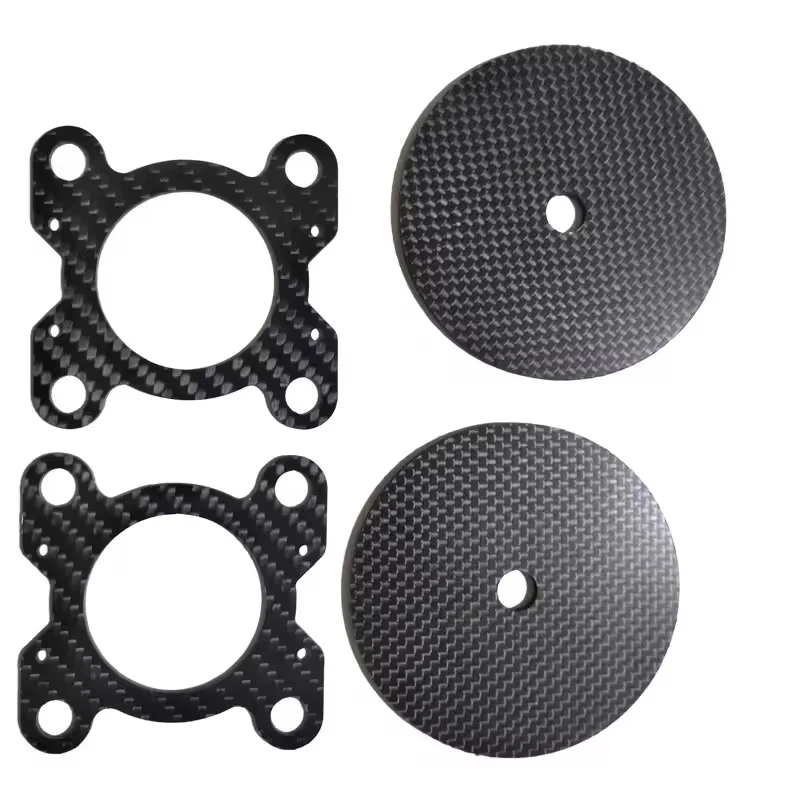
Láminas y placas de fibra de carbono
Láminas planas de laminado para corte CNC y componentes estructurales ligeros.
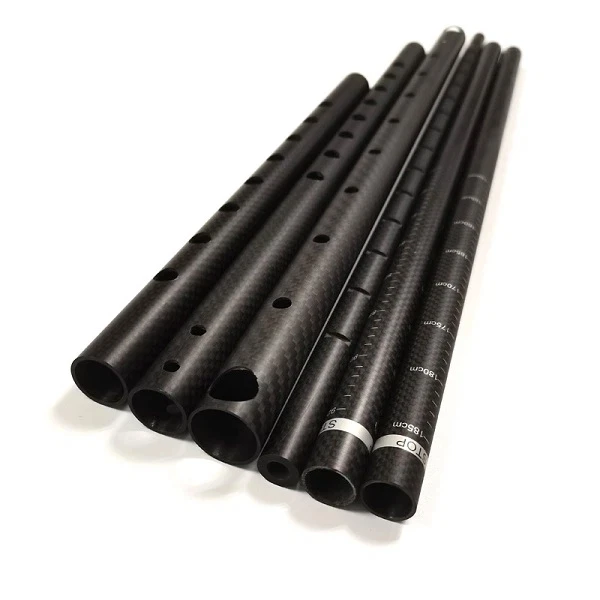
Varillas de material compuesto
Productos compuestos en forma de barra destinados a ensamblajes industriales y de fabricantes de equipos originales (OEM).
