
Choosing the right carbon fiber cue shaft manufacturer is not only about price. Buyers should compare custom capability, joint accuracy, surface finish, straightness control, sample support, and bulk production quality before placing an OEM order.
Carbon fiber cue shafts are performance products. They are not just carbon fiber tubes with a tip installed. A good cue shaft must stay straight, feel smooth in the bridge hand, fit the cue butt correctly, and give stable feedback during play.
For cue brands, distributors, and cue makers, the challenge is even bigger. You do not only need one good sample. You need a manufacturer who can repeat the same quality in bulk production.
This guide explains how to choose a carbon fiber cue shaft manufacturer for custom orders. It is written for B2B buyers who need private-label cue shafts, OEM carbon fiber pool cue shafts, custom joint types, logo branding, sample development, and long-term supply support.
Why Choosing the Right Carbon Fiber Cue Shaft Manufacturer Matters
A good manufacturer affects the final quality, playing feel, and brand reputation of your carbon fiber cue shafts.
Many buyers compare suppliers by price first. This is understandable, especially for bulk orders. But for carbon fiber cue shafts, the lowest price is not always the safest choice.
A cue shaft has many small details that affect real use. If the shaft is not straight, the player will notice. If the joint does not fit well, the cue may feel loose or unstable. If the surface is too rough or sticky, the bridge hand will not feel comfortable. If the bulk order is different from the approved sample, the buyer may face returns and complaints.
A reliable carbon fiber cue shaft manufacturer should control these points:
- Shaft straightness
- Shaft diameter accuracy
- Carbon fiber layup
- Taper consistency
- Surface smoothness
- Joint insert accuracy
- Tip and ferrule assembly
- Weight consistency
- Logo and finish quality
- Bulk order repeatability
For a player, one poor shaft means a bad playing experience. For a brand or distributor, one unstable batch can damage customer trust.
That is why the right manufacturer should not only produce carbon fiber parts. They should understand how a cue shaft is actually used.
Carbon Fiber Cue Shaft Manufacturer vs Trading Company
A manufacturer and a trading company may both sell carbon fiber cue shafts, but their control over production is different.
A carbon fiber cue shaft manufacturer usually has more direct control over material, layup, processing, finishing, inspection, and custom development. This can make communication faster when you need special shaft diameter, joint type, surface finish, logo, or packaging.
A trading company may also provide good service, especially for standard products. But for custom carbon fiber cue shaft orders, buyers should be careful. If the supplier cannot control production directly, it may be harder to adjust details or solve quality issues.
| Faktor | Manufacturer | Trading Company |
|---|---|---|
| Production control | Direct control over process | Depends on partner factory |
| Custom options | More flexible | May be limited |
| Technical discussion | More direct | May need to check with factory |
| Sample adjustment | Easier to modify | May take longer |
| Qualitätskontrolle | Easier to manage | Depends on factory process |
| Bulk consistency | Easier to repeat | Can vary by supplier |
| Am besten geeignet für | OEM, custom, private label | Standard sourcing |
This does not mean every trading company is bad. Some trading companies are professional and responsible. But if your goal is to build your own carbon fiber cue shaft product line, working with a manufacturer is usually more practical.
For OEM buyers, the key question is simple:
Can this supplier turn my product requirements into stable, repeatable production?
If the answer is unclear, you should slow down and check more details before placing an order.
Key Manufacturing Capabilities to Check
A carbon fiber cue shaft manufacturer should have the ability to control both carbon fiber structure and cue shaft performance.
Carbon fiber cue shafts are different from normal carbon fiber tubes. A normal tube may only need strength, stiffness, and appearance. A cue shaft also needs playing feel, low-deflection design, smooth surface finish, straightness, and joint fit.
Before choosing a manufacturer, check these key capabilities.
Carbon Fiber Layup
The carbon fiber layup affects stiffness, strength, weight, and hit feedback. If the layup is not stable, different batches may feel different.
A good manufacturer should understand how fiber direction, wall thickness, and structure affect shaft performance. This is especially important for buyers who want low-deflection carbon fiber cue shafts.
Shaft Straightness
Straightness is a basic requirement for cue shafts. Even a small issue can affect player confidence.
A reliable manufacturer should check straightness during and after production. For B2B buyers, it is helpful to ask how straightness is inspected before shipment.
Taper Control
Taper affects how the shaft feels during the stroke. A shaft that becomes thick too quickly may feel uncomfortable. A shaft that feels too thin may not give enough stability for some players.
Different markets may prefer different taper styles, so the manufacturer should be able to follow confirmed specifications.
Oberflächenbehandlung
The surface finish directly affects bridge hand comfort.
A good carbon fiber cue shaft should feel smooth, clean, and easy to slide. It should not feel rough, sticky, or uneven. Some players prefer matte finish. Some prefer satin or semi-gloss finish. For most cue shafts, hand feel is more important than a very shiny appearance.
Joint Insert Accuracy
Joint fit is one of the most important details for replacement cue shafts.
Common joint types include 5/16×18, 5/16×14, 3/8×10, 3/8×11, Radial, and Uni-Loc. If the joint does not match the cue butt, the shaft cannot be used correctly.
The manufacturer should confirm joint details before sample production.
Tip and Ferrule Assembly
The tip and ferrule affect sound, feedback, durability, and control. Even if the carbon fiber body is well made, poor tip or ferrule assembly can reduce the quality of the whole shaft.
For custom orders, buyers should confirm tip hardness, ferrule design, and assembly requirements before production.
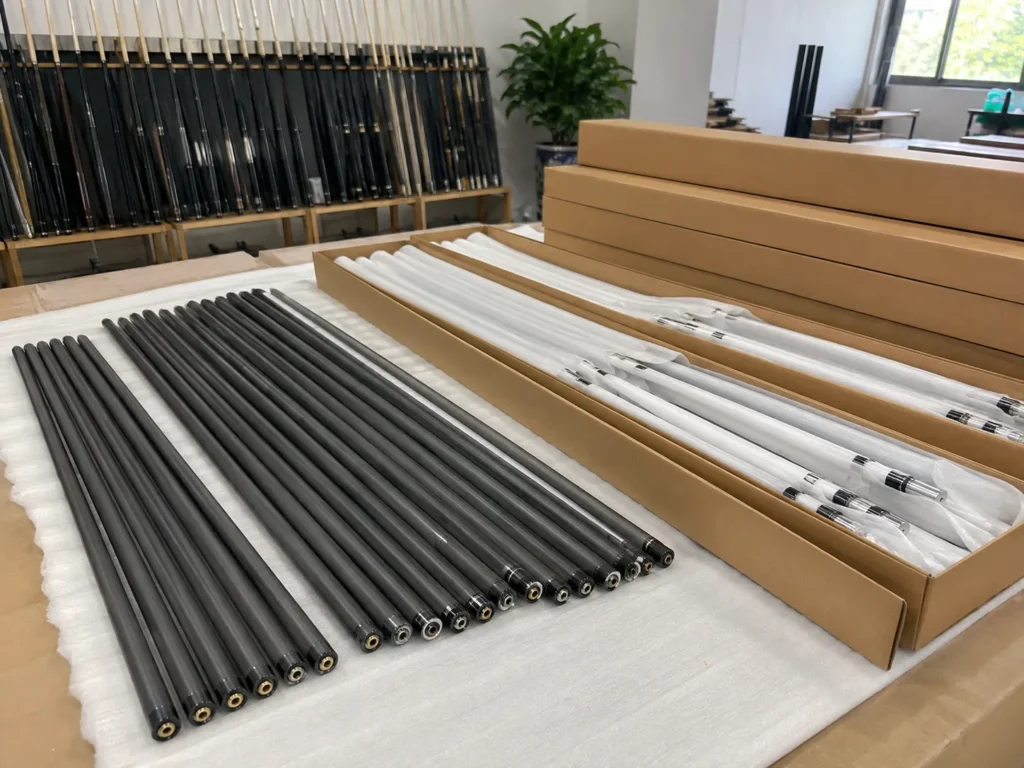
Custom Options for Carbon Fiber Cue Shafts
Custom options help brands and distributors create products that match their target market.
For B2B buyers, standard cue shafts may not be enough. A brand may need a specific diameter, joint type, surface finish, logo, or packaging style. These custom details help the product stand out.
Zu den gängigen Anpassungsoptionen gehören:
| Individuelle Option | Warum es wichtig ist |
| Wellendurchmesser | Affects bridge feel and player preference |
| Wellenlänge | Matches different cue designs |
| Verbindungstyp | Ensures compatibility with cue butts |
| Taper | Affects stroke comfort |
| Tip hardness | Changes control and feedback |
| Ferrule design | Affects feel and durability |
| Oberflächengüte | Affects hand feel and appearance |
| Carbon fiber pattern | Supports product positioning |
| Logo placement | Helps private-label branding |
| Verpackung | Improves retail presentation |
A good carbon fiber cue shaft manufacturer should help buyers turn these custom needs into a clear specification sheet.
For example, instead of only saying “we need a carbon fiber cue shaft,” a buyer should confirm:
- Required shaft diameter
- Wellenlänge
- Verbindungstyp
- Aufbau von Spitze und Hülse
- Oberflächengüte
- Logo position
- Packaging style
- Sample quantity
- Bulk order quantity
- Target market level
The clearer the specification, the lower the risk during production.
Joint Compatibility for Custom Carbon Fiber Cue Shafts
Joint compatibility is critical because a cue shaft must fit the cue butt correctly.
This is especially important for replacement carbon fiber cue shafts. Many players do not buy a full new cue. They keep their existing wood butt and upgrade only the shaft. In this case, the joint must match.
Common joint options include:
- 5/16 × 18
- 5/16 × 14
- 3/8 × 10
- 3/8×11
- Radial
- Uni-Loc
- Maßgefertigte Gelenkeinsätze
For distributors, it is important to understand the target market. Some markets may prefer Uni-Loc. Others may use 5/16×18 or Radial more often. If you choose the wrong joint options, the product may be hard to sell.
For OEM orders, buyers should confirm the joint before sample production. If possible, provide a reference cue butt, technical drawing, or exact joint requirement.
A good manufacturer should also test joint fit during quality control. The connection should feel secure. It should not be too loose or too tight.
Quality Control for Carbon Fiber Cue Shafts
Quality control is what separates a good sample from a reliable bulk order.
Many suppliers can make one good-looking sample. The real question is whether they can produce the same quality again and again.
A good carbon fiber cue shaft QC process should include:
| QC Item | Warum es wichtig ist |
| Straightness check | Ensures the shaft is suitable for play |
| Diameter check | Keeps hand feel and tip fit consistent |
| Surface inspection | Avoids roughness, bubbles, or finish defects |
| Joint fit check | Ensures correct connection with cue butt |
| Weight check | Helps maintain consistent product feel |
| Tip inspection | Affects control and durability |
| Ferrule inspection | Affects sound and feedback |
| Visual inspection | Protects brand image |
| Logo check | Ensures private-label quality |
| Packaging check | Reduces shipping and presentation issues |
For brands and distributors, QC should not be vague. Before bulk production, ask the manufacturer how they inspect the shaft.
Important questions include:
- How do you check straightness?
- How do you control shaft diameter?
- Do you inspect every joint insert?
- Can you check surface finish before packing?
- Can you follow an approved sample?
- Can you provide photos or inspection details before shipment?
A professional manufacturer should be willing to discuss these details.
Sample Development Before Bulk Orders
Sample development is necessary for custom carbon fiber cue shaft orders.
Cue shafts are feel-based products. Photos are not enough. A buyer needs to test the real shaft in hand. The sample helps check surface feel, joint fit, straightness, taper, tip, ferrule, weight, and overall playing response.
A practical sample process usually looks like this:
- Confirm the buyer’s required specifications.
- Make the first sample.
- Check shaft diameter, joint, finish, and appearance.
- Test the shaft feel and fit.
- Adjust details if needed.
- Approve the final sample.
- Start bulk production based on the approved sample.
For private-label brands, sample testing is very important. Your customers will judge the product by real use, not by product photos.
For new buyers, sample development also helps reduce risk. It is better to solve small problems before bulk production than after shipment.
At LH Carbon Solutions, we usually suggest custom buyers start with sample confirmation before moving to larger orders. This helps both sides confirm the product direction clearly.
MOQ, Lead Time, and Bulk Order Planning
MOQ and lead time affect inventory planning, launch schedules, and total cost.
Before choosing a carbon fiber cue shaft manufacturer, ask about sample lead time, bulk production time, MOQ, mixed specifications, packaging time, and shipping options.
Useful questions include:
- What is the MOQ for custom carbon fiber cue shafts?
- Can different diameters be mixed in one order?
- Can different joint types be mixed in one order?
- What is the sample lead time?
- What is the bulk production lead time?
- Can you support private-label packaging?
- What information do you need before production?
- How do you pack the shafts for export?
A good manufacturer should give realistic answers. Be careful if a supplier promises everything very quickly without checking specifications. Custom cue shaft production needs clear details.
For new brands, it may be better to start with a smaller first order after sample approval. This allows you to test market response before increasing quantity.
Work with a Custom Carbon Fiber Cue Shaft Manufacturer in China
A China-based carbon fiber cue shaft manufacturer can help brands, distributors, and cue makers develop custom cue shaft products with flexible specifications.
China has a strong supply chain for carbon fiber composite products, machining, surface finishing, packaging, and export support. This makes China a practical sourcing base for OEM carbon fiber cue shafts.
However, buyers should not choose a supplier only because they are located in China. The real point is whether the manufacturer understands carbon fiber cue shaft requirements and can control the details.
Bei LH Carbon Solutions, we are a China-based custom carbon fiber products manufacturer. We support brands, distributors, and cue makers with OEM carbon fiber cue shaft development, sample testing, and bulk production.
We can help develop carbon fiber cue shafts based on:
- Wellendurchmesser
- Wellenlänge
- Taper requirement
- Verbindungstyp
- Tip and ferrule options
- Oberflächengüte
- Carbon fiber appearance
- Logo placement
- Private-label packaging
- Sample development
- Bulk order production
Our goal is not only to supply a standard shaft. We help buyers turn their product idea into a clear specification, make samples for testing, and then support stable bulk production after approval.
For buyers who are building a new product line, this process is important. It helps reduce risk and makes the final product easier to sell.
Red Flags When Choosing a Supplier
Some warning signs can help buyers avoid the wrong carbon fiber cue shaft supplier.
A good supplier should ask about your product requirements. If a supplier only asks for quantity and target price, they may not understand the details that affect cue shaft quality.
Common red flags include:
- They do not ask about joint type.
- They cannot explain shaft diameter options.
- They avoid sample testing.
- They cannot discuss surface finish.
- They do not have a clear QC process.
- They promise very low prices without details.
- They cannot confirm lead time clearly.
- They cannot support logo or packaging details.
- They use only generic product photos.
- They do not understand cue shaft feel.
For carbon fiber cue shafts, small details matter. A supplier who ignores these details may create bigger problems later.
The best manufacturer is not always the cheapest one. It is the one who can provide stable quality, clear communication, and real support for your product plan.
Manufacturer Selection Checklist
Use this checklist before choosing a carbon fiber cue shaft manufacturer.
- Confirm whether the supplier is a manufacturer or trader.
- Ask about carbon fiber cue shaft production experience.
- Check available shaft diameter options.
- Confirm joint type capability.
- Ask about tip and ferrule options.
- Review surface finish samples.
- Ask how straightness is inspected.
- Confirm logo and packaging support.
- Ask about sample development.
- Confirm MOQ and lead time.
- Review QC process before shipment.
- Test samples before bulk orders.
This checklist helps buyers compare suppliers more clearly. It also makes communication easier.
If a supplier can answer these questions clearly, they are usually more suitable for custom orders.
FAQ About Carbon Fiber Cue Shaft Manufacturers
What should I look for in a carbon fiber cue shaft manufacturer?
You should check production experience, shaft straightness control, joint accuracy, surface finish quality, custom options, sample support, and QC process.
Can carbon fiber cue shafts be customized?
Yes. Carbon fiber cue shafts can be customized by diameter, length, taper, joint type, tip, ferrule, surface finish, logo, and packaging.
What joint types can be used for carbon fiber cue shafts?
Common joint types include 5/16×18, 5/16×14, 3/8×10, 3/8×11, Radial, Uni-Loc, and custom joint inserts.
Should I order samples before bulk production?
Yes. Samples are important because cue shafts must be tested for feel, joint fit, surface finish, straightness, and overall playing response.
Is China a good place to source carbon fiber cue shafts?
Yes, China can be a good place to source custom carbon fiber cue shafts because of its carbon fiber supply chain, manufacturing flexibility, and export support. But buyers should still check the manufacturer’s experience and quality control.
What affects the cost of custom carbon fiber cue shafts?
Cost can be affected by shaft diameter, carbon fiber structure, surface finish, joint insert, tip, ferrule, logo, packaging, MOQ, and quality requirements.
Can I create a private-label carbon fiber cue shaft?
Yes. Private-label carbon fiber cue shafts can be made with custom logo, packaging, shaft specifications, joint options, and surface finish.
Need Custom Carbon Fiber Cue Shafts for Your Brand?
Choosing the right carbon fiber cue shaft manufacturer is important for long-term product quality.
A good supplier should understand shaft feel, joint compatibility, surface finish, straightness control, branding, and bulk production consistency.
If you need custom carbon fiber cue shafts, OEM carbon fiber pool cue shafts, or private-label cue shaft products, LH Carbon Solutions can help you develop samples based on your required specifications.
Send us your target diameter, joint type, shaft length, surface finish, tip preference, logo requirements, packaging needs, and estimated order quantity. Our team can review your needs and suggest a suitable custom solution.
Abschließende Überlegungen
Choosing a carbon fiber cue shaft manufacturer is a serious decision for brands, distributors, and cue makers.
A good supplier should not only provide a product. They should help confirm specifications, develop samples, test details, control quality, and prepare for bulk production.
Before placing an order, compare more than price. Check shaft diameter, joint compatibility, surface finish, straightness, tip, ferrule, logo options, packaging, MOQ, lead time, and QC process.
The best manufacturer is the one who understands your market and can turn your requirements into stable products.
If you are planning to develop custom carbon fiber cue shafts for your brand, starting with clear specifications and sample testing is the safest first step.
