

Carbon fiber pool cues and wood pool cues both have their place. The right choice depends on how you play, what feel you prefer, and whether you care more about tradition, stability, or low maintenance.
For many years, wood was the standard material for pool cues. Most players learned the game with a wooden cue. The sound, feel, and feedback of wood are familiar to many people. But in recent years, carbon fiber pool cues and carbon fiber cue shafts have become much more popular.
This change is not only about appearance. Carbon fiber brings different performance features. It can offer better stability, easier cleaning, strong resistance to warping, and low-deflection performance. That is why many players, cue brands, and distributors are comparing carbon fiber vs wood pool cues before making a decision.
But carbon fiber is not always the perfect choice for every player. Some players still prefer wood because it feels warmer, more natural, and more traditional. So the real question is not “Which material is always better?” The better question is:
Which pool cue material is better for your playing style, market, and buying purpose?
This guide compares carbon fiber and wood pool cues in a simple and practical way.
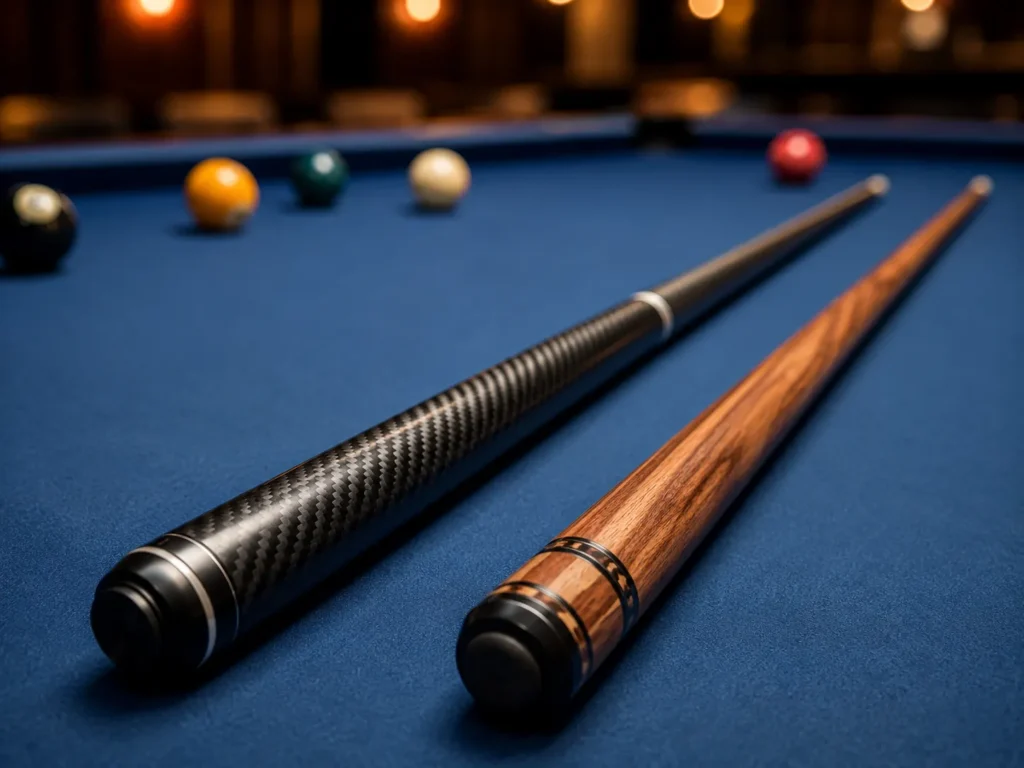
Carbon Fiber vs Wood Pool Cue: Quick Answer
Carbon fiber is better for players who want stability, low maintenance, and consistent performance. Wood is better for players who prefer traditional feel, natural feedback, and classic cue design.
If you want a short answer, here it is:
Choose a carbon fiber pool cue or carbon fiber cue shaft if you want:
- More stable performance
- Better resistance to warping
- Easier cleaning
- A smooth surface feel
- Low-deflection performance
- A modern look
- Better consistency in different environments
Choose a wood pool cue if you want:
- Traditional cue feel
- Natural wood feedback
- Classic appearance
- Softer hit sound
- A familiar playing experience
- A wider range of price options
For many players, the best middle option is simple: use a carbon fiber cue shaft with a wood butt. This gives the player the stability and low-deflection benefits of carbon fiber while keeping the look and balance of a traditional wooden cue.
For brands and distributors, the right choice depends on your customer group. If your customers are traditional players, wood may still be important. If your customers want modern performance products, carbon fiber cue shafts are worth considering.
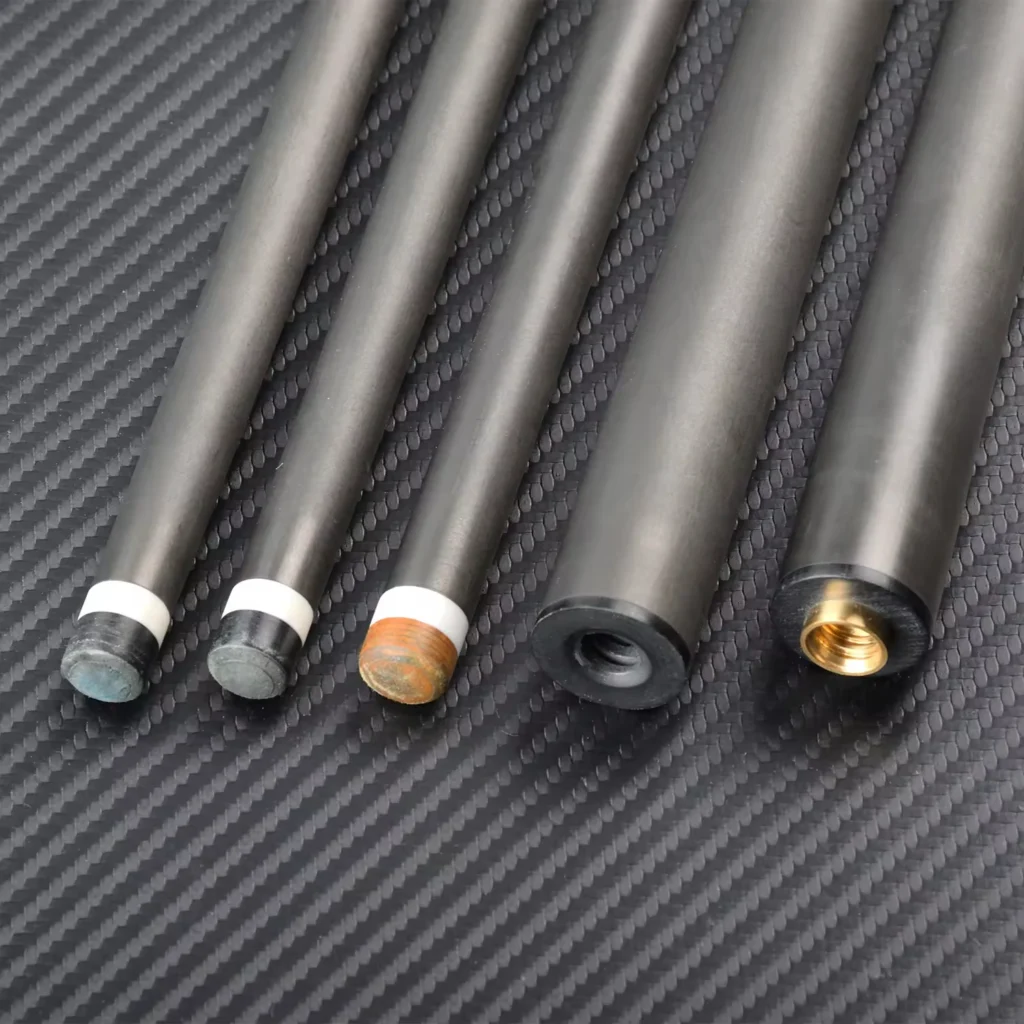
Material Feel and Hit Feedback
Feel is one of the biggest differences between carbon fiber and wood pool cues.
A wood pool cue usually gives a warmer and more natural hit. Many players like the small vibration and feedback that wood gives during a shot. It feels familiar because most players have used wood cues for a long time.
A carbon fiber cue shaft usually feels smoother, firmer, and more modern. Some players describe it as cleaner and more stable. Others may feel that it is less “natural” than wood when they first try it.
This does not mean one feel is right and the other is wrong. It depends on player preference.
Wood feel is often preferred by players who:
- Like traditional feedback
- Care about sound and vibration
- Prefer a classic cue style
- Have used wood shafts for many years
Carbon fiber feel is often preferred by players who:
- Want smooth bridge movement
- Want stable response
- Care about consistency
- Prefer a modern performance shaft
- Do not want to worry much about maintenance
For B2B buyers, this point is important. A carbon fiber cue shaft should not only look good. It should also feel comfortable in the bridge hand. If the surface is too sticky, too rough, or too glossy, players may not like it.
That is why surface finish matters. A good carbon fiber pool cue should feel smooth, clean, and easy to control.
Low Deflection and Cue Ball Control
Die geringe Durchbiegung ist einer der Hauptgründe, warum Spieler sich für Queueschäfte aus Kohlefaser entscheiden.
When a player uses side spin, the cue ball may move away from the original aiming line. This is often called deflection or squirt. A low-deflection shaft is designed to reduce this effect and help the player aim more consistently.
Many carbon fiber cue shafts are designed with low front-end mass. This can help reduce cue ball deflection. Because of this, carbon fiber shafts are popular with players who use English often.
Wood shafts can also be low deflection, depending on their design. But carbon fiber gives manufacturers more control over structure, wall thickness, stiffness, and front-end design.
Here is the simple difference:
| Faktor | Queueschaft aus Kohlefaser | Wood Cue Shaft |
|---|---|---|
| Deflection control | Oft für geringe Durchbiegung ausgelegt | Depends on wood type and shaft design |
| Front-end mass | Easier to control in production | More affected by material variation |
| Consistency | More repeatable | Can vary from shaft to shaft |
| Player adjustment | May need time to adapt | Feels familiar to many players |
Low deflection does not mean zero deflection. No shaft can completely remove all aiming adjustment. A better way to describe carbon fiber is this:
A good carbon fiber cue shaft can help reduce deflection and support more consistent cue ball control.
For players, this can be helpful. For brands and distributors, it is also a strong selling point. But it should be explained honestly. Overpromising performance can reduce trust.
Durability, Warping, and Maintenance
Carbon fiber has a clear advantage in durability and maintenance.
Wood is a natural material. It can be affected by humidity, temperature, storage conditions, and long-term use. A good wood shaft can last a long time, but it needs care. If it is exposed to poor conditions, it may warp, dent, or change feel.
Carbon fiber is much more stable. It is less likely to warp and is easier to clean. This is one reason many players choose carbon fiber cue shafts, especially if they play often or travel with their cue.
A carbon fiber shaft is also more resistant to small dents compared with wood. A wood shaft can be dented by impact or careless handling. Carbon fiber is not impossible to damage, but it generally handles normal use very well.
Maintenance is also different.
Wood cue shafts may need:
- Regular cleaning
- Shaft conditioning
- Careful humidity control
- Protection from dents
- Smoother surface maintenance
Carbon fiber cue shafts usually need:
- Wiping with a soft cloth
- Proper cleaner if needed
- Avoiding harsh chemicals
- Avoiding rough abrasives
- Safe storage after play
For pool halls, clubs, distributors, and rental environments, the low-maintenance advantage of carbon fiber can be important. Less maintenance means fewer after-sales problems and a longer useful life.
For players, the benefit is also simple. A carbon fiber cue shaft is easier to keep smooth and clean.
Price and Long-Term Value
Carbon fiber pool cues usually cost more than basic wood cues, but the long-term value can be strong.
Wood pool cues have a very wide price range. There are low-cost beginner cues, mid-range cues, and expensive custom cues. This makes wood easy to sell across different market levels.
Carbon fiber pool cues and carbon fiber cue shafts usually start at a higher price level. The material, production process, joint assembly, surface finish, and quality control all affect cost.
At first, a carbon fiber cue shaft may seem expensive. But buyers should also consider long-term value.
Carbon fiber may offer better value if the buyer cares about:
- Lower maintenance
- Better stability
- Longer service life
- Less warping risk
- Consistent performance
- Modern product positioning
Wood may offer better value if the buyer cares about:
- Lower entry price
- Traditional feel
- Wide product range
- Classic design
- Custom wood appearance
For individual players, the right choice depends on budget and preference. A player who plays often may feel that a carbon fiber shaft is worth the higher price. A casual player may prefer a lower-cost wood cue.
For distributors, it can be useful to offer both. Wood cues can cover entry-level and traditional customers. Carbon fiber shafts can cover premium and performance-focused customers.
Carbon Fiber Shaft with Wood Butt: A Practical Middle Option
A carbon fiber cue shaft with a wood butt is one of the most practical choices for many players.
Many players do not want to give up their favorite cue butt. They may like the weight, balance, grip, artwork, and feel of their current wood cue. But they still want the performance benefits of carbon fiber.
This is why replacement carbon fiber cue shafts are popular.
A player can keep the wood butt and upgrade only the shaft. This gives several benefits:
- The player keeps the familiar cue balance.
- The cue still looks traditional.
- The shaft becomes more stable and easier to maintain.
- The player can get low-deflection performance.
- The total cost may be lower than buying a full new cue.
This option is also useful for brands and cue makers. Instead of launching only full carbon fiber pool cues, they can offer carbon fiber shafts as an upgrade product.
For this to work, joint compatibility is very important. The carbon fiber cue shaft must match the cue butt. Common joint types include 5/16×18, 5/16×14, 3/8×10, Radial, and Uni-Loc.
If the joint does not match, the shaft cannot be used correctly. So buyers should always confirm the joint system before ordering.
Carbon Fiber vs Wood Pool Cue Comparison Table
This table gives a simple overview of the main differences between carbon fiber and wood pool cues.
| Vergleichsfaktor | Carbon Fiber Pool Cue / Shaft | Wood Pool Cue / Shaft |
| Gefühl | Geschmeidig, fest, modern | Natural, warm, traditional |
| Durchbiegung | Often lower | Hängt von der Wellenkonstruktion ab |
| Stabilität | Very stable | Can change with humidity |
| Warping risk | Very low | Higher than carbon fiber |
| Wartung | Easy to clean | Erfordert mehr Sorgfalt |
| Aussehen | Modern carbon fiber pattern | Classic wood grain |
| Durability | Strong and dent resistant | Can dent or warp |
| Price | Usually higher | Wide price range |
| Am besten geeignet für | Players who want consistency | Players who love classic feel |
| B2B value | Good for premium product lines | Good for traditional markets |
This table does not mean carbon fiber is always better. It means carbon fiber and wood serve different types of players.
For modern performance, carbon fiber has strong advantages. For tradition and natural feedback, wood still has value.
Who Should Choose Carbon Fiber?
Carbon fiber is a good choice for players who want consistency, low maintenance, and modern performance.
You should consider a carbon fiber pool cue or carbon fiber cue shaft if you:
- Play often
- Use side spin frequently
- Want low-deflection performance
- Want a shaft that stays stable
- Prefer smooth bridge movement
- Do not want to maintain wood often
- Travel with your cue
- Like modern cue design
Carbon fiber is also a good option for competitive players who care about small performance differences. A stable shaft can help players build a more repeatable stroke and aiming system.
For cue brands and distributors, carbon fiber is a good choice if your customers are looking for upgrade products. A carbon fiber cue shaft can be positioned as a premium performance product.
It is also useful for private-label brands. With custom options such as diameter, joint type, tip, finish, logo, and packaging, brands can build a clear product line for their market.
Who Should Stay with Wood?
Wood is still a good choice for many players.
You may prefer a wood pool cue if you:
- Like traditional cue feel
- Want natural hit feedback
- Prefer classic wood appearance
- Are sensitive to sound and vibration
- Want a lower entry price
- Enjoy custom wood designs
- Already have a wood cue you love
Some players feel that carbon fiber is too firm or too different from what they are used to. For these players, wood may still feel better.
Wood cues also have strong emotional value. Many players like the look of wood grain, the craftsmanship, and the traditional style. This is something carbon fiber cannot fully replace.
For brands and distributors, wood products may still be important if your market is traditional or price-sensitive.
The best approach is not always to replace wood with carbon fiber. Sometimes the best strategy is to offer carbon fiber as an upgrade option.
Custom Carbon Fiber Pool Cues for Brands and Distributors
Custom carbon fiber pool cues and cue shafts can help brands create a modern performance product line.
For B2B buyers, carbon fiber is not only a material choice. It is also a product positioning choice. A carbon fiber cue shaft can be sold as a premium upgrade, a private-label product, or part of a complete cue line.
As a China-based custom carbon fiber pool cue manufacturer, we help brands, distributors, and cue makers develop carbon fiber cue shafts and full cue options based on their required specifications.
Zu den individuellen Optionen können gehören:
- Wellendurchmesser
- Wellenlänge
- Verbindungstyp
- Aufbau von Spitze und Hülse
- Oberflächengüte
- Carbon fiber pattern
- Gewicht und Schwerpunkt
- Logo placement
- Verpackung
- Sample development
- Bulk production
For brands, the goal is not only to buy carbon fiber shafts. The goal is to build a product that customers can trust. That requires stable production, clear specifications, and strict quality control.
A good supplier should help buyers confirm the real details before production. These details include diameter, taper, joint type, surface finish, tip, ferrule, logo method, MOQ, and lead time.
For new brands, starting with carbon fiber cue shafts may be easier than starting with full cues. Shafts are easier to test in the market, easier to match with existing cue butts, and often easier to sell as an upgrade product.
Buying Advice: How to Decide Between Carbon Fiber and Wood
The best choice depends on what you want from the cue.
Before choosing, ask these questions:
- Do you prefer traditional feel or modern consistency?
- Do you use side spin often?
- Do you want lower maintenance?
- Do you play in different environments?
- Do you already have a cue butt you like?
- Is your market more traditional or performance-focused?
- Are you buying for personal use, resale, or private label?
- Do you need custom diameter, joint type, logo, or packaging?
If you are a player, test both materials if possible. Feel matters. What works for one player may not work for another.
If you are a distributor or brand, do not choose only by trend. Study your customers. If they care about performance and upgrade products, carbon fiber cue shafts are a strong option. If they care about classic style and price, wood may still be important.
For many markets, the best product plan is a mix:
- Wood cues for traditional and entry-level customers
- Carbon fiber cue shafts for performance upgrades
- Full carbon fiber pool cues for premium product lines
- Custom OEM options for brand differentiation
This gives buyers more choice and reduces the risk of relying on only one product type.
FAQ About Carbon Fiber vs Wood Pool Cues
Are carbon fiber pool cues better than wood?
Carbon fiber pool cues are better for stability, low maintenance, and modern performance. Wood cues are better for traditional feel and natural feedback. The better choice depends on the player.
Do carbon fiber pool cues warp?
Carbon fiber pool cues and cue shafts have very low warping risk compared with wood. They are much more stable in different environments.
Lohnen sich Queueschäfte aus Kohlefaser?
Yes, they are worth it for many players who want low deflection, smooth feel, and easier maintenance. But players who prefer traditional wood feedback may still choose wood.
Can I put a carbon fiber shaft on a wood cue?
Yes, if the joint type matches. Many players use a carbon fiber shaft with a wood butt. This is a practical way to upgrade performance without replacing the whole cue.
Does a carbon fiber cue feel different from wood?
Yes. Carbon fiber usually feels smoother, firmer, and more modern. Wood usually feels warmer, more natural, and more traditional.
Is carbon fiber good for beginners?
Yes, beginners can use carbon fiber, but it may not always be necessary. For beginners, comfort and budget are also important. Carbon fiber is more useful when the player wants stable performance and lower maintenance.
Which is better for distributors, carbon fiber or wood?
It depends on the market. Carbon fiber is better for premium and performance-focused products. Wood is better for traditional, entry-level, and classic cue markets. Many distributors can benefit from offering both.
Abschließende Überlegungen
Carbon fiber and wood pool cues are not the same, and they should not be sold in the same way.
Carbon fiber is best for buyers who want stability, low maintenance, modern design, and low-deflection performance. Wood is best for buyers who want traditional feel, natural feedback, and classic appearance.
For many players, the best choice is not a full carbon fiber cue or a full wood cue. It may be a carbon fiber cue shaft with a wood butt. This gives a good balance between modern performance and traditional cue feel.
For brands and distributors, carbon fiber cue shafts offer strong value as a premium upgrade product. They can be customized by diameter, joint type, finish, tip, logo, and packaging.
Before choosing between carbon fiber and wood, compare the real needs of your players or customers. The right cue is not only about material. It is about feel, control, maintenance, value, and long-term trust.
If you want to have carbon fiber pool cue you can click here :
Queueschaft aus Kohlefaser
