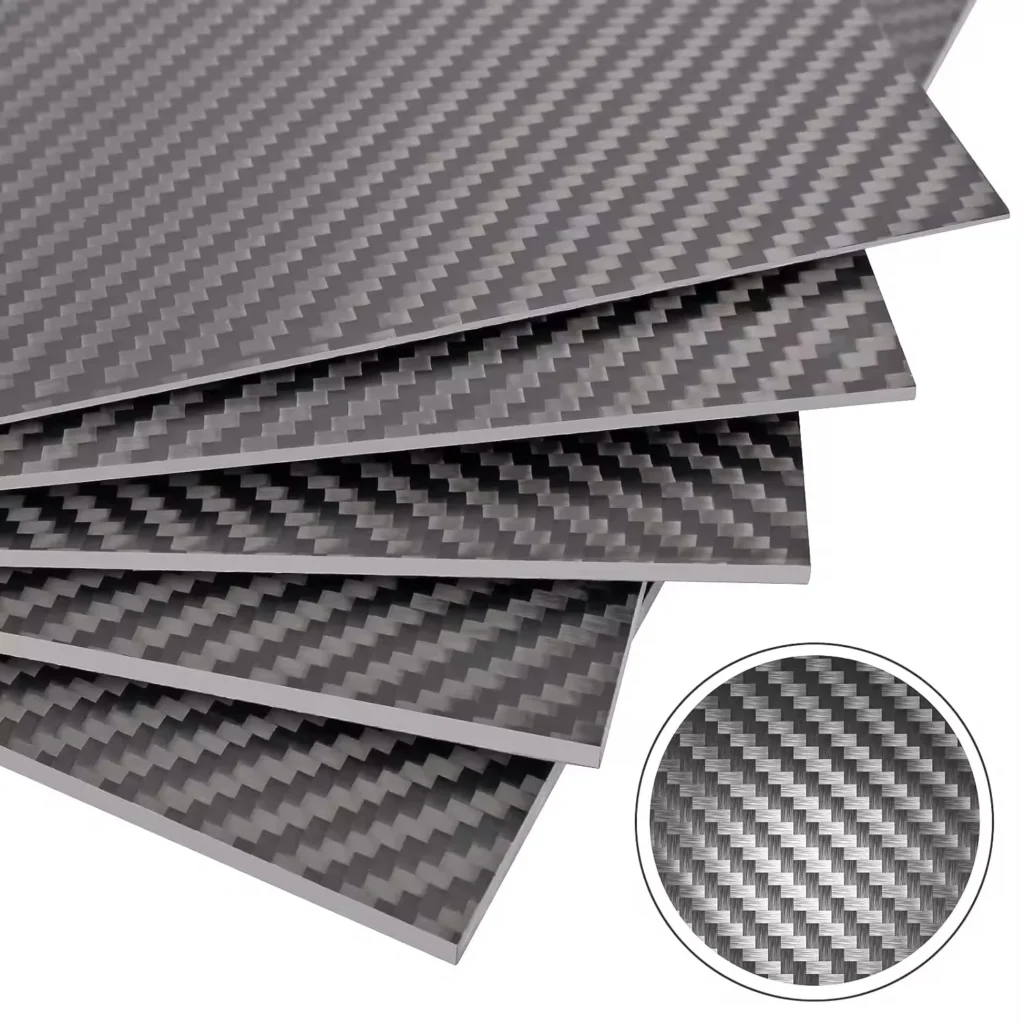
A solid carbon fiber sheet weighs about 1.60 kg per square meter per 1mm thickness.
For example:
-
A 1000 × 1000 × 1mm carbon fiber sheet weighs about 1.60 kg.
-
A 1000 × 1000 × 3mm carbon fiber sheet weighs about 4.80 kg.
-
A 1220 × 2440mm / 4×8 ft 3mm carbon fiber sheet weighs about 14.29 kg / 31.5 lb.
The actual weight may change slightly because of resin content, fiber layup, surface coating, and whether the panel is solid laminate or a sandwich panel.
Overview: Why Carbon Fiber Sheet Weight Matters
Carbon fiber sheets are known for being lightweight and strong. But for buyers, engineers, and product designers, “lightweight” is not enough.
They often need to know the real weight before ordering.
A buyer may ask:
-
How much does a 3mm carbon fiber sheet weigh?
-
How heavy is a 4×8 carbon fiber sheet?
-
Is carbon fiber sheet lighter than aluminum?
-
Can I reduce weight by replacing steel sheet with carbon fiber?
-
What thickness should I choose for my part?
These are practical questions. The answer affects design, shipping, installation, handling, and final product performance.
Carbon fiber sheets are often used in drone frames, robot panels, machine covers, automotive parts, sports equipment, marine panels, tooling plates, and lightweight custom parts. In these applications, weight can directly affect how the final product works.
If the sheet is too thin, it may not be stiff enough. If it is too thick, it may become expensive and heavier than expected. That is why weight calculation is useful before choosing the final thickness.
If you are selecting sheets for a custom project, it is also helpful to compare this guide with your carbon fiber sheet sizes, thickness options, and machining requirements.
How to Calculate Carbon Fiber Sheet Weight
Carbon fiber sheet weight is calculated by volume and density.
The basic formula is:
Weight = Length × Width × Thickness × Density
For common solid carbon fiber composite sheets, a practical density value is around 1.5–1.6 g/cm³. In this guide, we use 1.60 g/cm³ as the calculation basis.
In metric units, the simple formula is:
Weight in kg = Area in m² × Thickness in mm × 1.60
For example, a 1000 × 1000 × 2mm carbon fiber sheet:
-
Area = 1 m²
-
Thickness = 2 mm
-
Density factor = 1.60
Weight = 1 × 2 × 1.60 = 3.20 kg
This formula is useful for quick project estimation.
However, it is still an estimate. The final weight can vary because carbon fiber sheet is a composite material. It includes carbon fiber and resin. Different suppliers may use different fiber volume, resin systems, layup designs, and surface finishes.
For early design and quotation, this formula is usually accurate enough. For precision parts, the final weight should be confirmed with the supplier after the sheet structure and production method are fixed.
Carbon Fiber Sheet Weight Table by Thickness
The table below shows estimated weights for common carbon fiber sheet sizes from 0.5mm to 10mm thickness.
Calculation basis:
-
Material: solid carbon fiber reinforced epoxy sheet
-
Density used: 1.60 g/cm³
-
Source note: Toray CFRP laminate data and carbon/epoxy composite material references
-
Values are rounded estimates
| Thickness | 300 × 300 mm | 500 × 500 mm | 1000 × 1000 mm | 1220 × 2440 mm / Approx. 4×8 ft |
|---|---|---|---|---|
| 0.5 mm | 0.07 kg | 0.20 kg | 0.80 kg | 2.38 kg |
| 1 mm | 0.14 kg | 0.40 kg | 1.60 kg | 4.76 kg |
| 1.5 mm | 0.22 kg | 0.60 kg | 2.40 kg | 7.14 kg |
| 2 mm | 0.29 kg | 0.80 kg | 3.20 kg | 9.53 kg |
| 3 mm | 0.43 kg | 1.20 kg | 4.80 kg | 14.29 kg |
| 4 mm | 0.58 kg | 1.60 kg | 6.40 kg | 19.05 kg |
| 5 mm | 0.72 kg | 2.00 kg | 8.00 kg | 23.81 kg |
| 6 mm | 0.86 kg | 2.40 kg | 9.60 kg | 28.58 kg |
| 8 mm | 1.15 kg | 3.20 kg | 12.80 kg | 38.10 kg |
| 10 mm | 1.44 kg | 4.00 kg | 16.00 kg | 47.63 kg |
This table is useful for early design, shipping estimates, and product planning.
For example, a 1000 × 1000 × 3mm carbon fiber sheet weighs about 4.80 kg. A full 1220 × 2440mm sheet with 3mm thickness weighs about 14.29 kg.
A 1mm difference in thickness may seem small, but it can make a large weight difference when the sheet size is big. For a full 4×8 sheet, increasing thickness from 2mm to 3mm adds about 4.76 kg.
4×8 Carbon Fiber Sheet Weight in kg and lbs
A full-size carbon fiber sheet is often called a 4×8 sheet.
The exact 4×8 ft size is about 1219 × 2438 mm. Many suppliers use 1220 × 2440 mm as a practical metric size. The difference is very small, so this guide uses 1220 × 2440 mm for calculation.
The table below gives the estimated 4×8 carbon fiber sheet weight in both kg and lbs.
| Thickness | Inch Equivalent | 4×8 Sheet Weight | 4×8 Sheet Weight | Common Use |
|---|---|---|---|---|
| 1 mm | 0.039 in | 4.76 kg | 10.5 lb | Decorative panels, thin covers, light backing plates |
| 1.5 mm | 0.059 in | 7.14 kg | 15.7 lb | Light structural panels, covers, trim parts |
| 2 mm | 0.079 in | 9.53 kg | 21.0 lb | Drone parts, machine covers, automotive panels |
| 3 mm | 0.118 in | 14.29 kg | 31.5 lb | Brackets, stronger panels, CNC parts |
| 4 mm | 0.157 in | 19.05 kg | 42.0 lb | Rigid panels, industrial parts |
| 5 mm | 0.197 in | 23.81 kg | 52.5 lb | Structural plates, support panels |
| 6 mm | 0.236 in | 28.58 kg | 63.0 lb | Heavy-duty custom panels |
| 8 mm | 0.315 in | 38.10 kg | 84.0 lb | High-stiffness plates and machined parts |
| 10 mm | 0.394 in | 47.63 kg | 105.0 lb | Thick structural plates and CNC components |
This table is useful for buyers in the United States and other markets that use inch and pound units.
A 3mm 4×8 carbon fiber sheet weighs about 31.5 lb. A 10mm 4×8 sheet weighs about 105 lb. So even though carbon fiber is much lighter than metal, a large thick carbon fiber sheet still needs careful handling and packaging.
Carbon Fiber Sheet vs Aluminum Sheet vs Steel Sheet Weight
Carbon fiber sheet is much lighter than steel and also lighter than aluminum.
For comparison, this table uses common material density values.
| Material | Density Used for Calculation | Source Note |
|---|---|---|
| Carbon fiber composite sheet | 1.60 g/cm³ | Toray CFRP laminate reference data |
| Aluminum 6061-T6 | 2.70 g/cm³ | ASM / MatWeb aluminum 6061-T6 data |
| AISI 1020 carbon steel | 7.87 g/cm³ | AZoM AISI 1020 steel data |
Based on these density values, carbon fiber sheet is about:
-
40.7% lighter than aluminum 6061-T6
-
79.7% lighter than AISI 1020 steel
The table below compares estimated weights for a 1220 × 2440 mm sheet.
| Thickness | Carbon Fiber Sheet | Aluminum 6061-T6 Sheet | AISI 1020 Steel Sheet | Carbon Fiber vs Aluminum | Carbon Fiber vs Steel |
|---|---|---|---|---|---|
| 1 mm | 4.76 kg | 8.04 kg | 23.43 kg | 40.7% lighter | 79.7% lighter |
| 2 mm | 9.53 kg | 16.07 kg | 46.85 kg | 40.7% lighter | 79.7% lighter |
| 3 mm | 14.29 kg | 24.11 kg | 70.28 kg | 40.7% lighter | 79.7% lighter |
| 5 mm | 23.81 kg | 40.19 kg | 117.14 kg | 40.7% lighter | 79.7% lighter |
| 10 mm | 47.63 kg | 80.37 kg | 234.27 kg | 40.7% lighter | 79.7% lighter |
This comparison shows why carbon fiber sheets are used in lightweight applications.
For a 3mm full-size sheet, carbon fiber weighs about 14.29 kg, aluminum weighs about 24.11 kg, and steel weighs about 70.28 kg.
This weight difference can change the final product design. A lighter panel may reduce shipping weight, make installation easier, and improve product performance.
But weight is not the only factor. Aluminum is easier to machine and usually lower in cost. Steel is tougher and better for welded or high-impact structures. Carbon fiber is best when low weight, stiffness, corrosion resistance, and appearance are more important.
If you are comparing materials for a structural part, it may also help to review carbon fiber sheet applications and custom carbon fiber parts before choosing the final material.
What Affects the Final Weight of a Carbon Fiber Sheet?
The table values are good for estimation, but the final weight can still vary.
Here are the main factors.
Sheet Thickness
Thickness has a direct effect on weight.
If the sheet size and density stay the same, a 4mm sheet weighs twice as much as a 2mm sheet.
This is why buyers should not choose the thickest sheet by default. More thickness can improve stiffness, but it also increases weight, cost, machining time, and shipping cost.
Sheet Size
A larger sheet has more area, so it weighs more.
For example, using 1.60 g/cm³ density:
-
500 × 500 × 2mm sheet weighs about 0.80 kg
-
1000 × 1000 × 2mm sheet weighs about 3.20 kg
-
1220 × 2440 × 2mm sheet weighs about 9.53 kg
This matters for packaging and international shipping.
Fiber and Resin Content
Carbon fiber sheets are composite materials. They contain carbon fiber and resin.
A sheet with different resin content may have a different weight and different mechanical performance. A resin-rich sheet is not always better. Good carbon fiber sheet design needs a balance between fiber, resin, layup, curing, and surface quality.
Surface Finish
Surface finish may slightly affect the final weight.
For example:
-
Glossy clear coat may add a small amount of weight.
-
Painted finish may add coating weight.
-
Sanded bonding surface may remove a very small amount of material.
-
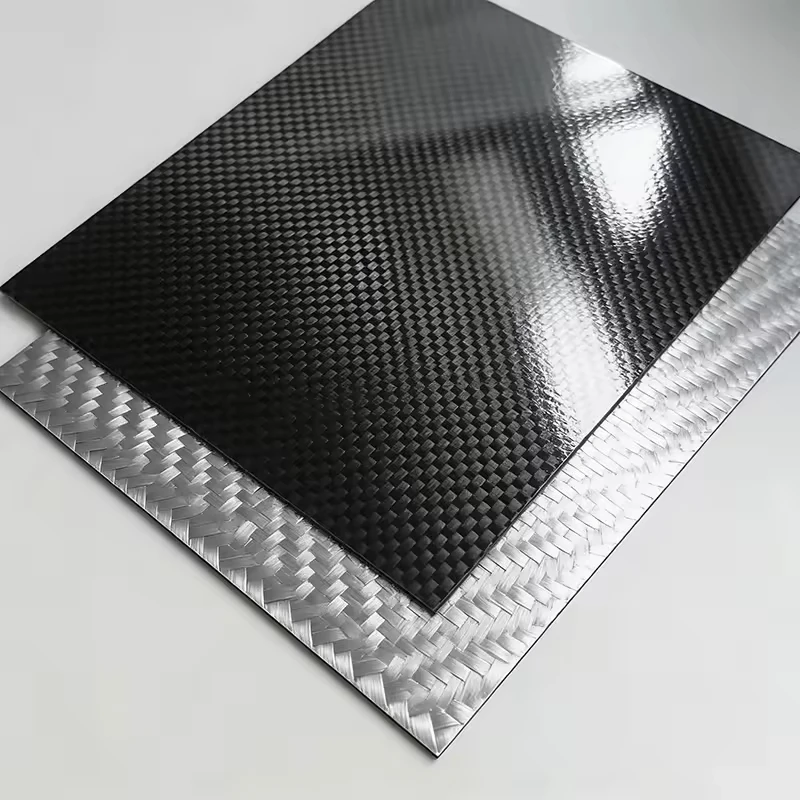
Decorative 3K twill surface may have a different structure than UD carbon fiber sheet.
For most normal projects, this weight difference is small. But for precision parts, racing products, drones, or lightweight sports parts, every gram may matter.
Solid Sheet or Sandwich Panel
Not all carbon fiber panels are solid carbon fiber laminate.
Some panels use foam, honeycomb, or lightweight core material between carbon fiber skins. These are called sandwich panels.
A 10mm solid carbon fiber sheet is heavy and expensive. A 10mm carbon fiber sandwich panel may be much lighter while still giving good bending stiffness.
If the project needs a large lightweight panel, a sandwich panel may be better than a thick solid carbon fiber plate.
Manufacturing Method
Different manufacturing methods can also affect final weight.
Common carbon fiber sheet methods include:
-
Compression molding
-
Prepreg layup
-
Wet layup
-
Vacuum bagging
-
Autoclave curing
-
CNC cutting from flat sheets
-
Thermoformable carbon fiber sheet production
For standard solid sheets, density is usually close to the reference value. For special projects, the final weight should be confirmed after the sheet structure is fixed.
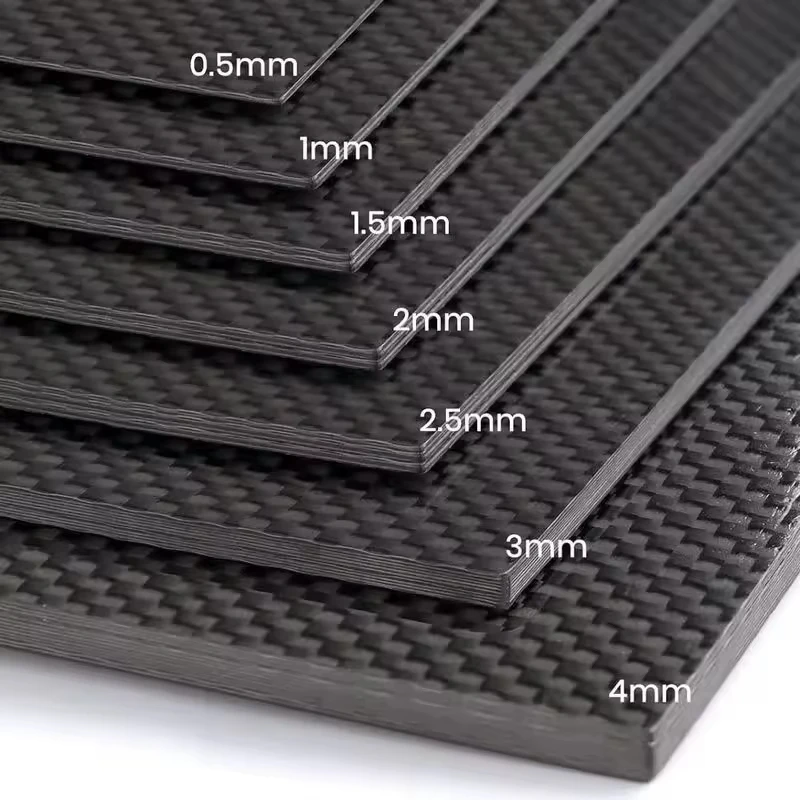
How to Choose the Right Carbon Fiber Sheet Thickness
A thicker carbon fiber sheet is not always the best choice.
The right thickness depends on sheet size, load, stiffness requirement, machining method, and target weight.
0.5mm to 1mm Carbon Fiber Sheet
Thin carbon fiber sheets are often used for decorative panels, light covers, and small non-structural parts.
They are lightweight and easy to cut, but they are not suitable for heavy load-bearing structures.
Common uses:
-
Decorative carbon fiber panels
-
Thin covers
-
Small backing plates
-
Cosmetic parts
-
Lightweight inserts
-
DIY panels
1.5mm to 2mm Carbon Fiber Sheet
This range is common for lightweight structural parts.
It gives better stiffness than 1mm sheet while still keeping weight low.
Common uses:
-
Drone frames
-
RC parts
-
Light machine covers
-
Sports parts
-
Thin support plates
-
Automotive trim parts
3mm Carbon Fiber Sheet
3mm carbon fiber sheet is one of the most popular thicknesses for custom parts.
It gives a good balance between stiffness, weight, and machining. It is often used when the part needs more strength than a thin panel but still needs to stay lightweight.
Common uses:
-
Brackets
-
Drone plates
-
Robot panels
-
Tooling fixtures
-
Automotive parts
-
Industrial covers
-
Custom CNC parts
4mm to 6mm Carbon Fiber Sheet
This range is used for stronger and more rigid parts.
The sheet becomes much stiffer, but cost and weight also increase.
Common uses:
-
Strong support plates
-
Rigid machine covers
-
Structural brackets
-
Marine panels
-
Larger CNC parts
-
Industrial custom parts
8mm to 10mm Carbon Fiber Sheet
Thick carbon fiber sheets are used for special structural applications.
They are strong and rigid, but they are also expensive and heavier than many buyers expect.
Common uses:
-
Thick structural plates
-
High-stiffness custom parts
-
CNC machined components
-
Tooling plates
-
Heavy-duty brackets
-
Special industrial panels
If the main goal is stiffness, a sandwich panel may sometimes be a better choice than a solid 10mm sheet.
Common Mistakes When Estimating Carbon Fiber Sheet Weight
Many buyers estimate carbon fiber sheet weight too quickly. This can lead to wrong thickness choices, higher cost, or shipping problems.
Mistake 1: Only Looking at Thickness
Some buyers only ask for 3mm, 5mm, or 10mm thickness.
But sheet size is just as important.
A 3mm sheet may be light if it is 300 × 300 mm. The same 3mm thickness becomes much heavier when the sheet is 1220 × 2440 mm.
Mistake 2: Thinking All Carbon Fiber Sheets Have the Same Density
Most solid carbon fiber sheets are close in density, but they are not always exactly the same.
Resin content, layup, surface finish, and fiber type can change the final weight.
Mistake 3: Confusing Solid Carbon Fiber Sheet with Sandwich Panel
A solid 10mm carbon fiber sheet and a 10mm carbon fiber sandwich panel are very different.
The solid sheet is heavier and stronger through the full thickness. The sandwich panel may be much lighter and better for large lightweight panels.
Mistake 4: Ignoring Packaging Weight
Shipping weight is not only sheet weight.
Large carbon fiber sheets need corner protection, foam, cartons, or wooden crates. For international shipping, dimensional weight can also affect freight cost.
Mistake 5: Replacing Metal Sheet with the Same Thickness
A carbon fiber sheet does not always need to use the same thickness as an aluminum or steel sheet.
Carbon fiber has different stiffness, strength, and load behavior. The best thickness should be chosen based on the part size, load direction, support points, and connection method.
Carbon Fiber Sheet Weight and Shipping
Shipping weight is not only the sheet weight.
When ordering carbon fiber sheets, buyers should also consider packaging weight and protection materials. Carbon fiber sheets need proper packaging to avoid corner damage, scratches, cracks, or delamination during transport.
A small sheet can often be packed in a carton with foam protection. A large sheet may need a wooden crate or reinforced packaging.
For full-size sheets, shipping cost can be affected by:
-
Actual sheet weight
-
Packaging weight
-
Package length and width
-
Dimensional weight
-
Quantity
-
Destination country
-
Whether the sheet is cut or full-size
-
Edge protection
-
Wooden crate requirement
Sometimes, cutting a large sheet into smaller panels can reduce handling risk and shipping difficulty.
For example, shipping four 610 × 1220 mm panels may be easier than shipping one full 1220 × 2440 mm sheet, depending on the carrier and application.
Before ordering, buyers should confirm whether they need a full sheet or cut-to-size carbon fiber panels.
Carbon Fiber Sheet Weight vs Performance
Lower weight is important, but it should not be the only goal.
A very thin carbon fiber sheet may be light, but it may not be stiff enough. A thick sheet may be strong, but it may be too expensive or too heavy.
Good material selection should balance:
-
Weight
-
Thickness
-
Stiffness
-
Strength
-
Cost
-
Machining method
-
Surface finish
-
Application environment
-
Installation method
-
Shipping size
For example, a 2mm carbon fiber sheet may be enough for a small drone part, but not for a large machine panel. A 5mm sheet may be strong enough for a bracket, but a 3mm sheet with better design may be enough in some cases.
For large flat panels, bending stiffness is often more important than tensile strength. If the panel is large and needs to resist bending, thickness and panel structure matter a lot.
In some cases, a sandwich panel may provide better stiffness-to-weight performance than a solid carbon fiber sheet.
Custom Carbon Fiber Sheets for Lightweight Applications
For OEM projects, carbon fiber sheets can be customized by size, thickness, layup, finish, tolerance, and machining.
Common custom options include:
-
Custom carbon fiber sheet thickness
-
Cut-to-size carbon fiber panels
-
3K twill glossy finish
-
3K twill matte finish
-
UD carbon fiber sheet
-
Plain weave surface
-
Painted carbon fiber sheet
-
CNC cut carbon fiber parts
-
Drilled holes and slots
-
Sanded bonding surface
-
Thermoformable carbon fiber sheet
-
Carbon fiber sandwich panels
-
Custom shape parts from sheet
For buyers, the most useful information to send is:
-
Required length and width
-
Required thickness
-
Quantity
-
Surface finish
-
Load requirement
-
Indoor or outdoor use
-
Hole or slot drawing
-
Tolerance requirement
-
Target weight
-
Application details
If the part is replacing aluminum or steel, it is helpful to send the current metal part drawing. A carbon fiber sheet does not always need the same thickness as a metal sheet. The design may need to be adjusted based on stiffness, load direction, and connection method.
A good supplier can help check whether a solid carbon fiber sheet, thinner laminate, or sandwich panel is more suitable for your project.
FAQ
How do you calculate carbon fiber sheet weight?
Use this formula: Weight in kg = Area in m² × Thickness in mm × 1.60. The number 1.60 is the estimated density factor for common solid carbon fiber composite sheets.
What is the density of carbon fiber sheet?
A common calculation value for solid carbon fiber composite sheet is about 1.5–1.6 g/cm³. In this guide, we use 1.60 g/cm³ as the reference value.
How much does a 1mm carbon fiber sheet weigh?
A 1000 × 1000 × 1mm carbon fiber sheet weighs about 1.60 kg. A 1220 × 2440 × 1mm sheet weighs about 4.76 kg / 10.5 lb.
How much does a 3mm carbon fiber sheet weigh?
A 1000 × 1000 × 3mm carbon fiber sheet weighs about 4.80 kg. A 1220 × 2440 × 3mm sheet weighs about 14.29 kg / 31.5 lb.
How much does a 4×8 carbon fiber sheet weigh?
A 4×8 carbon fiber sheet weighs about 10.5 lb at 1mm, 21.0 lb at 2mm, 31.5 lb at 3mm, 52.5 lb at 5mm, and 105.0 lb at 10mm. These values are based on 1.60 g/cm³ density.
Is carbon fiber sheet lighter than aluminum?
Yes. Based on typical density values, carbon fiber composite sheet is about 40% lighter than aluminum 6061-T6 sheet of the same size and thickness.
Is carbon fiber sheet lighter than steel?
Yes. Carbon fiber composite sheet is about 80% lighter than AISI 1020 steel sheet of the same size and thickness.
Is 3mm carbon fiber sheet strong enough?
It depends on the part size, load direction, support points, and application. 3mm carbon fiber sheet is commonly used for brackets, drone plates, robot panels, covers, and CNC parts. For large panels or heavy loads, thicker sheets or sandwich panels may be needed.
Why does carbon fiber sheet weight vary between suppliers?
Weight can vary because of resin content, fiber type, layup, surface finish, core material, and manufacturing method. Solid carbon fiber sheets and sandwich panels can also have very different weights.
Can carbon fiber sheet be cut to custom size?
Yes. Carbon fiber sheets can be cut, CNC machined, drilled, and shaped. Proper tools and dust control are important because carbon fiber is abrasive and can splinter if processed incorrectly.
Conclusion: Use Weight Data Before Choosing Sheet Thickness
Carbon fiber sheet is much lighter than aluminum and steel, but thickness still matters.
A 1mm carbon fiber sheet can be very light. A 10mm full-size sheet can still be heavy and difficult to handle. That is why buyers should estimate weight before choosing sheet thickness.
For early calculation, use this simple rule:
Carbon fiber sheet weight in kg = Area in m² × Thickness in mm × 1.60
This gives a practical estimate for most solid carbon fiber composite sheets.
If your project needs a lightweight panel, bracket, cover, drone frame, robot part, or custom structural sheet, carbon fiber can be a strong choice. But the best thickness depends on sheet size, load, stiffness requirement, machining method, and target weight.
For custom carbon fiber sheets, send your required size, thickness, quantity, surface finish, drawing, and application. With the right design, carbon fiber can reduce weight while keeping the performance your product needs.
