Pourquoi les clients nous choisissent :
- Fabricant-Contrôle direct
- Soutien à l'ingénierie
- Une qualité constante
- Délai de livraison fiable
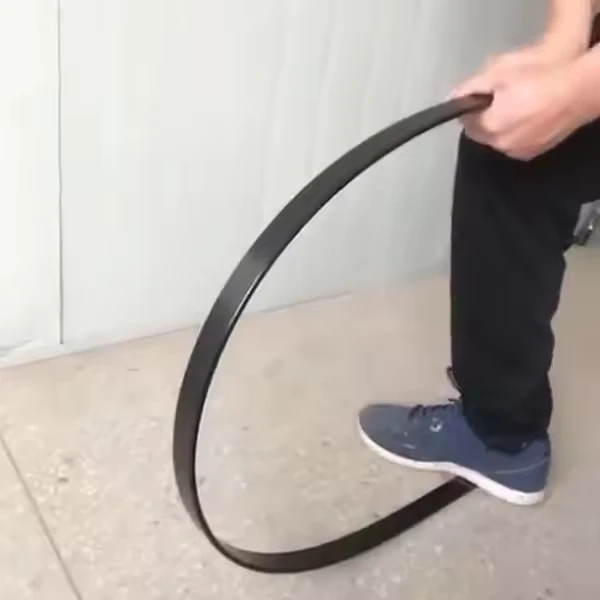
Carbon fiber strips are flat, high-strength composite profiles manufactured using continuous carbon fiber reinforcement and controlled resin systems. Known for their high stiffness-to-weight ratio, dimensional stability, and directional strength, carbon fiber strips are widely used in industrial, structural, and OEM applications where lightweight reinforcement and precise geometry are required.
Unlike decorative carbon fiber trims or surface veneers, carbon fiber strips are structural components designed to carry mechanical loads. Depending on the manufacturing process, carbon fiber strips may feature unidirectional fiber alignment or engineered laminate structures, allowing performance to be optimized for axial stiffness, bending resistance, or machinability. These characteristics make carbon fiber strips suitable for CNC machining, bonding, and integration into mechanical assemblies.
Carbon fiber strips are typically produced using pultrusion or laminated layup processes with epoxy resin systems to ensure consistent fiber volume and mechanical performance. Properly designed carbon fiber strips offer excellent fatigue resistance, corrosion resistance, and long-term durability compared to traditional flat materials such as steel or aluminum, especially in weight-sensitive applications.
To ensure reliable performance in production environments, carbon fiber strips should be manufactured with controlled thickness, straightness, and fiber orientation. For OEM and volume applications, process stability, dimensional tolerance, and resin compatibility are critical to achieving repeatable mechanical properties and consistent surface quality across batches.
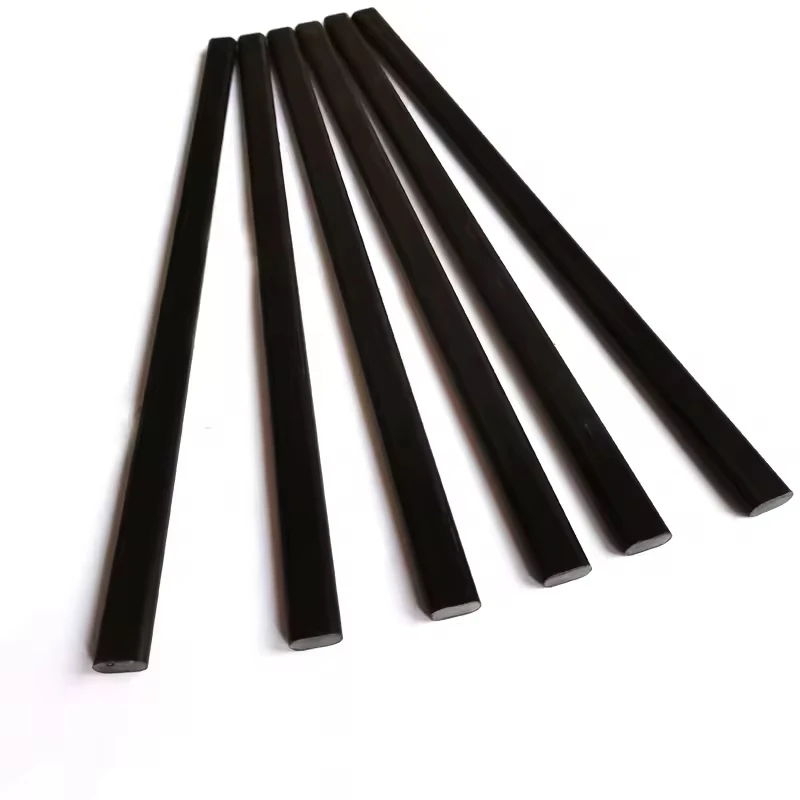
Carbon fiber strips are engineered flat composite products supplied in multiple configurations.
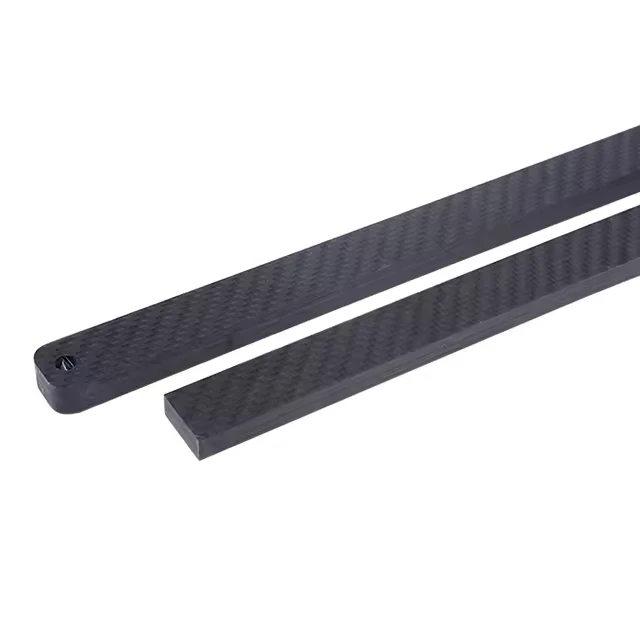
Carbon fiber flat strips are flat-profile composite products defined by uniform thickness and width, making them suitable for applications requiring precise geometry and planar load distribution.
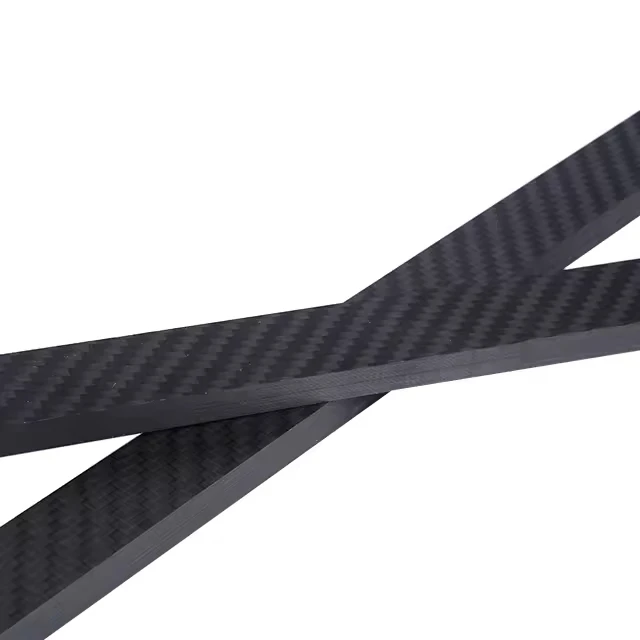
Pultruded carbon fiber strips are manufactured using a continuous pultrusion process that aligns unidirectional fibers along the strip length for maximum axial stiffness and straightness control.

Carbon fiber foundation strips are structural-grade carbon fiber strips supplied for load transfer and stiffness enhancement within reinforcement and stabilization assemblies.
The specification ranges below are provided to support initial engineering selection and OEM evaluation of carbon fiber strip products.
| Parameter | Typical Range | Notes |
|---|---|---|
| Product Form | Flat strip / flat bar | Solid flat composite profile |
| Manufacturing Process | Pultrusion / Laminated layup | Selected based on structural requirement |
| Thickness | 0.5 mm – 10 mm | Custom thickness available |
| Width | 5 mm – 100 mm | Wider sections on request |
| Length | Up to 2000 mm | Cut-to-length supply supported |
| Fiber Orientation | 0° unidirectional / engineered layup | Process-dependent |
| Resin System | Epoxy (standard) | Other systems on request |
| Density | ~1.5–1.6 g/cm³ | Typical carbon fiber composite |
| Surface Finish | Smooth / matte / peel-ply | Machining allowance available |
| Straightness | Controlled per process | Pultruded strips offer highest consistency |
| Dimensional Tolerance | Process-controlled | Tight tolerance available for OEM |
| Machinability | CNC cutting / drilling | Proper tooling required |
Carbon fiber strips are manufactured using controlled composite processes to ensure consistent fiber alignment, dimensional accuracy, and repeatable mechanical performance. The manufacturing method selected directly affects stiffness, tolerance control, and suitability for structural or OEM integration.
For applications requiring high axial stiffness and tight straightness control, carbon fiber strips are commonly produced through pultrusion. In this process, continuous unidirectional carbon fibers are impregnated with resin and pulled through a heated die, forming a solid flat strip with uniform cross-section. Pultruded carbon fiber strips offer excellent strength-to-weight ratio, predictable mechanical behavior, and consistent quality across production batches.
For applications requiring greater flexibility in thickness, surface finish, or laminate structure, laminated layup processes are used. Laminated carbon fiber strips are produced by stacking multiple layers of carbon fiber reinforcement in controlled orientations and curing them under defined pressure and temperature conditions. This method allows engineers to tailor stiffness, machinability, and bonding performance based on specific design requirements.
Regardless of process, industrial-grade carbon fiber strips are manufactured with controlled resin systems, fiber volume fraction, and curing parameters. For OEM and volume production, process stability and dimensional repeatability are critical to ensure that carbon fiber strips perform consistently during machining, assembly, and long-term service.
The selection of carbon fiber for this application is driven by its mechanical performance and design constraints, which are explained in our Référence des matériaux en fibre de carbone.
Carbon fiber strips are supplied as structural reinforcement components for basement and foundation stabilization systems. As flat, high-strength composite strips, they are integrated into wall-mounted reinforcement assemblies to increase stiffness and control deflection under structural loads.
Demande de renseignementsCarbon fiber strips are commonly supplied as flat stock for CNC machining into brackets, spacers, and precision flat components. Consistent thickness, straightness, and laminate stability support accurate cutting, drilling, and secondary processing.
Demande de renseignementsIn automotive and vehicle applications, carbon fiber strips are used as flat structural elements where lightweight reinforcement and dimensional stability are required. Typical uses include stiffeners, flat brackets, and linear reinforcement components within vehicle assemblies.
Demande de renseignementsCarbon fiber strips are used in lightweight frames and small-scale structural assemblies where high stiffness-to-weight ratio is critical. The flat strip geometry supports efficient load transfer in compact structures such as RC aircraft frames and lightweight composite assemblies.
Demande de renseignementsThe table below compares typical material properties of carbon fiber strips and steel strips using commonly cited engineering references.
| Comparison Factor | Carbon Fiber Strips (Typical) | Steel Strips (Typical) | Data Source |
|---|---|---|---|
| Density | 1.5–1.6 g/cm³ | 7.8 g/cm³ | ASM Handbook, Vol. 21; MatWeb |
| Tensile Strength | 600–1500 MPa (fiber-direction) | 250–1000 MPa (grade dependent) | ASM Handbook; ASTM A36 / A572 |
| Tensile Modulus | 70–230 GPa (fiber-direction) | 200–210 GPa | ASM Handbook; ASTM E111 |
| Strength-to-Weight Ratio | ~3–5× steel (directional) | Baseline | Engineering Materials Handbook |
| Fatigue Resistance | Excellent; minimal degradation | Finite fatigue life | ASM Handbook, Vol. 19 |
| Résistance à la corrosion | No corrosion | Requires coating / alloying | NACE Corrosion Basics |
| Thermal Expansion (CTE) | −0.5 to 2 ×10⁻⁶ /°C (fiber-dir.) | 11–13 ×10⁻⁶ /°C | ASM Handbook |
| Machining Considerations | CNC machinable (composite tooling) | CNC machinable (metal tooling) | Industry practice |
| Initial Material Cost | Higher (≈3–6× steel/kg) | Lower | Global raw material averages |
| Lifecycle Cost | Lower in corrosive / fatigue-critical use | Higher with maintenance | Engineering economics models |
Yes. Carbon fiber strips can be supplied in custom thickness, width, and cut-to-length dimensions based on drawings or technical requirements. Custom sizing is commonly used for OEM projects and machining applications.
Pultruded carbon fiber strips use continuous unidirectional fibers for high axial stiffness and consistent straightness, while laminated strips allow more flexibility in thickness, surface finish, and laminate structure. Selection depends on load direction and processing needs.
Yes. Carbon fiber strips are suitable for CNC cutting, drilling, and profiling when proper tooling and dust control are used. They are often supplied with machining allowance for precision components.
Yes. Carbon fiber strips are commonly used as flat structural reinforcement elements due to their high strength-to-weight ratio, corrosion resistance, and dimensional stability. Performance depends on strip design, fiber orientation, and integration method.