
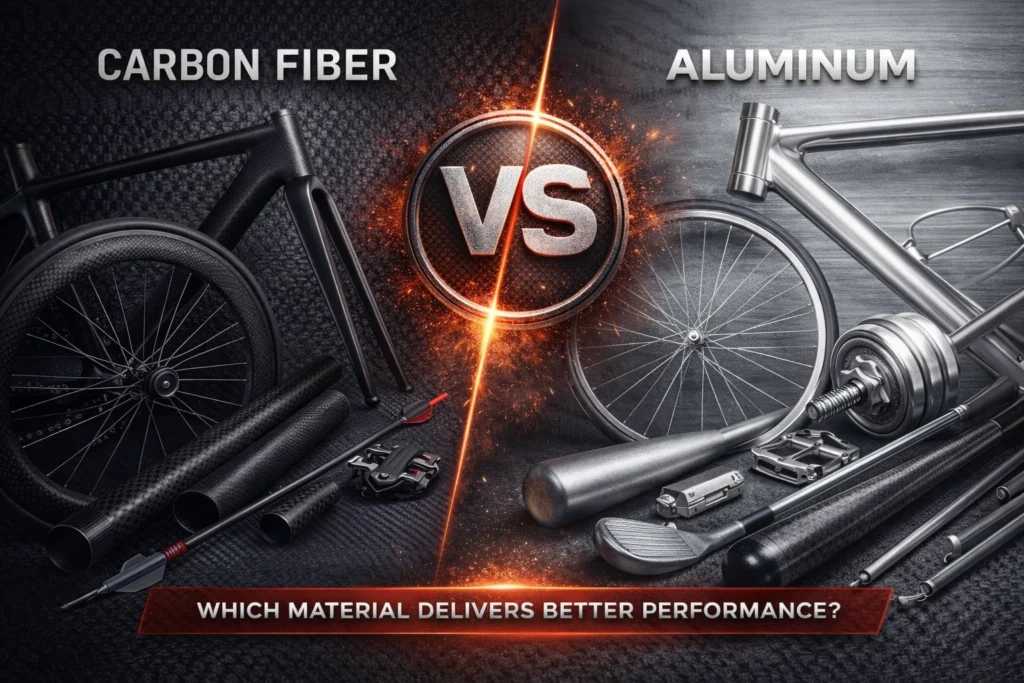
Material selection plays a decisive role in modern sports equipment design. When weight, strength, stiffness, and fatigue resistance directly influence athlete output, the difference between carbon fiber and aluminum becomes more than theoretical — it becomes performance-critical.
Both materials are widely used across cycling, golf,hřídele tága, archery, baseball, tennis, paddling, and outdoor equipment. However, their mechanical behavior and long-term performance characteristics differ significantly.
Is Carbon Fiber Stronger Than Aluminum?
Yes — in terms of strength-to-weight ratio, carbon fiber significantly outperforms aluminum.
| Majetek | Carbon Fiber Composite | Aluminum (6061-T6) |
|---|---|---|
| Hustota | 1.5–1.6 g/cm³ | 2.7 g/cm³ |
| Tensile Strength | 600–1500 MPa (fiber dependent) | ~310 MPa |
| Specific Strength | Very High | Mírná |
Carbon fiber composites can deliver up to 4–5× higher specific strength than aluminum alloys. While aluminum is strong for its cost, carbon fiber provides superior structural efficiency when weight reduction is critical.
Which Material Is Lighter for Sports Equipment?
Carbon fiber is approximately 40–45% lighter than aluminum at comparable stiffness levels.
For weight-sensitive sports equipment, this translates into measurable benefits:
Faster acceleration in cycling
Higher swing speed in golf
Reduced arm fatigue in paddles and racquets
Improved maneuverability in archery and baseball
In competitive sports environments, even small weight reductions improve performance margins.
Which Material Offers Better Stiffness Control?
Carbon fiber is anisotropic, meaning its stiffness can be engineered by controlling fiber orientation and layup structure.
Typical fiber orientations include:
0° fibers for axial stiffness
±45° fibers for torsional control
90° fibers for hoop strength
Aluminum, by contrast, is isotropic and cannot be tuned in this way. Its stiffness is fixed by material properties.
This tunability explains why carbon fiber is widely used in:
Golf shafts for torque control
Bicycle frames for optimized flex zones
Hockey sticks for energy transfer efficiency
Racing components requiring stiffness-to-weight optimization
Which Material Absorbs Vibration Better?
Carbon fiber composites provide inherent vibration damping due to their polymer matrix structure. Aluminum, being metallic, transmits vibration more directly.
Improved vibration damping results in:
Reduced muscle fatigue
Increased comfort
Better control under dynamic loading
Improved energy return in repetitive motion
This is particularly valuable in cycling frames, baseball bats, ski poles, paddles, and racquets.
Which Material Has Better Fatigue Resistance?
Aluminum gradually weakens under cyclic loading and is susceptible to fatigue cracking over time.
Properly engineered carbon fiber composites offer:
Excellent fatigue resistance
No traditional crack propagation behavior
Long-term structural stability under high-cycle loading
For sports equipment exposed to repetitive motion — such as pedaling, swinging, rowing, or striking — fatigue resistance directly affects service life and reliability.
Carbon Fiber vs Aluminum in Specific Sports Applications
| Aplikace | Uhlíkové vlákno | Aluminum |
|---|---|---|
| Bicycle Frames | High-end racing & performance models | Entry & mid-level models |
| Golf Shafts | Industry standard for performance | Rarely used |
| Baseball Bats | Composite performance bats | Traditional metal bats |
| Tent Poles | Lightweight expedition poles | Budget outdoor poles |
| Archery Arrows | Precision competition arrows | Training or entry-level arrows |
Carbon fiber dominates performance-driven segments, while aluminum remains common in cost-sensitive or entry-level categories.
Cost Comparison: Is Carbon Fiber Worth the Investment?
Aluminum Advantages
Lower raw material cost
Mature manufacturing processes
Suitable for large-scale production
Carbon Fiber Advantages
Higher strength-to-weight efficiency
Tunable mechanical performance
Premium product positioning
Brand differentiation potential
For OEM sports brands targeting high-performance markets, carbon fiber often justifies its higher initial material cost through enhanced performance and market value.
Why High-Performance Sports Brands Choose Carbon Fiber
Performance-driven brands prioritize:
Maximum strength-to-weight ratio
Tunable stiffness
Vibration damping
Long-term fatigue resistance
Lightweight structural integrity
Carbon fiber enables manufacturers to meet all these performance targets simultaneously, which explains its dominance in competitive sports equipment.
When Aluminum Still Makes Sense
Aluminum remains suitable for:
Budget-level product lines
Impact-heavy environments
Simplified structural components
Cost-sensitive production programs
Material selection ultimately depends on target market positioning and performance expectations.
OEM Perspective: Manufacturing Flexibility and Customization
Carbon fiber offers significantly greater engineering flexibility compared to aluminum extrusion.
Customization options include:
Fiber grades (T300, T700, T800)
Layup orientation control
Surface finishes (3K twill, UD, forged carbon)
Wall thickness optimization
Integrated structural design
For sports equipment manufacturers seeking product differentiation and performance optimization, carbon fiber enables structural designs that are not achievable with aluminum.
Final Verdict: Which Is Better for Sports Equipment?
For entry-level products, aluminum may provide sufficient structural performance at lower cost.
For performance-driven sports equipment, carbon fiber delivers measurable advantages in:
Strength-to-weight ratio
Fatigue resistance
Vibration damping
Stiffness control
Competitive positioning
In high-performance sports markets, marginal performance gains matter. Carbon fiber consistently provides those gains.
You may also like

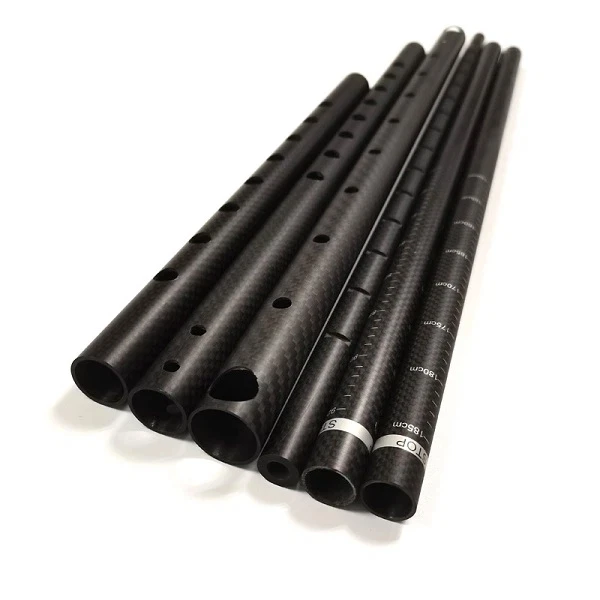
Kompozitní trubky
Zaměření na vysokou tuhost a nízkou hmotnost pro konstrukce zaměřené na výkon.
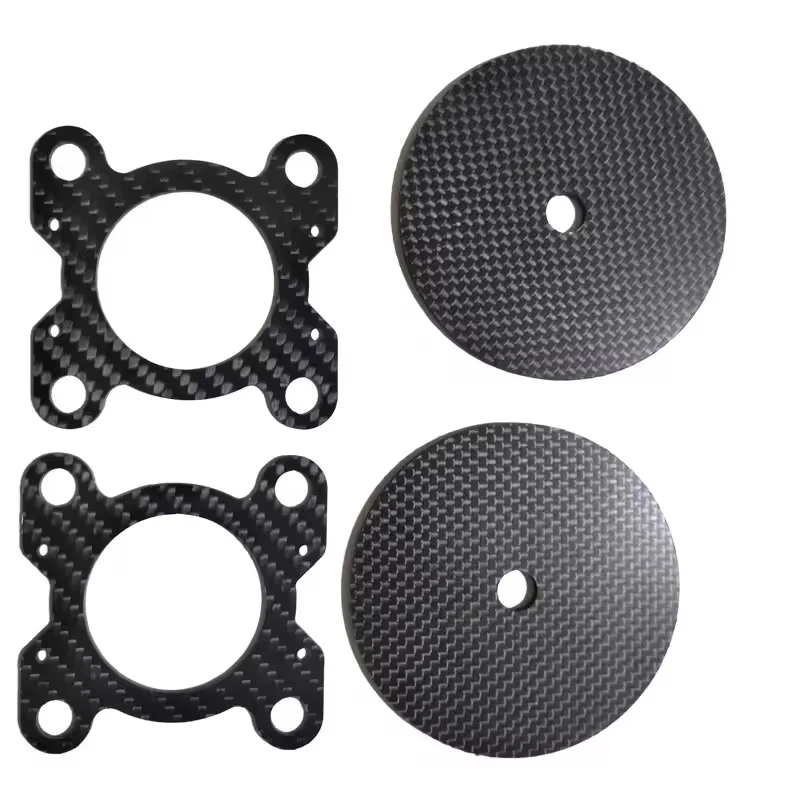
Carbon Fiber Sheets & Plates
Flat laminate stock for CNC cutting and lightweight structural components.
Kompozitní tyče
Rod-shaped composite products supplied for industrial and OEM assemblies.
